

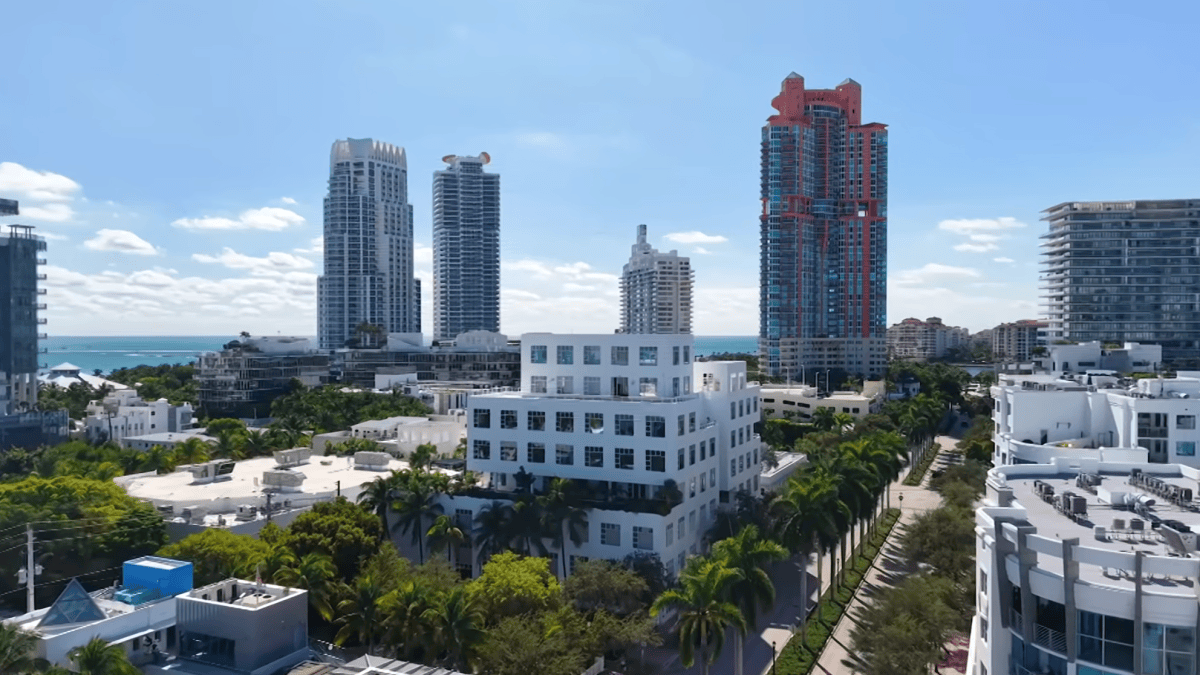
South Florida has attracted thousands of new residents in recent years. But as people and businesses move to the region, what kinds of office spaces are they choosing?
In Miami, the answer increasingly depends not only on location and price, but on the experience an office building can provide.
Watch NBC6 free wherever you are
Cyril Bijaoui, a broker associate with The Corcoran Group who has worked in commercial real estate for more than 20 years, says the traditional concept of an office is changing.
Instead of simply looking for four walls, desks and a place to work, some companies are seeking smaller spaces in high-end buildings with amenities such as gyms and restaurants, as well as offices within walking distance of where employees live.
The shift comes as workers have returned to offices following the pandemic, and Miami continues to attract businesses and residents from outside South Florida.
According to CoStar data cited by Bijaoui, Miami’s overall office vacancy rate has been slowly decreasing and is now around 9%.
But in some of Miami’s most desirable areas, companies looking for premier Class A office space can face a much bigger price tag.
Local

Broward County’s Supervisor of Elections warns about fake political flyer showing his face
Couple recounts moment they saw dolphin struggling in North Bay Village, leading to rescue
Bijaoui said office space that was leased for about $40 to $60 per square foot roughly a decade ago in areas including Brickell and Lincoln Road can look very different today. At the high-end building where he spoke with NBC6, he said the entry price for an average office suite is about $165 per square foot.
Bijaoui attributes some of that demand to the migration of companies and wealthy individuals to South Florida, including people moving from areas with higher taxes.
“People are moving to where the luxury areas are that they are familiar with,” Bijaoui said, pointing to Miami Beach and Coconut Grove among the areas that have attracted newcomers.
Who is moving into Miami’s offices?
The makeup of newcomers is changing, too.
Bijaoui said that while international clients once represented the overwhelming majority of the people he saw moving into and working from these spaces, domestic movers now play a larger role.
Some have followed other wealthy individuals and high-profile newcomers to South Florida and are establishing businesses in the region.
But Miami’s office market is far from uniform.
Older and more affordable Class B and Class C properties tell a different story.
Bijaoui said gross asking rents for some of those spaces can range from about $20 to $40 per square foot, depending on the location.
Class C properties can be particularly challenging to lease, he said, while improvements to Class B properties are increasingly pushing some into what he describes as a “B-plus” category.
The vacancy numbers, however, illustrate just how different Miami’s office markets can be.
CoStar figures cited for this story show Class C office vacancy at 3.1% and Class B at 5.9%, compared with about 13% for Class A space.
At the same time, the development pipeline is heavily tilted toward the upper end of the market. The data shows no new Class C office development under construction, compared with more than 4.5 million square feet of Class A space being built.
What comes next for South Florida’s office market?
For Bijaoui, the future of Miami’s office market will depend on more than simply constructing new buildings.
Transportation, infrastructure and affordability could all play a role in whether South Florida can sustain the businesses relocating to the region.
Companies moving to Miami need employees, he noted, and those employees need housing they can afford, schools for their children and reliable ways to get to work.
While executives may be able to live within walking distance of expensive new office developments, entry-level employees and support staff may not be able to afford the same neighborhoods.
“Miami needs to think intelligently about how to work for everyone,” Bijaoui said.
The challenge for South Florida will be balancing its growing appetite for high-end office space with the needs of the workforce required to keep those businesses running.
