

Welcome to HackerNoon’s Meet the Writer Interview series, where we learn a bit more about the contributors that have written some of our favorite stories.
So let’s start! Tell us a bit about yourself. For example, name, profession, and personal interests.
My name is Vladimir Sinitsyn. I am an SEO practitioner, researcher, and entrepreneur. I am also the founder of SEO-Module, a platform designed to automate SEO workflows, including technical analysis, website architecture, content optimization, and AI-driven search optimization processes.
I have more than 20 years of experience in SEO and search marketing. I have helped businesses improve their online visibility through technical architecture, automation, content strategy, and data-driven methods.
In recent years, my main focus has shifted toward the intersection of SEO and artificial intelligence: how AI systems interpret experts, companies, products, and other digital entities.
Outside of technology, I enjoy studying how information systems evolve and how human knowledge is represented in digital environments.
Interesting! What was your latest Hackernoon Top story about?
My latest HackerNoon Top Story, “Google Gemini Knows Me in Russian — But Recommends My Competitors in English,” was based on a personal experiment.
I tested how Google Gemini interpreted my professional identity when I used similar queries in different languages.
The result was unexpected. In Russian, the system was able to associate my name with SEO expertise. In English, it failed to identify me and returned information about other people with similar names.
This was not about ranking higher. It was about whether an AI system could correctly understand an entity.
The experiment highlighted an important challenge in AI-powered search: having information available online is not enough. AI systems also need to establish accurate connections between people, companies, areas of expertise, and trusted sources.
Do you usually write on similar topics? If not, what do you usually write about?
Yes. Most of my writing focuses on the future of search.
I write about technical SEO, website architecture, automation, content systems, GEO, and AI Visibility.
My current research interest is how generative AI is changing the role of SEO professionals.
Traditional SEO focused on helping search engines discover, interpret, and rank pages. The next stage also involves helping AI systems understand entities, expertise, and relationships between information sources.
Great! What is your usual writing routine like (if you have one?)
My writing usually starts with an observation, an experiment, or a practical problem.
I prefer investigating real cases rather than writing purely theoretical articles. I collect evidence, test hypotheses, analyze the results, and then turn my findings into a structured story.
For me, the strongest articles come from a combination of professional experience and curiosity.
Being a writer in tech can be a challenge. It’s not often our main role, but an addition to another one. What is the biggest challenge you have when it comes to writing?
The biggest challenge is explaining complex technical changes in a way that is useful to specialists while remaining accessible to a broader audience.
SEO, AI systems, and search technologies are becoming increasingly complex. A good technical article should explain not only how something works, but also why it matters in practice.
I try to focus on the practical consequences of technological changes.
What is the next thing you hope to achieve in your career?
My goal is to continue researching and developing solutions at the intersection of SEO and artificial intelligence.
I believe the next generation of search optimization will combine technical SEO, structured knowledge, AI interpretation, entity understanding, and knowledge representation.
I want to contribute to this transition by building practical tools, conducting experiments, and sharing research that helps businesses become more understandable to AI systems.
Wow, that’s admirable. Now, something more casual: What is your guilty pleasure of choice?
Probably testing new technologies when I should already be sleeping.
Many of my best ideas come from experiments: testing new AI tools, analyzing unexpected search results, or trying to understand why a system behaves differently than expected.
Curiosity is probably both my biggest weakness and my greatest advantage.
Yes. I like working on practical projects outside the digital world.
After spending so much time in digital environments, I enjoy working on physical projects where the result is something I can see and touch.
I like building, improving, and understanding how physical systems work. It gives me a useful balance to technology and helps me maintain a practical mindset.
I plan to continue writing about AI Visibility, GEO, and the evolution of search.
My future articles will explore how AI systems build an understanding of brands, experts, and organizations, and what businesses can do to improve their presence in generative search.
I am particularly interested in the transition from keyword optimization to entity and knowledge optimization.
What’s your opinion on HackerNoon as a platform for writers?
HackerNoon gives technical writers an opportunity to reach an international audience and share ideas beyond their local professional communities.
What I appreciate most is the platform’s focus on practical experience and original thinking, rather than purely academic-style writing.
For technology authors, it is valuable to have a place where experiments and real-world observations can become part of a broader global discussion.
Thanks for taking time to join our “Meet the writer” series. It was a pleasure. Do you have any closing words?
The internet is entering a new era.
For many years, search was primarily about helping users find documents. Now AI systems are beginning to interpret information, generate answers, and recommend solutions.
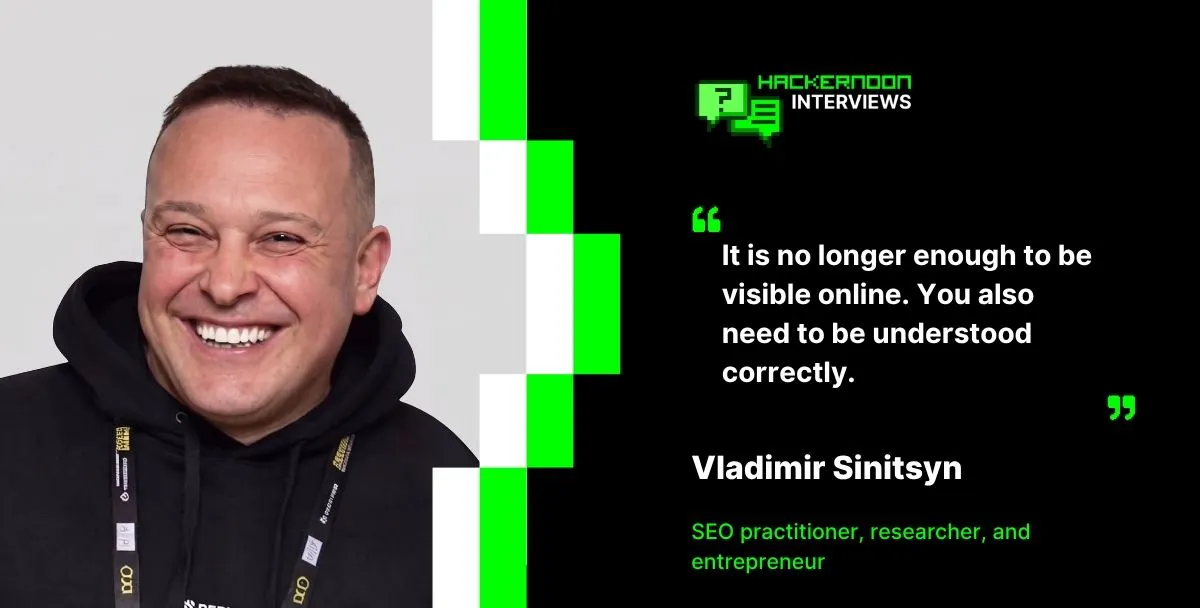
This creates a new challenge: it is no longer enough to be visible online. You also need to be understood correctly.
I believe the future of SEO will involve building clear connections between expertise, information, and trust.
Thank you to the HackerNoon community for the opportunity to share my research, experiments, and ideas about the future of search.
