

Every generation of finance software has made the same quiet compromise, which is that the system would record the work and a human would still do it and for forty years that compromise held because the humans kept showing up.
They have stopped showing up. First-time candidates for the CPA exam have collapsed from 49,597 in 2016 to 28,082 in 2024, accounting degrees awarded have sunk to a twenty-year low of 55,152 against a government projection of 124,200 openings every year through 2034 and more than 300,000 accountants have simply left the profession, retired or burned out or lured into work without a busy season, while the AICPA has been warning for years that roughly three-quarters of practicing CPAs sit at or near retirement age. The shortage is structural rather than cyclical, every serious analysis now agrees on that point and the operational consequence lands in the same place every month: a close that used to be staffed by a full bench is now carried by whoever remains, exported into Excel, reconciled by hand and prayed over before the auditors arrive.
Anatomy of the accountant shortage
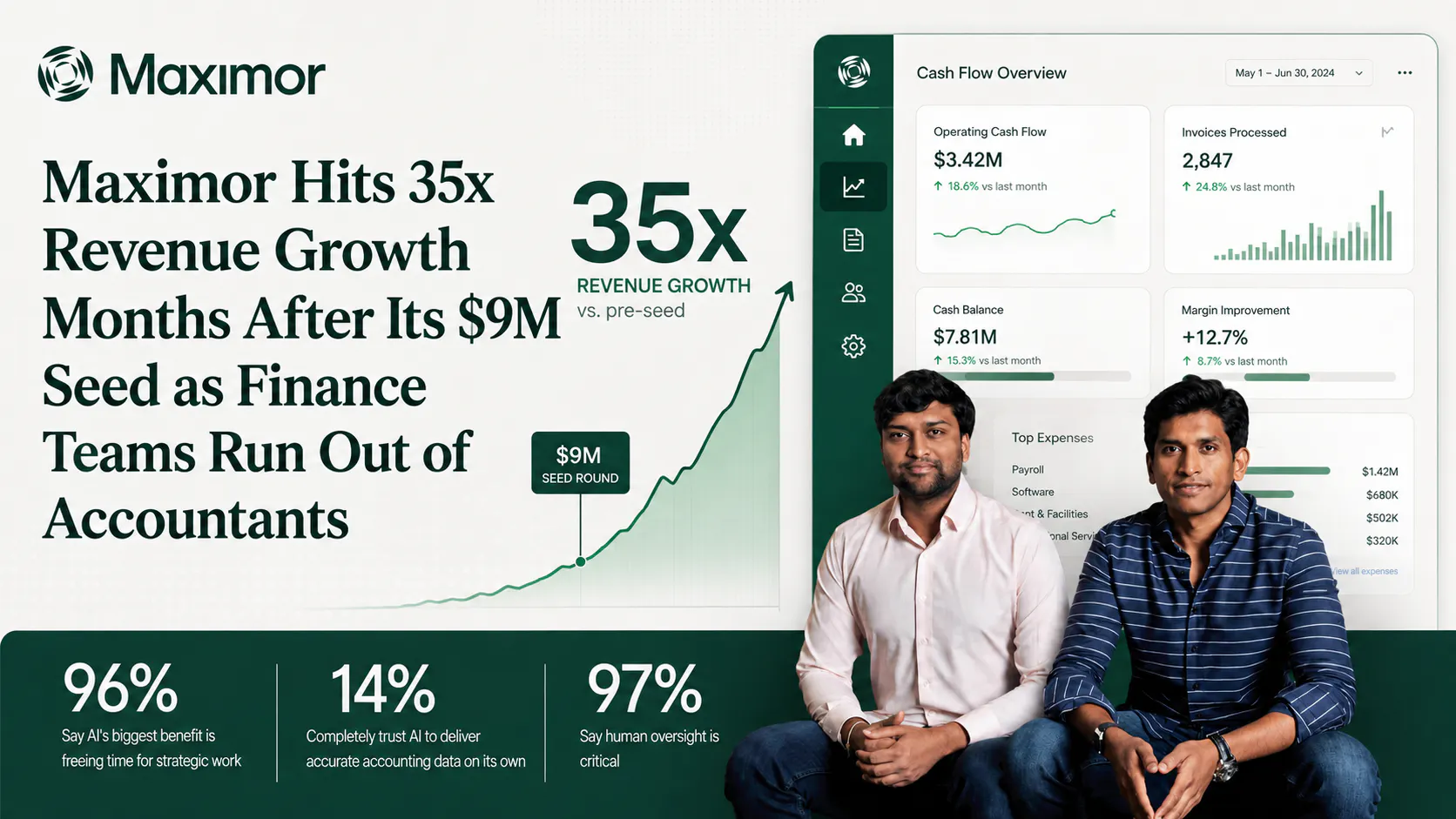
Maximor was built by two people who watched this machinery grind from inside the largest software company on earth, and this morning it put numbers behind a bet that the machinery can be replaced rather than patched. Nine months after coming out of stealth with a $9 million seed round led by Foundation Capital, the New York company reports that revenue has grown 35 times to a multi-million-dollar annual run rate, that its customer base has passed 25 companies, and that its platform, a network of what it calls Audit-Ready Agents, now handles 98 per cent of transactions autonomously while cutting manual finance work by 90 per cent and audit exceptions by 75 per cent. Alongside the numbers comes a repositioning, from a tool that automates accounting tasks to what the company describes as a system of action for CFOs, and beneath the phrase sits a genuinely pointed argument about the last forty years of enterprise software: ERPs, billing systems and planning tools are all systems of record, which is to say elaborate filing cabinets, and the actual doing of finance has always lived outside them, in spreadsheets and human hours that no vendor ever owned.
The pitch is unusual for an AI company in 2026, because it leads with the auditor rather than the demo. Maximor’s agents connect to the ERPs a company already runs, NetSuite, Intacct, QuickBooks or Zoho Books, along with payroll, billing, banking and CRM systems, and every task they complete, from revenue recognition to accounts payable to reconciliation, produces workpapers, reviewer notes and audit trails by default, which is a design decision aimed squarely at the reason finance teams have distrusted automation for a decade. In a domain where the output of every process must eventually survive an audit, an AI that cannot show its work is a liability regardless of how much labor it saves, and building the evidence trail into the agent rather than around it is the difference between software a controller experiments with and software a controller signs.
The Most Expensive Vacancy in the Back Office
The market context is what turns a good product into a moment, and the context here is a hiring gap that compounds every year it goes unfixed. Hold the current rates constant and the arithmetic is grim: roughly 69,000 more accounting openings than degrees every year, stacking toward something on the order of 690,000 unfilled roles by 2034, and the true figure runs wider still because a meaningful share of graduates never enters accounting at all. Companies have responded the only ways they could, by offshoring, by paying retention premiums that have pushed controller salaries up tens of thousands of dollars per job switch, and by quietly letting close timelines slip, and none of those responses scales, which is precisely the vacuum into which agentic software is now being pulled.
The decade-long hole in finance hiring
The competitive weather has shifted in the same direction, because the CFO back office has become the most contested beachhead in applied AI. Every serious platform in adjacent categories now ships an accounting agent, Ramp raised its June round substantially on the strength of one, and Satya Nadella, the chief executive of the founders’ former employer, has publicly predicted that agents will replace traditional business applications altogether. What separates the contenders is no longer whether they have agents but where those agents sit, and Maximor’s position, inside the ERP the company already trusts rather than inside a card program or a payments relationship, is a deliberate wager that the close itself, the most conservative and most auditable workflow in the building, is where autonomy gets adopted first and defended hardest.
Founder-Market Fit, Measured in Revenue Systems Shipped
If any founding team was manufactured for this specific problem, it is, plausibly, this one, because the two people running Maximor did not study broken finance operations from the outside; they were the ones sent in to fix them at Fortune 500 scale. Ramnandan Krishnamurthy, the chief executive, was a founding member of Microsoft’s digital transformation group, leading finance and data projects for clients including Coca-Cola, and Ajay Krishna Amudan, the chief technology officer, worked on rebuilding Microsoft’s own internal revenue systems, which is to say the pipes through which one of the world’s largest revenue streams is recognized, reconciled and reported. The two have worked together for fourteen years, going back to their student days at IIT Madras, and a partnership of that vintage entering a grind-it-out enterprise category is an underrated asset, because the categories that reward patience punish co-founder churn above almost everything else.
The seed round’s composition reads, in hindsight, like a customer development exercise disguised as a cap table. Beyond Foundation Capital, whose general partner Ashu Garg framed the thesis around seamless integration with any ERP rather than another feature race, and institutional participation from Gaia Ventures and Boldcap, the angel list was stacked with CFOs and finance leaders from Ramp, Gusto, Opendoor, MongoDB and the Big Four accounting firms, the exact buyer persona the product would have to win, alongside Perplexity’s Aravind Srinivas, a former IIT Madras classmate, and Zuora’s Tien Tzuo, whose entire company was built on the revenue-recognition complexity Maximor now automates. When the people who run finance organizations for a living put personal money into a tool for finance organizations, the check is a reference call that cleared, and nine months later the reference calls appear to have converted, because the growth that followed came from a customer base of mid-market and enterprise companies with revenues above $50 million, a segment that does not buy software casually and does not expand it without proof.
Thirty-five times in nine months
The 35x number deserves both its headline and its footnote, and an honest reading holds the two together. Off a base that was necessarily small nine months after stealth, multiplication comes easier than it will at scale, and a multi-million-dollar run rate is the beginning of an enterprise story rather than its proof. What makes the trajectory meaningful is its texture: more than 25 deployed customers in the most risk-averse buying category in software, an early adopter in Rently that reported cutting its close time in half, and expansion across functions, from revenue recognition into accounts payable, treasury-adjacent work and audit preparation, that suggests the land-and-expand motion is running inside accounts rather than merely across logos.
The Product: A System of Action
Every category-defining enterprise vendor of the past four decades, from the ERP to the CRM to the planning suite, sold a system of record, software that became the authoritative memory of what had happened, and the labor of making things happen remained human, exported nightly into the spreadsheets that is memorably described as finance’s makeshift databases held together with VLOOKUP. Maximor’s claim is that the agent layer inverts this arrangement without replacing the incumbent systems, because the agents work inside the existing stack, continuously pulling transactions, matching, reconciling and documenting, so that the ERP keeps its role as memory while the doing migrates to software, and the humans move from performing the close to reviewing it.
The most important number in the platform is therefore not the 98 per cent of transactions handled autonomously but the 2 per cent that is not, because the escalation threshold is the product’s actual design philosophy. An agent that touches everything is a liability in a controlled process; an agent that resolves the routine and surfaces only the genuinely novel decisions, with the workpapers already attached, maps exactly onto how a well-run finance team already divides labor between staff accountants and controllers, which is why the reported outcomes, 90 per cent less manual work and 75 per cent fewer audit exceptions, read less like automation metrics and more like the arrival of a very large, very tireless junior team that documents everything and never books a flight home for the holidays.
The forward ambition is making finance the intelligence layer of the company, with real-time visibility into decisions and their financial consequences, is the logical extension: once the agents are executing the transactions, they are also the freshestuarterly archaeology project
What the agents absorb, and what they hand back
What Has to Go Right
Honest analysis requires naming the hard parts and Maximor has four worth naming. The first is that multiplication must survive scale, because 35x from a small base is a statement about demand while the durable questions, net revenue retention inside those $50 million-plus accounts, gross margins on a product that carries a human-in-the-loop option, and the pace at which 25 customers become a hundred, are statements about a business, and the next milestone that matters will be denominated in those terms rather than in multiples.
The second is that trust in this category is asymmetric, since a hundred clean closes build a reputation and one materially wrong one ends it, and the 98 per cent autonomy figure will be tested precisely where automation has always broken, at quarter-end, across multi-entity consolidations, in the usage-based billing edge cases that made revenue recognition hard enough to build companies around. The audit-ready architecture is the correct defense, and the defense is only proven the day an auditor signs off on agent-produced workpapers at scale, customer after customer, season after season.
The third is that the incumbents own the ground the agents stand on, because a platform that lives inside NetSuite, Intacct and QuickBooks is a platform whose substrate belongs to Oracle, Sage and Intuit, all of whom are shipping their own agents, while the best-funded fintechs approach the same buyer from the spend side with enormous distribution. Maximor’s ERP-agnostic position is simultaneously its moat and its exposure, and the founders’ former employer, whose chief executive believes agents will replace business applications entirely, is the largest reminder that the thesis being validated is also the thesis being crowded.
The fourth is that the intelligence-layer ambition changes the buyer, because automating the close sells to a controller’s pain while becoming the company’s forecasting brain sells to a CFO’s strategy, and those are different conversations, different sales cycles and different competitors, including the planning suites that already own the second conversation. The repositioning announced today is a declaration of intent to cross that bridge, and crossing it is the work of the next two years rather than the last nine months.
Final Thoughts
The most valuable enterprise software companies have always been built where a large pool of expensive professional labor performed repetitive work that everyone agreed was necessary and nobody wanted to do, and for four decades the monthly close has been the purest example in the building, protected from automation not by its difficulty but by the absence of software that could be trusted with it. The accountants who did that work are leaving faster than they can be replaced, the gap compounds by roughly 69,000 people a year, and into that gap has stepped a company whose founders automated the revenue systems of Microsoft itself and whose design principle, evidence first, autonomy second, is aimed at the exact reason every previous attempt stalled.
Growth stories are easy to announce and hard to interpret, but this one comes with an unusually clean test, and it is the same test the product applies to itself. Either the audit trail holds, meaning the agent-produced workpapers keep clearing real audits as the customer count climbs from twenty-five toward triple digits and the 35x becomes a durable revenue curve rather than a small-base artifact, or it does not, and in a market where every vendor now claims agents, a company that has made auditability the product is volunteering to be measured by the one metric that cannot be marketed.
Don’t forget to like and share the story!
Vested Interest Disclosure: HackerNoon has reviewed the report for quality, but the claims herein belong to the author. #DYOR.
