

Add to Google Preferred Sources
Physical AI company MakinaRocks unveiled its vision for building fully autonomous manufacturing plants at its own conference “Attention 2026” held in Seoul on the 3rd. CEO Yoon Sung-ho pointed to the “long-tail problem”—where general-purpose AI models fail to resolve edge cases on the ground, preventing enterprise productivity gains—and emphasized a strategy of directly connecting on-site data and work processes to AI. The company has enhanced its proprietary AI operating system “Runway” and, through its Forward Deployed Engineer (FDE) organization, has deployed more than 6,000 AI models across over 80 sites in five countries. MakinaRocks plans to build a fully autonomous factory by 2028 in partnership with EnerTalk, a leading electric actuator manufacturer. The company also presented “Enterprise AI Sovereignty”—the ability for companies to directly own and control their AI and its outputs—as a core strategic pillar.
Key Elements

Physical artificial intelligence (AI) company MakinaRocks is moving to build “fully autonomous manufacturing plants” by leveraging AI technology that operates reliably even in unpredictable industrial environments. The company has concluded that benchmark performance competition among general-purpose AI models alone cannot lift productivity on the factory floor, and is betting on a strategy of directly connecting on-site data and work processes to AI.
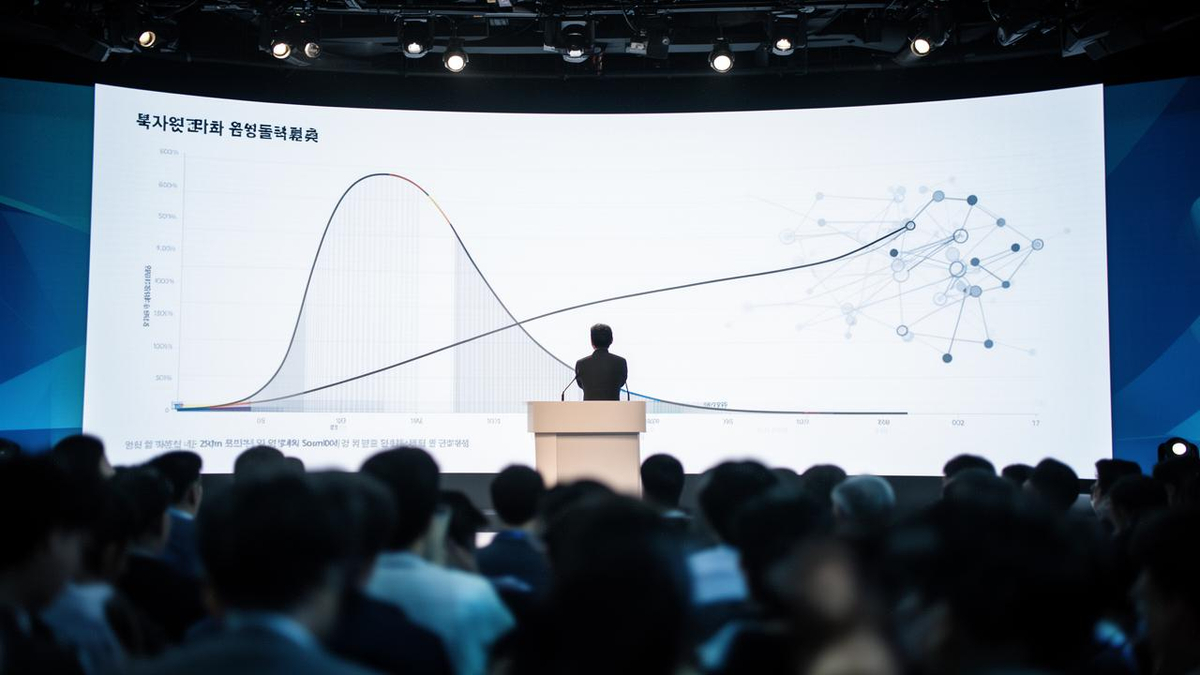
Yoon Sung-ho, CEO of MakinaRocks, said at the company’s AI conference “Attention 2026” held at the Westin Seoul Parnas in Seoul’s Gangnam district on the 3rd: “Real-world sites like semiconductor fabs can never operate on frontier AI models alone. To genuinely raise a company’s productivity with AI, you need to deploy AI that reflects on-site variables and context, and secure sovereignty over it.”
He identified the “long-tail phenomenon” as the reason enterprise AI adoption fails to deliver tangible results. More than 80% of all problems are simple and easily handled, but AI cannot resolve the remaining 20%—the low-frequency, complex, and exceptional cases. He noted this is not unrelated to a recent U.S. economic research institute survey in which 90% of companies reported that despite three years of AI usage, they had failed to achieve improvements on their income statements.
Yoon pointed out: “The AI model benchmark metrics touted by frontier labs do nothing to solve the long-tail problem, so they have no bearing whatsoever on enterprise AI productivity.” Using semiconductor equipment predictive maintenance as an example, he explained that while AI can analyze sensor data and draw trend lines, it struggles to determine whether to shut down equipment, call a technician, or take other actions when a specific sensor value crosses a threshold.
He also cited the case of McDonald’s, which deployed an AI ordering system at U.S. drive-thru locations before discontinuing it. The system repeatedly misrecognized customer orders, inflating quantities or adding the wrong ingredients. While some stores could simply remove the system, in automotive production lines, semiconductor processes, or military operations, even minor errors can lead to catastrophic damage.
MakinaRocks’ proposed solution is “the field.” The approach involves understanding on-site data and work processes, connecting AI to actual systems, validating it in the field, and continuously improving it. The company is advancing its proprietary AI operating system (OS) “Runway” in this direction. The architecture applies a company’s diverse internal data and work processes to AI, then accumulates the resulting outputs back into the company’s internal assets.
The company is also expanding its “Forward Deployed Engineer (FDE)” organization, which handles on-site implementation and deployment. FDEs have visited more than 80 sites across 32 cities in five countries, logging approximately 70,000 hours in the field this year alone. To date, more than 6,000 AI models have been deployed to actual operational sites.
Real-world results were also presented. The company reduced work hours by more than 1,000 in a design document change review process, and AI is being used to manage over 1,400 robots across six global automotive plants. Recently, MakinaRocks’ AI technology was piloted in the Ulchi Freedom Shield (UFS) joint military exercise between South Korea and the United States. The system searches vast internal military archives to find needed information, provides permitted information and sources based on authorization levels, and supports operational report writing and recovery decision-making during equipment failures. This marks the first time in South Korean defense history that AI has been applied to military exercises.
Yoon presented “Enterprise AI Sovereignty” as the core of corporate competitiveness. This refers to the capability to fully own a company’s data, knowledge, and know-how, and to internalize both the AI developed from these assets and its outputs. “Independence and control are also key elements of AI sovereignty,” he said. “Companies must have the ability to select and change their technology stack at any time so they are not locked into a specific foundation model or infrastructure.”
To this end, Runway is designed to selectively leverage various open-nt, approval workflows, and audit trail capabilities, enabling companies to maintain control over their AI. The rationale is that if companies must rebuild internal systems and security procedures every time they switch models or infrastructure, achieving AI sovereignty becomes nearly impossible
EnerTalk, the leading electric actuator manufacturer in South Korea by domestic market share, has been selected as the first partner for building a fully autonomous manufacturing plant. The two companies have identified more than 80 AI transformation (AX) initiatives to date and plan to transform the factory over three years from 2025 through 2028, progressing from a “visible factory” to a “connected factory” and ultimately to an “autonomous factory.”
Yoon said: “If civilization is ever built on Mars, MakinaRocks will be the first company to build a fully autonomous manufacturing plant there. To that end, we have launched a project to create the initial blueprint of a fully autonomous factory.” He added: “Our vision is to build AI that operates in the harshest and most unpredictable environments—from factories to battlefields. We will achieve fully autonomous manufacturing plants and hyper-productivity.”
MakinaRocks has effectively reaffirmed that for AI to deliver real productivity gains in industrial settings, building systems capable of handling on-site edge cases—not merely improving model performance—is essential. The company is pursuing AX initiatives across manufacturing, defense, and other sectors, with a goal of achieving a fully autonomous factory within three years.
Once added, BigGo Finance appears first in Google Search Top Stories, so you get the broadest, most up-to-the-minute, and most comprehensive global financial news first.
