

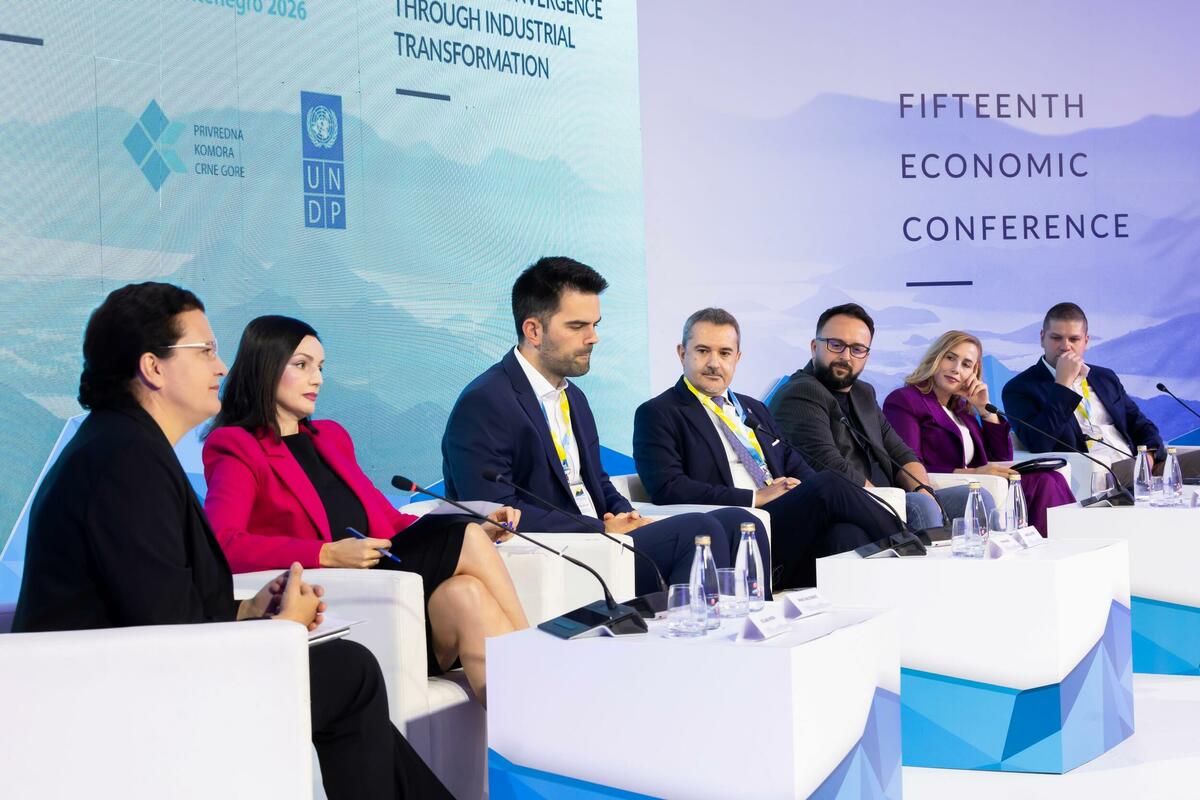
The panel of the Montenegro 2026 Economic Conference assessed that education, new skills and regional cooperation are necessary for further economic growth
1134 views0 comment(s)
Photo: PKCG
Disclaimer: The translations are mostly done through AI translator and might not be 100% accurate.MINA business
01.10.2026. 15:26h
Investing in knowledge, skills, innovation and new technologies, along with stronger cooperation between the public and private sectors, is crucial for increasing productivity, competitiveness and further economic development of the countries in the region, it was assessed at a panel in Budva.
The panel titled Improve. Empower. Integrate: Industrial Transformation as a Path to EU Convergence, which was held as part of the Montenegro 2026 Economic Conference organized by the Chamber of Commerce of Montenegro (PCCG), was realized in partnership with the United Nations Development Program (UNDP).
UNDP Istanbul Regional Hub Director Steliana Nedera, who moderated the panel, said that the region needs to invest in knowledge, skills, innovation and technology to increase productivity and create better quality jobs.
She also emphasized the importance of educating youth and women, developing new skills, and regional economic cooperation, which are essential for future economic growth.
The Director General of the Directorate for Industry and Crafts at the Ministry of Economic Development, Renata Milutinović, said that they see European integration as the economic integration of the Montenegrin economy.
As announced by the Chamber of Commerce and Industry of Montenegro, she emphasized that in August 2024, the Government adopted a document that is the basis for the transformation of the economy, and that it is based on green, digital transition and innovation.
Milutinović stated that this document was one of the bases for the temporary closure of negotiation chapter 20 – Entrepreneurship and Industrial Policy, but also that it has three goals – strengthening medium and small enterprises, diversifying the Montenegrin economy, and focusing on people and their skills.
“The point is not to bring the economy closer to the EU, but to prepare companies for all the benefits offered by the single market. A small company from Montenegro cannot become a market leader overnight, but it can become a partner. Success will be measured when small and medium-sized companies become reliable partners to the European economy,” Milutinović pointed out.
She emphasized that the productivity of small and medium-sized enterprises is key, and that it is the task of everyone in the chain, the government, the economy, and financial institutions, to make this possible.
Expert in artificial intelligence implementation and strategy and founder of the Innovation Center, Stefan Badža, said that with the first strategy from 2019, they laid the foundations for further development, and from 2021, they will introduce AI into Serbian schools.
“Further development will come not thanks to IT experts, but to those who know how to use artificial intelligence,” believes Badža.
He believes that companies in the region are not that interested in investing in innovation and new technologies unless they see their competition doing so.
“Companies are not digitized enough, they rely too much on paper in their business. And it is easier to introduce AI into digitized processes. For greater competitiveness, it is necessary to improve productivity, and AI is the main tool for that. Artificial intelligence helps you grow with the same number of employees,” said Badža.
The President of the Board of Intesa Sanpaolo Bank, Bosnia and Herzegovina, Mikele Kastoro, announced that infrastructure, digitalization and the application of new technologies are key areas for the future development of the economy, especially in the context of improving the flow of goods, connecting markets and strengthening the competitiveness of the region.
Speaking about technological developments, he emphasized the increasingly important role of digital payments and artificial intelligence in improving business.
“Technology is today key to the development of all sectors, and digitalization and artificial intelligence are becoming important drivers of greater productivity and competitiveness of the economy,” Kastoro pointed out, adding that further development of digitalization and harmonization with European standards represent an important step towards stronger regional integration.
Producer and CEO of Ikone Studio, Valon Bajgora, said that they have attracted a lot of <a href="https://bitcomme.com/munson-adds-150k-for-street-medicine-bringing-total-investment-since-2024-to-300k/” title=”Munson adds $150K for street medicine, bringing total investment since 2024 to $300K”>investment in Kosovo and developed the film industry, and that 1,8 million euros have been invested so far in films, commercials and video games.
He stated that this helped the development of a small country with a large number of young people, but that problems such as underdeveloped infrastructure, lack of education and personnel for the film industry still remain.
Bajgora believes that education for young people in the film industry should be provided, and they are cooperating with neighboring countries on this – which shows that they actually have to educate the staff themselves.
“We are trying to encourage neighboring countries to pass tax laws so that we can have uniform tax rules, so that we can cooperate in this sector. The laws need to be finalized because no country is ready for investments and feature films,” said Bajgora.
He emphasized that the state cannot be a good player in the film industry if it does not have a good playing field.
Albania’s Deputy Minister of Economy and Innovation, Olta Manjani, stressed the importance of developing qualifications and skills, as there is an increasing move towards a knowledge-based economy.
“We are moving towards a higher value and productivity economy, and the skills we have today cannot meet that. With digital forecasting systems, you can adequately predict what qualifications will be needed tomorrow. You cannot refer to the economy of the past, but of the future,” believes Manjani.
According to her, Albania, along with Montenegro, is the leader of EU integration in the Balkans.
“The question is not how to prepare people for the EU, but how to successfully establish themselves within the EU economy, how to involve companies in everything and start working on skills for which there is a strong demand. If we do not have stakeholders from the business community, politics and science gathered around this topic, we cannot implement it,” said Manjani.
Tessa Group’s Chief Operating Officer, Vladimir Kostadinov, emphasized the importance of cooperation between the private and public sectors for launching new investments and developing complex projects, especially in the field of infrastructure and new technologies.
He emphasized that companies in North Macedonia have the knowledge, talents, and technological capacities that can be the basis for a stronger presence not only on the domestic, but also on the regional and European markets.
“We have technology, knowledge, capital and markets, but none of these resources is enough on its own. True value only arises when we connect them and use them together to create better results,” concluded Kostadinov.
Download the app and follow the news
PKCGChamber of Commerce of MontenegroUNDPSteliana NederaRenata MilutinovićMinistry of Economic DevelopmentGovernment of MontenegroStefan BadžaOlta ManjaniVladimir Kostadinov
