

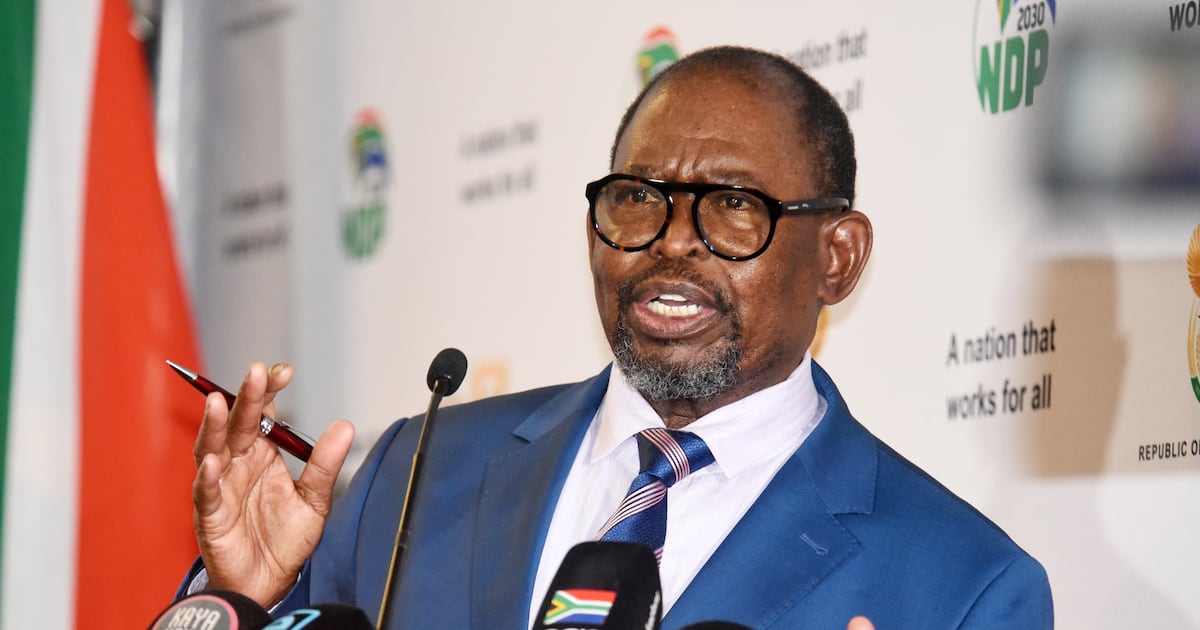
Over the past few weeks an unexpected illustration of soft power has been exercised by finance minister Enoch Godongwana. In April the minister delivered a letter to Johannesburg mayor Dada Morero threatening to withhold the July instalment of the city’s equitable share grant.
The basis for the threat was the dire state of the city’s finances, which the minister believed were still headed in the wrong direction. A city whose historic billing and debt management chaos had left it unable to effectively collect all that was due to it had decided to enter into a wage agreement whose funding source was (and remains) unknown and also passed a budget based on “revenue targets that the city was not able to meet”.
This was all the more shocking given that Johannesburg is the economic epicentre of the country, so the fact that it cannot balance its books leaves one wondering how other cities, metros and municipalities that have far less economic muscle are able to do so.
More critically, for a party that has always practised comradely reluctance to intervene when those that ought to be held to account are ANC deployees, the idea that an ANC minister could threaten to pull the plug on the most contested and lucrative metro in an election year was a huge shock. Unbeknownst to many at that point was the fact that the National Treasury had actually put 99 municipalities on its watch list for the July tranche intervention.
These municipalities were characterised by persistent breaches of their financial management obligations in the Municipal Finance Management Act, ranging from unpaid bills to third parties such as Eskom, various water boards, the South African Revenue Service and the auditor-general to generally poor financial management, as illustrated by instances of fruitless, wasteful and irregular expenditure.
From consultations with the 99 municipalities the pathway to regularising their standing and getting the July tranche was outlined and 30 municipalities managed to get themselves off the list before July. However, the remaining 69 failed to convince the National Treasury and were duly denied their equitable payments on the scheduled date.
The unprecedented broad use of thisinstrument of intervention illustrated the collective frustration that is shared by the Treasury and citizens. The municipalities affected depend on their equitable share of national revenues as most do not have strong ratepayer bases or alternative sources of revenue.
The unprecedented broad use of this instrument of intervention illustrated the collective frustration that is shared by the Treasury and citizens.
In response to the withholding process the Treasury was accused of punishing citizens who had little to do with the activities listed as the basis for withholding the funds. The authority to unilaterally implement the process without prior approval from parliament was cited as proof of a Treasury gone rogue.
The Financial & Fiscal Commission took issue with the Treasury “borrowing its power from one regime and its vocabulary from the other” to punish municipalities and, by extension, citizens. The Treasury argued that this was a corrective rather than punitive step aimed at fast-tracking reforms at municipal level.
While the distinction between corrective and punitive may be substantive for politicians, the reality is that the punitive action in this case is required to enforce the discipline expected from municipalities. The range of actions required from municipalities is nothing more than an application of existing rules and requirements.
These include disciplinary actions for errant bureaucrats and forced payments to third parties who have provided services to municipalities. All the remedial actions stipulated by the Treasury are well-known and the idea that forcing people to do their jobs is undue punishment seems odd.
The painful reality is that the deviant behaviour of officials who mismanage public funds has a negative effect on citizens anyway. Delaying a grant by a few weeks to weed out bad habits is merely short-term pain that is worth suffering if it gets municipalities back on the path to better management.
• Sithole (@coruscakhaya) is an accountant, academic and activist.
