

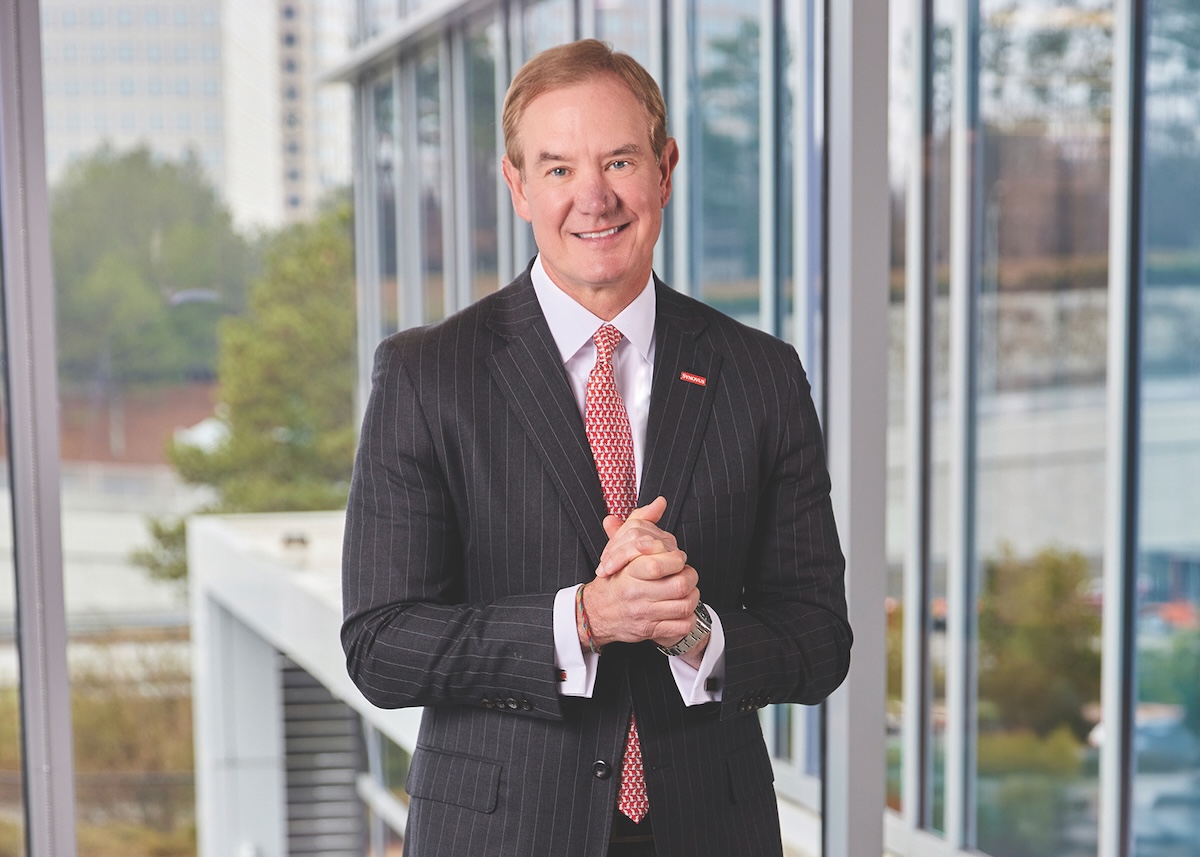
KEVIN BLAIR HAS BEEN in banking for three decades, but when he joined Columbus-headquartered Synovus nine years ago, he discovered a new culture of doing business.
“Our people care so much about each other, and that transfers over into how we relate to our clients,” says the CEO, president, and chairman of the company founded in 1888 as the Columbus Bank and Trust Company. “We’re not perfect, but [the culture] feels different than anything I’ve ever seen.”
That sentiment is not just a proud leader talking. Synovus has won numerous Coalition Greenwich awards (considered the key designation for financial institutions), including 15 Best Bank Awards this year, earning top marks for ease of doing business, relationship management, customer service, and more. Here, we chat with the dynamic leader to learn more about what keeps him inspired and how he’s leading the company into the future.
Columbus may not be the first place that comes to mind for a banking headquarters. Why is it the right fit for Synovus?
We were born here in Columbus. We’re the 39th-largest bank in the United States and the largest that’s not headquartered in a major MSA (metropolitan statistical area). Most of the large banks have migrated to major MSAs. We didn’t just grow to our size based upon starting in a MSA that had outsized growth.
We’ve had to work harder because we have 55 markets that we serve. And although Atlanta is our largest market by size today, Columbus is the second largest, and Birmingham, Alabama, is the third largest. We’ve been able to leverage growth across all five states (Alabama, Georgia, Florida, Tennessee, North Carolina, and South Carolina) within our footprint over this 136-year timeframe.
Columbus fits because, number one, it gives you a cost advantage—the cost of living is less. Number two, the city kind of follows our values in terms of who we want to be and the family-based culture we have.
Synovus consistently ranks as a top bank by customer reputation. What sets it apart?
It starts with talent selection. People in our company share our purpose to help people reach their full potential. It’s part of the fabric of the people we attract—we have a very empathetic culture. Secondly, our turnover rates are low. We just don’t have a lot of attrition from our team members. Last year, our voluntary turnover was 11 percent, the lowest it’s been in over a decade. Clients don’t want to come into our branches and see a new face every week or have a new commercial relationship manager.
Also, everybody wants immediate gratification, and technology is enabling people to access their banking services 24/7 in the comfort of their home. I truly believe that it has to be high tech for self-service with things such as money movement, checking balances, and paying bills.
But when people have a problem, they want to deal with a real person who has empathy and expertise. Big banks are trying to move everything to technology with AI and robo-type activities, and the small guys don’t have the ability to provide the same capabilities and technology.
We talk about the Goldilocks principle—we are big enough to give you all the capabilities and functionality, but we’ve remained small enough and attuned to the fact that people want personal attention. I think that’s why our service scores are so high, and we stand out relative to our peers.
Georgia’s leadership continues to focus on rural development. How do you see Synovus playing a role?
Growth is all about access to capital. We deploy a lot of capital in the state of Georgia to ensure that businesses that want to relocate here have access. For example, there’s a new electric-based aircraft facility in Covington. When they were moving here, it was important to them to have a local bank, and we serve in that capacity.
We’ve also developed a lot of specialty banking units. For example, when you talk about infrastructure, we have an alternative energy vertical that deals with things like solar or small nuclear facilities. As we’re moving in the direction of non-fossil fuel-type opportunities—as battery manufacturers move here and solar becomes more adopted across the state—we’re there to provide expertise and capital.
We also focus a lot on community service. Our bankers and executives have to sit on very active boards and show that they’re not just spending their money in a market but spending their time and energy there too.
What future Synovus initiatives are you most excited about?
For the first time in my nine years here, we are adding more sales resources across all of our markets than we’ve ever had. We think there’s an inflection point in our industry where there’s a lot of disruption, with unhappy clients and unhappy team members. We have a model that [sales resources] want to join and can thrive in. We are opening up our expense growth plan for 2025, bringing in over 100 new FTEs (full-time equivalent employees) to generate outsized growth.
Also, we have spent a lot of time and energy on our technology to better leverage it to serve our clients’ needs. We’re really focused on what we can do to continue to improve the client experience. High tech needs “high touch.” You’ve got to keep developing the high-tech stuff, coupled with having great people.
How is Synovus helping boost consumer confidence in a volatile time?
Volatility is bad for consumers, it’s bad for the markets, and it’s bad for bankers because everybody wants certainty. I tell our bankers that this is a great time to reach out to clients and have conversations because we don’t have all the answers.
I don’t know everything that’s going to happen with tariffs and the impact it’s going to have on every industry, but we understand the current situation of that client. We can talk about what their goals and objectives are and how we can best help them if something were to change. Making sure our clients have the agility and resiliency to be able to roll with the punches is important.
What keeps you engaged and excited as a leader?
Growing up in the small town of Waynesboro, Virginia, my mother was a factory worker, and my father had odd jobs. I was the first in my household to go to college.
Helping people reach their full potential is very important to me because I’m a product of that. Our bank has the ability to help people—from a consumer who’s saving for their first home to a business that’s opening their first store. If our company can live up to our purpose, we can help change people’s lives.
