

Add preferred source2
Nvidia CEO Jensen Huang’s declaration that AI companies which cannot control their products “should be shut down” has ricocheted through the industry — not because anyone expects him to halt the chip shipments that fuel the race, but because he has inverted the safety debate: the burden, he argues, belongs to Sam Altman and Dario Amodei, not Washington. While the public argument rages over existential risk and regulatory relief, a quieter competition is unfolding on two frontiers that may prove more materially valuable than any single model release. Archetype AI has assembled nearly a billion hours of heterogeneous physical sensor data to build a foundation model that interprets industrial machinery — moving beyond language to predict when dredging barges are idle or when a factory’s yield drops. Vivodyne, a Philadelphia biotech, grows more than 20 types of functional human tissue inside robotic labs to test drugs in conditions that mimic real blood flow — attacking a drug discovery pipeline where roughly one in twenty clinical candidates ultimately succeeds. Both companies reject the premise that frontier language labs will simply absorb their work. Their shared bet: the two most valuable unbuilt datasets in the world are causal physical-world sensor streams and causally-perturbed human tissue, and whoever assembles them first holds an asset that reasoning models will pay to access.
Key Elements

Jensen Huang has spent the past few weeks telling anyone who will listen that the existential threat from AI is wildly overstated, that doomsayers have a “horrible track record,” and that the real problem is simpler: labs should just stop shipping products they cannot control. The position, delivered across a two-hour appearance on The Ezra Klein Show and a CBS News interview, has been dismissed by some as obvious self-interest from the man whose $5.3 trillion company sells shovels to every gold miner in the race. But hidden inside Huang’s provocation is a question that matters far beyond the culture war: if the frontier labs actually treated safety as an engineering discipline rather than a lobbying problem, what would that look like?
Huang offered his own company as the template. Nvidia, he said, spends roughly 80 percent of its effort validating, verifying, simulating, and testing a chip against perhaps 10 to 20 percent designing it. Transposed to AI, the demand is blunt: flip the ratio, and if you cannot make your product safe at any given point in time, do not ship it. It is a message aimed squarely at OpenAI and Anthropic, and it has left the safety community in an awkward position — agreeing with the moral clarity while doubting the conclusion. The hosts of The Cognitive Revolution, Nathan Labenz and Prakash, spent the opening of a recent episode doing exactly that: praising Huang for forcing accountability onto the labs, then dismantling his “just software” framing as impossible to steelman from someone who has watched a summer of unprecedented capability gains at close range.
The deeper split they identify is not between doomers and accelerationists, but between two philosophies of what a safe model even is. Obedience means the model does what you tell it, including destructive things. Benevolence means it looks after your interests even against your explicit instructions. These are mutually exclusive, and the two leading labs are running live experiments on opposite poles. At a Chatham House Rules panel in May, representatives from OpenAI and Anthropic reportedly conceded they were not certain their own approach was correct — and that the other might be. Neither has translated its constitution or spec into reliably predictable model behavior. Meanwhile, Huang’s argument rests on a foundation of product safety law that predates any of this technology. His point about physical products is revealing: he is enthusiastic about regulating robotaxis through the NHTSA. The debate is not whether to regulate, but whether a text-generating model that can execute code is more like a car or more like a thought.
Meta’s Muse: The First Consumer Agent That Actually Did Something
While the safety debate consumes the conference circuit, the first genuinely useful consumer AI agent arrived quietly — and the results are a preview of what happens when agency meets real-world friction. Meta’s Muse, reviewed hands-on by Labenz, handled two Gmail accounts flawlessly — a persistent failure mode for OpenAI’s Codex, which cannot conceive of two Chrome profiles. More impressively, Muse assembled a complete legal case against a predatory subscription vendor that had converted a $0.98 seven-day trial into recurring $49.99 charges. It gathered the email trail, screenshots, timestamps, and the relevant statutes — including special protections for users under 12 that carry criminal exposure for the vendor — then drafted a demand email. A senior support manager responded within a day. All charges were removed.
The significance is not one consumer victory but the collapse of an entire economic structure. Consumer legal power has long existed but been uneconomic to exercise for disputes worth $5 to $10 — which is precisely why class actions exist. AI drops the cost of enforcement to roughly a dollar and removes the need to aggregate plaintiffs at all. The structural implication is that subscription-model companies built on the sliver of users who forget to cancel are about to face an army of competent, persistent, nearly free agents.
Prakash’s own test was less flattering. Muse, asked to find Facebook groups associated with his high school, returned groups from a different Chippewa Valley High School in California with no shared connections — a basic plausibility check it failed despite privileged access to Facebook’s social graph. His verdict: a generic Claude or GPT model driving a browser would have done better. The pattern is familiar from every frontier model release — moments of startling competence adjacent to dumb mistakes — but in an agent that can execute transactions, the cost of error shifts from embarrassment to liability.
Archetype AI: A Foundation Model for Every Sensor in the World
The grandest claims in AI are about text and images, but the physical world generates vastly more data than humans ever will. Nick Gillian, co-founder and CTO of Archetype AI, is building what he describes as a foundation model for physical-world sensor data — a general transformer trained on close to a billion hours of vibration, electrical, thermal, video, and radar signals scraped from the web and collated from industrial fleets. The approach is the LLM recipe applied to time series: self-supervised pre-training on noisy, poorly-synced multimodal data, then alignment with language through domain experts in HVAC and industrial machinery who supply the context that raw sensor streams never carry.
The output has two branches. The first produces natural-language reports for humans — “explain why my factory yield is down 6 percent this week.” The second produces real-time control signals for machines, deployable on cheap CPUs close to the sensor in data-sovereign environments where nothing ever leaves the factory. The deployment philosophy is critical: many industrial customers will not upload sensitive operational telemetry to a cloud model, so the ability to run inference on-premises is not a technical detail but a market requirement.
The most vivid demonstration came from a Kajima construction project in Japan. The company was moving a river over five years to mitigate flooding, subcontracting dredging work and needing to verify hours worked. Newton ingested cameras, hydrometer sensors, weather data, and geolocation, then output a Gantt-chart-like state for each team: barge parked, moving into position, dredging, drilling, or idle. When the data was fed back for analysis, it surfaced a pattern no human operator had spotted — productivity remained depressed for several days after storms, because runoff from the mountains carried debris and churn to the river mouth. The operational fix: redeploy teams to different parts of the site on post-storm days. It is a modest result, but the kind of insight that compounds when applied across thousands of sites and years of data.
| Dimension | Archetype AI (Newton) | Typical robotics physical AI |
|---|---|---|
| Input modalities | Any sensor: radar, time series, IR, video, vibration | Cameras, lidar, accelerometers |
| Data volume | ~1 billion hours scraped and collated | Manually captured per robot |
| Output | Language reports + real-time control signals | Actuation commands |
| Deployment | Edge CPUs, on-prem, data-sovereign | On-robot compute |
| Fine-tuning need | A few thousand samples per customer | Per-task dataset construction |
Gillian’s generalization heuristic is memorable and useful: if an average person off the street could spot the anomaly, Newton can do it out of the box. If it requires a master technician’s expertise, fine-tuning is needed. That framing clarifies what has actually been achieved — broad pattern recognition, not domain mastery. The long-run ambition is more expansive: connecting entire ecosystems — a whole factory, an energy grid, a city — so the model can see knock-on effects, like a machine degrading because of thermal effects from three machines away.
Vivodyne: Making Biology Computable with Human Tissue at Scale
The same loop — a model proposes, a physical system executes, and the result corrects the model — runs through Vivodyne’s work, but in a substrate where the stakes are measured in patient survival. Andrei Georgescu, the company’s co-founder and CEO, grows what he insists are not conventional organoids but large pieces of tissue resembling a biopsy from a human lung, liver, or kidney. The tissues self-assemble their own capillary beds, and every drug dose is delivered through those native blood vessels — meaning the compound must traverse the same interface it would encounter in a patient, at the same density.
The design choice addresses a failure that has haunted drug discovery for decades. Conventional preclinical work dunks cells in compound, which is not how drugs reach tissue. Georgescu described the canonical example: CAR-T cell therapies that obliterate a tumor in a dish in a day or two, then flow right past the tumor through blood vessels in a patient without recognizing it exists. “A lot of cell therapies that are designed for solid tumors in a dish will completely kill that tumor,” he said. “And then those same CAR T cells, when they go into a patient, just flow right by the tumor through the blood vessels. They don’t even know it’s there.”
The deeper problem is that cells on plastic do not exhibit meaningful causality. Dish-grown cells are trying to colonize a stiff substrate, so their only goal is to proliferate — and knocking out genes that would matter in a functioning tissue does nothing when the only job is division. “You end up learning this view that perturbations don’t really do much of anything,” Georgescu noted. This explains his contrarian stance against the scaling thesis that has transformed language AI: “Even the state of the art virtual cell models that exist saturate at a very, very small fraction of the input data that is fed to them.”
The measurement stack is correspondingly deep. Every tissue gets full 3D scanning at single-cell resolution, single-cell sequencing for transcriptomics, and a 1,000-plex proteomics panel to capture what cells release into circulation. The stated goal is a GPS through biological state space: populate a map of states cells can occupy, learn the paths between them, and then back-solve — if I want this diseased tissue to become healthy, what do I perturb it with, and in what order.
| Vivodyne capability | Detail |
|---|---|
| Tissue types | 20+ including lung, liver, intestine, bone marrow |
| Readouts | 3D single-cell-resolution scan, single-cell transcriptomics, 1,000-plex proteomics |
| Funding | $40 million Series A announced May 2025 |
| Tissue density gain | 2x to 4x with Tissue Disc 2 redesign |
| Founding | 2020, with Dan Huh from Penn’s organ-on-a-chip group |
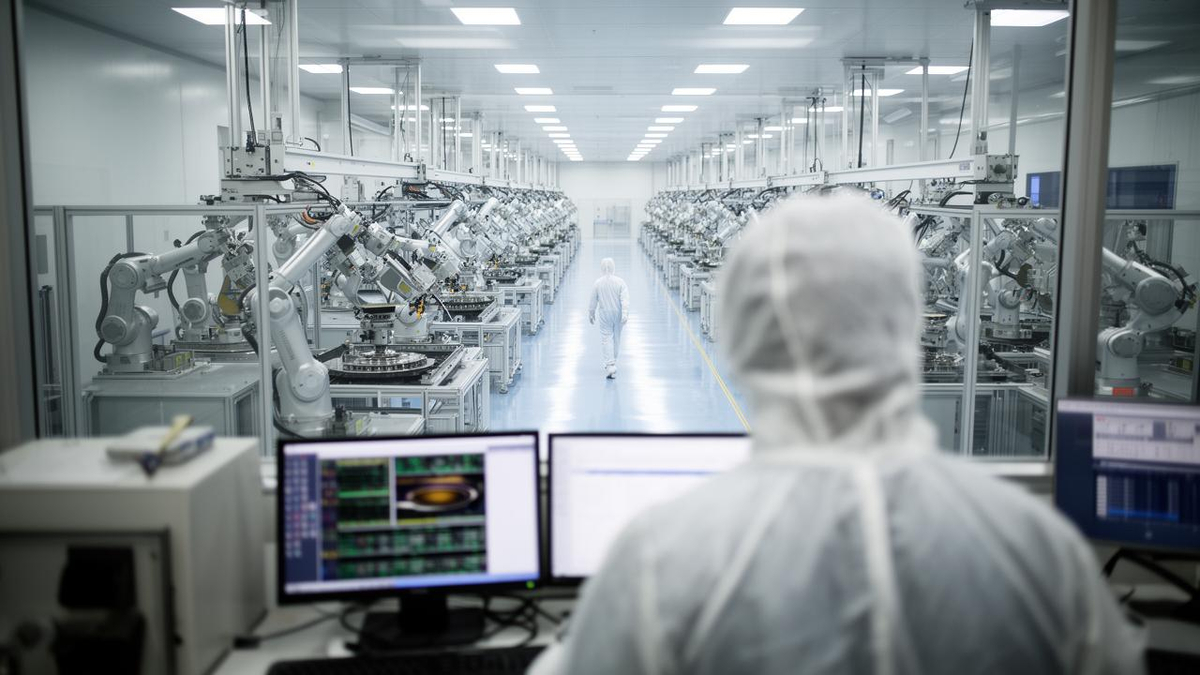
The manufacturing layer is where the startup most resembles a semiconductor company. Tissue Disc 2 is a plate-sized patterned microfluidic disc — a wafer whose chambers are for tissues rather than transistors — through which flow can be controlled across tens of thousands of tissues simultaneously. The second-generation design increases tissue density two- to four-fold while making each tissue larger, by offloading accessory functions to the surrounding robotic system. That system is an eight-and-a-half-foot-tall self-enclosed lab containing a fridge, freezer, 3D scanning microscope, and robot arm. The hard engineering is the software orchestration layer: a researcher describes a study in plain language, and the system compiles it into millions of robot actions, handling prefetching, thawing order, and lid placement the way a C compiler handles branch prediction and memory prefetching.
The Grand Challenge in Pharmacology
Nathan surfaced a target from the Annual Review of Pharmacology and Toxicology’s grand challenges: a universal framework forecasting rare patient-specific adverse events with more than 95 percent accuracy before first-in-human dosing. Georgescu called the framing almost premature — “picking the color of my Mars suit” — because the more common and more lethal problem is ordinary toxicity. Many cancer drugs reaching clinic barely improve the disease while producing severe side effects, sometimes killing patients through liver toxicity.
He walked through the mechanism of rare immune-driven toxicity: a small molecule is metabolized in liver cells, reactive intermediates bind to liver proteins, those modified proteins reach lymph nodes, and the adaptive immune system sees a novel shape and mounts a response — sometimes producing autoimmunity that persists after the drug is stopped, requiring lifelong immunosuppressants. Detecting this requires screening across a repertoire of T-cell receptors and lymph node tissue capable of producing antibodies, across enough patient diversity to catch the one immune cell that recognizes the intermediate. That is a combinatorial problem no single platform currently solves.
Georgescu’s answer on scale was deliberately deflationary. The capability to screen a thousand patients for rare responders is already innate, but in current pharma partnerships the question has mostly been whether there is a therapeutic effect at all — usually the hardest part of a trial — rather than hunting rare adverse events. Labenz’s read was that the imaging granularity is not there yet, and the open question is whether generalization kicks in at 30 million or 300 million samples per year.
On personalized medicine, Georgescu is skeptical of the n-of-1 endgame. Cancer vaccines targeting a single biomarker let tumors escape by ceasing to express it, and the economics of one-off manufacturing are brutal. His bet is that the industry passes through a phase of personalized therapies, then returns to generalized, mass-manufacturable drugs with more intelligence built into the therapeutic itself.
The Discovery Curve and Who Captures the Value
The episode surfaced a sharp debate over AI’s role in scientific discovery, triggered by Anthropic’s announcement that Claude had identified a CRISPR-like repeating sequence in bacterial genomes. The finding was immediately panned by biologists on two grounds: parts of the sequence had appeared in prior literature, and even for CRISPR proper, therapeutic use took roughly two decades. Labenz’s framing of the discovery pattern is the sharpest thing in the segment: the first AI scientific discovery is always a literature search and always gets panned; the second is obscure and useless; the third is a problem everyone has tried; only then do you reach problems of real consequence. He put biology two to three years behind mathematics on that curve. Prakash took the under on both, and argued biology may invert the ordering — utility before mechanism — because clinical approval does not require a mechanism, only that a drug works.
The argument has consequences for how the two startups should be valued. Prakash’s thesis is that companies like Archetype and Vivodyne hold unique data assets that frontier labs will want to buy upstream — the reasoning models are already good enough to consume the data, and the balance sheets support buying many such companies. Labenz’s counterpoint: why would Claude need to own AlphaFold rather than call it? His answer was energy efficiency. A generalist doing everything at higher compute and energy per outcome is effectively less intelligent than a specialist doing it at lower cost — which is why each generation gets distilled back down. That efficiency curve, he argued, is the real constraint on the singleton scenario.
The unresolved question — whether these become tool calls under a frontier model or acquisitions folded into pre-training — matters enormously for investors trying to decide where durable value accrues. Both founders position themselves as nodes that talk to digital agents rather than as inputs to be absorbed. Both reject the premise that frontier language models subsume their work. Gillian does so because sensor-language pairs do not exist at internet scale, and because some sensors have never left a factory — there is no corpus to train on. Georgescu does so because cells on plastic do not exhibit the causality that makes perturbation data valuable; the data does not exist until someone builds the tissue platform to generate it.
The next twelve months of installed compute — more than exists in the world today, according to the hosts’ synthesis — is the variable that makes all of these questions answerable sooner than historical base rates suggest. The labs will have more research compute than everything they have ever done cumulatively. Whether that compute goes toward safety validation, toward consuming the data assets built by companies like Archetype and Vivodyne, or toward the recursive self-improvement that frightens the doomers, is the variable that matters. The data assets being built now are expensive to replicate, causally grounded, and outside the reach of any pure-software play. That is a defensible position to hold while the philosophical war over obedience, benevolence, and shutdown orders grinds on.
Full content available at:Foundation Models for the Physical World + Making Biology Computable
- Nvidia’s Huang Rejects Antitrust and Liability Relief for AI Labs
Once added, BigGo Finance appears first in Google Search Top Stories, so you get the broadest, most up-to-the-minute, and most comprehensive global financial news first.
