


Rounak BhatPublished: Oct 23, 2026, 12:17 ISTUpdated: Oct 23, 2026, 12:17 IST
As artificial intelligence (AI) takes on more business functions, IIM Ahmedabad (IIM-A) wants managers to do more than learn how to use it: They must know when to question its recommendations, set ethical limits and redesign workplaces where humans and machines work together.
The push to integrate AI across its management programmes and its newly established Krishnamurthy Tandon School of Artificial Intelligence, backed by a Rs 100-crore endowment from alumna Chandrika Tandon and her husband, Krishnamurthy Tandon aims to create new breed of professional who can strike a balance between technology and changing business demands.
The institute’s blended MBA programme in Business Analytics and Artificial Intelligence is set to begin its second cohort in 2027, while its leadership also sees a broader shift ahead for management education—one that brings industry closer to classrooms without losing sight of the social consequences of technological change.
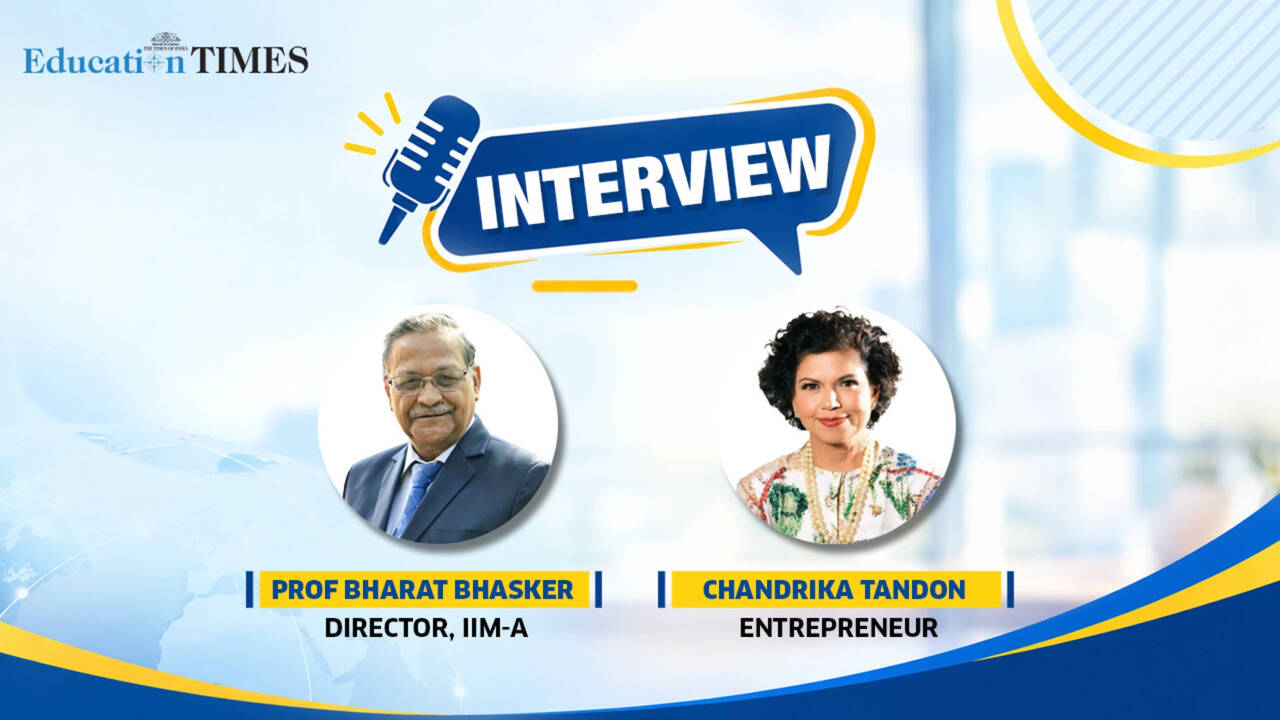
In an interview, IIM-A director Prof Bharat Bhasker and funder Chandrika Tandon discuss why managers need to challenge AI rather than simply deploy it, how business schools must prepare students for human-machine workplaces, and what the institute hopes to achieve with its new AI school.
Excerpts from the interview.
Q: As AI becomes central to management education, how will IIM-A integrate humanities, ethics and social sciences to prepare managers for AI’s wider social implications?
Prof Bhasker:There are two distinct aspects to this.
First, while engineering schools develop the underlying AI models, our research focuses on identifying the limitations of large language models (LLMs) and establishing ethical guardrails. Our human resources faculty examine the need to control technology crossing ethical boundaries.
Second, we address the challenge of managing hybrid work environments in which humans and intelligent machines collaborate.
Humans have finite working capacities, but they need rest, whereas machines can operate continuously. Management leaders must therefore design work environments that balance operational productivity with human well-being.
Tandon: Industry immersion must be accompanied by social immersion. If students focus only on profits and capitalism, we risk failing an entire generation and society. They must understand societal challenges, particularly in India, and how these affect the industry.
With humans and machines working together across business functions, we must also prepare students to become institution builders. The challenge is not merely to manage day-to-day operations but to rethink the kinds of companies and institutions we want to create.
Q: What is the long-term vision for theKrishnamurthy Tandon School of AI, established with a Rs 100-crore endowment, and what measurable outcomes do you expect in the next few years?
Tandon:Global business education initially integrated AI through standalone elective courses before moving towards experiential learning. The next phase requires much deeper integration between industry and higher education.
Since technological innovation happens rapidly within industry, we can envision hybrid educational models in which students work in industry during the day and attend academic classes in the evening.
Equally critical is social immersion. If we train leaders who focus exclusively on capital and profit maximisation, we risk neglecting societal well-being. Students must understand broader social challenges, particularly in developing economies such as India.
Finally, in an era of human-machine integration, management education must prepare institution-builders who can shape organisational culture, governance and ethical frameworks for modern enterprises.
Q: With the upcoming batch fee set at Rs 21 lakh, how does IIM-A balance revenue generation and financial sustainability with its academic mission?
Prof Bhasker: Our primary objective is the dissemination of knowledge, not profit maximisation.
The programme is priced at Rs 21 lakh on a cost-recovery, break-even basis, making it more accessible than traditional full-time executive programmes. Since our endowment fund supports research infrastructure and curriculum development, our non-profit mission remains focused on preparing AI-enabled leaders to serve the national economy.
Q: Amid economic uncertainty and AI-driven disruption, how does IIM Ahmedabad’s Blended MBA inBusiness Analytics and AIprepare working professionals to navigate career transitions and maximise their long-term return on investment, particularly in the absence of conventional campus placements?
Prof Bhasker: The Blended MBA in Business Analytics and AI is designed for working professionals to strengthen their capabilities and remain relevant in a rapidly evolving business environment.
Given the programme’s format and target audience, it does not offer conventional campus placements. Instead, it focuses on equipping participants to address real-world industry challenges, adapt to AI-driven disruption and prepare for greater responsibilities within their organisations or across the wider industry.
At IIM-A, ROI is viewed in terms of long-term career progression, ability to create sustained professional and organisational value, rather than immediate salary hike.
In an environment marked by economic upheaval and technological change, this may be reflected in participants taking on greater strategic responsibilities, leading AI-driven organisational transformation and progressing into senior management or CXO roles over a three-to-five-year horizon.
Q: Since the programme does not facilitate placements, will there be any career transition support?
Prof Bhasker:While the institute does not actively facilitate or manage job transitions, participants build professional networks and develop skills that can support career progression.
Many are sponsored or supported by their employers, making it ethically challenging for the institute to actively encourage them to move to other organisations.
Through action-learning assignments and capstone projects, participants tackle real-world challenges within their organisations. These initiatives can lead to the creation of new teams, expanded responsibilities and leadership opportunities.
As seen in comparable executive education programmes, participants may secure promotions or move into higher positions within their existing organisations.
Q: What are the application and enrolment figures for the second batch, and how does its profile compare with that of the inaugural batch?
Prof Bhasker:We have just begun the process, and there is still a long way to go. There is considerable interest in the market, which reflects in the enrolment. There is a lot of excitement. Only a week ago, we began the admission process for the batch set to start in April. By late December or January, we will have a clearer picture. – not needed
Q: How will IIM-A measure the programme’s outcomes in terms of career progression, workplace application and employer demand?
Prof Bhasker: Workplace demand becomes evident by the time students complete the two-year programme.
We track career progression over the longer term through our Alumni Relations Office, with follow-ups at the three- and five-year milestones after graduation.
Additionally, we undertake a comprehensive curriculum review every three to five years using a zero-based approach. This involves consulting industry leaders to ensure that our offerings remain aligned with market needs.
Q: What are IIMA’s key strategic priorities over the next five years, and how does the institution plan to strengthen its global presence?
Prof Bhasker: We have two main strategic priorities, first is to integrate AI and technology management across all IIM-A degree programmes and executive education offerings, preparing practising managers for increasingly automated work environments.
The second is to advance our internationalisation strategy through our new campus in Dubai, with a focus on expanding executive and postgraduate management education across the Middle East, Africa and the Commonwealth of Independent States (CIS) region
(The journalist was invited by IIM-A to visit the campus)
