

CEED’s study calls for developing a comprehensive ‘Heat Action Plan’ focused on health, labour and livelihood security.
Ranchi: Increasing heat coupled with frequent heatwaves is taking a toll on human productivity in Jharkhand. A recent study by the Centre for Environment and Energy Development (CEED), an organisation working in the environmental and energy sectors, has pointed out that extreme heat is causing a significant decline in worker efficiency, resulting in significant losses to the state’s Gross State Value Added (GSVA).
The report titled ‘Rising Heat and Economic Impact: Towards a Heat Resilient Jharkhand’ was released during a discussion on ‘The Economic Cost of Heat Exposure in Jharkhand’. It states that from 2011-12 to 2022-23, the state has suffered a cumulative economic loss of Rs 1.76 lakh crore (both direct and indirect) due to the impact of heat. This represents approximately 8% of the state’s total GSVA. Of this, approximately Rs 0.87 lakh crore was a direct loss.

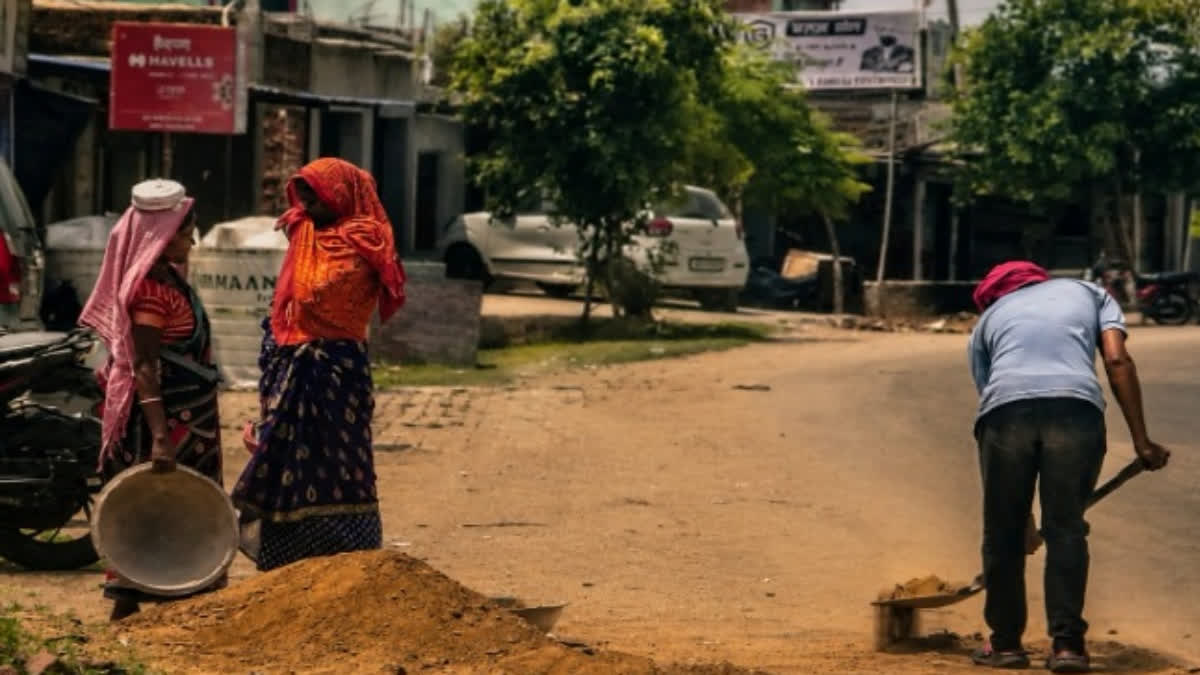
Workers working in a city in Jharkhand (ETV Bharat)
The report has warned that if concrete and appropriate measures are not taken in time, Jharkhand’s estimated labour productivity losses could reach Rs 9.35 lakh crore between 2023-24 and 2047-48, accounting for 10.31% of the estimated GSVA, which will include a direct economic loss of Rs 4.70 lakh crore.
The economic losses due to labour productivity caused by heat were most pronounced in sectors that primarily involved outdoor work between 2011-12 to 2022-23. The construction sector accounted for the largest share of losses, at 25&. Agriculture, forestry and fisheries contributed 11%, followed by transport, storage and communications at 10%, manufacturing at 8% and mining at 7%.
Those who carried out the study pointed out that heat doesn’t typically cause direct damage to buildings, roads or machinery. Its economic impact is primarily manifested in the form of reduced working hours for outdoor jobs, reduced labour efficiency, construction delays and reduced agricultural production. These losses often go unreported in general economic assessments yet they have a profound impact on the state’s economy.
Jharkhand’s Principal Chief Conservator of Forests (PCCF) and Nodal Officer for Climate Change, Ravi Ranjan, “Visionary planning and timely preventive measures are essential for the safety of workers. Under the State Climate Action Plan, efforts are being made to provide relief and mitigate the effects of heat in vulnerable areas. Immediate and long-term efforts involving communities can further strengthen the climate resilience campaign in the state.”
Economist Dr Harishwar Dayal pointed out that a large number of people are engaged in outdoor or physically demanding work. Lack of basic amenities, shade and flexible working hours reduces their efficiency and family income, impacting the overall economy. “This impacts the most vulnerable communities whose livelihoods depend on outdoor work,” he said.
Meanwhile, Srishti Pallav, CEED’s Director of Policy and Partnerships, stated that this is the first such study to examine the economic losses caused by heat. “Heat resilience planning requires better coordination between various departments and partnerships between industries, businesses and civil society organisations,” he underlined.
Shikhar Singh, CEED’s Manager of Resilience, who authored the report, stated that this is the first time a report has focused on the impact of heat. He disclosed that the report was based on secondary data.
The document has listed certain recommendations to mitigate the impact of heat on human productivity. It has underlined that no new laws or substantial budgets are required to address this challenge, and damage can be significantly reduced by streamlining existing systems.
It suggests that Jharkhand should develop a comprehensive ‘Heat Action Plan’ not just focused on health, but also incorporating labour and livelihood security.
All government and private workplaces should be mandated to provide shaded resting areas within a 100 meter radius, free drinking water and a minimum 30-minute break after every 90 minutes of work between 11 AM and 3 PM from April to September.
Under rural development schemes like Viksit Bharat-GRAM G, heavy physical work like soil digging, road construction and tree planting should be carried out during the cooler morning hours from 6 AM to 10 AM and from 4 PM to 6 PM.
Under the Birsa Harit Gram Yojana, shady fruit trees like jackfruit, tamarind and mango should be planted at work sites and along field boundaries so that they provide shade and generate additional income within three to four years. At the same time, local markets and street vendors should be instructed to operate in the morning or late evening to protect them from the scorching heat.
