

Infofla Targets the N2SF-Driven Security Market
Editions
Infofla Takes Aim at the High-Grade Security Market Driven by N2SF
- listen
- Font size down
- Font size up
Posted August. 24, 2026 17:25,
Updated August. 24, 2026 17:27
- listen
- Font size down
- Font size up
– South Korea is transitioning from rigid physical network separation to Multi-Level Security (MLS) under the N2SF, opening doors for AI and cloud adoption in public, defense, and financial sectors.
– Despite this policy shift, strict regulations prohibiting external data leakage remain for high-grade (Classified/Sensitive) zones, restricting standard cloud-based AI agents.
– Infofla’s ‘Selto’ AI automation agent operates entirely on-premise within internal servers, satisfying stringent security requirements and already proving its reliability in government ministry sites.
Recently, various companies and public institutions are rushing to adopt advanced technologies, including AI(Artificial Intelligence), to maximize work efficiency. In particular, beyond the limitations of existing AI that simply answers questions, ‘Agentic AI’ technology, which can perform practical task automation, is emerging as the core of business modernization.
However, there are quite a few cases where these latest technologies cannot be properly adopted for various reasons. This has been especially common in public institutions that must comply with various regulations and prioritize security.
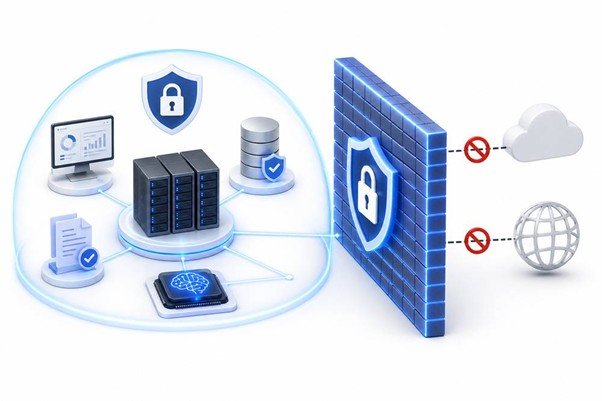
Conceptual diagram of a high-grade security zone operating on-premises while separated from external clouds /
A significant number of the latest AI technologies are operated on a cloud basis. For institutions that are extremely cautious about connecting to external networks due to security, this was a major hurdle. Business innovation based on the latest technology is of course important, but what is even more important is security.
Until now, the principle that has sustained the security of South Korean public institutions was simple. It is ‘network separation,’ which physically separates the business network and the internet network. While it was effective in fundamentally blocking external threats, it was practically impossible to bring new technologies like the cloud or generative AI into operations.
This principle is fundamentally changing. The National Intelligence Service(NIS) revised the existing ‘National Information Security Basic Guidelines’ into the ‘National Cybersecurity Basic Guidelines’ on May 1st, deleting the uniform network separation clause. Instead, filling its place is the ‘National Network Security Framework’ (N2SF), which differentially applies security levels according to the importance of the data. It is a method of dividing business information into three grades: Classified (C), Sensitive (S), and Open (O), and applying different security controls for each grade. The NIS first disclosed the Multi-Level Security(MLS) roadmap in 2024, went through a draft guideline last year, and reflected it in the official guidelines this year.
The scope of the ripple effect does not stop at public and administrative agencies. The trend of shifting to data-centric security is also spreading together to the defense and military sectors, as well as the financial sector, which have been subject to intense network separation regulations for a long time. However, since a uniform transition deadline applied to all institutions has not been set, the actual speed of transition is expected to vary depending on the infrastructure and budget conditions of each institution.
The purpose of the N2SF transition is clear. It is to enable new technologies like the cloud and generative AI to be brought into the previously blocked work environment. However, a gap remains here. This is because the principle that data must not leave the institution’s control boundaries is still maintained for the Classified (C) and Sensitive (S) grade areas. Since a typical AI agent is structured to transmit information to an external cloud for inference or data retrieval, it is difficult to enter this high-grade area. The door for AI adoption has opened, but there is virtually no suitable AI that can be used in the area where security is most important.
There is also a perspective that reads a new opportunity at this point. Until now, the AI market has been heavily influenced by global big tech companies and large corporations that conduct business based on cloud infrastructure. However, with the new condition of a high-grade security zone created by N2SF, there is a view that this can instead become a new opportunity for domestic small and medium-sized enterprises and startups equipped with customized solutions and niche solutions that satisfy these conditions.
Infofla, Takes Aim at High-Grade Security with On-Premise Solutions
‘Infofla’ (CEO In-Mook Choi), a company specializing in AI-based task automation technology, is also targeting this gap. Infofla’s AI task automation agent ‘Selto’ is an on-premise method that is installed and operated directly on the client company’s internal server. All processing, such as document analysis, screen-based task processing, and past data retrieval, is completed within the institution’s network, and data is not transmitted externally. This structure satisfies the ‘blocking of external data export’ condition required by the N2SF high-grade area right from the architectural level.

Selto can automate tasks in an on-premise environment /
This effectiveness has already been confirmed in the field. After the ‘Jungbu24 (Korea’s integrated government services portal)’ outage incident in 2023, the government classified various government websites according to their importance, and established a stance that Grade 1 sites with particularly high importance must be responded to within 120 to 150 minutes in the event of an outage. To respond to this demand, a Grade 1 site of a certain government ministry introduced Infofla’s VLAgent-based web monitoring solution, equipping it with a system that automatically sends notifications to the person in charge when a failure occurs. Selto is the follow-up task automation service that runs right on top of this VLAgent engine. Infofla has also secured the GS(Good Software) certification, an essential gateway for public procurement.
CEO In-Mook Choi of Infofla said in an interview with reporters, “Infofla’s automation solution has already been introduced to the field of public and administrative agencies and has undergone verification, through which the effectiveness of on-premise automation has been proven.” He added, “Based on this experience, we are preparing a plan to expand the adoption of Selto to the defense and military sectors, as well as the financial sector, which have begun to move together with the N2SF transition.”
Most Viewed
- “상자 두고 갑니다” 전화 뚝…9년간 7억 기부한 경남 ‘익명 천사’
- 손범수·진양혜 시부모 됐다…“아들, 첫사랑과 12년 연애 끝 결혼”
- “지드래곤 손짓이 남편 살렸다”…공연중 카메라 감독 추락 막아
- 한 복권방서 로또 1등 수동 4장…동일인이면 ‘47억 잭팟’
Headline News
Humanoid robot beats Bolt’s 100-meter record
Opinion
- EditorialSouth Korea needs tougher anti-corruption enforcement
- Op-edNaver ratings put small businesses under pressure
