

India B2C E-Commerce Market Size, Share and Trends 2026 to 2035
India B2C E-Commerce Market (By Type: Classifieds and B2C Retailers; By Application: Consumer Electronics, Automotive, Clothing & Footwear, Books & Stationery, Beauty & Personal Care, Media & Entertainment, Home Décor & Electronics, Travel & Tourism, Sports & Leisure, Information & Technology, and Others; By Brand Type: Single Brand and Multi-brand; By Device: PCs, Smartphone, Tablet, and Others) Industry Size, Share, Growth, Trends 2025-2035

Revenue,
2025
USD 230 Mn
Forecast Year,
2035
USD 2008.83 Mn
CAGR,
2026 – 2035
24.2%
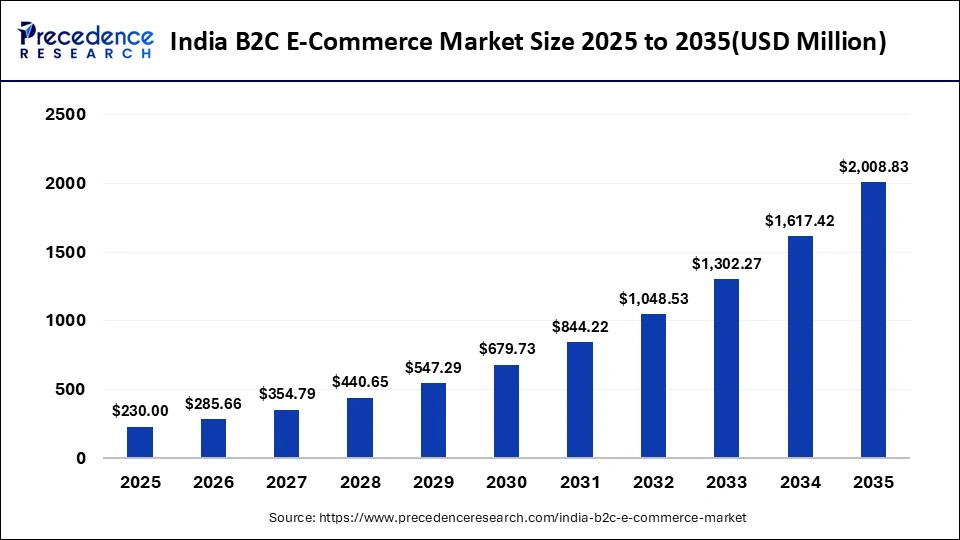
The India B2C e-commerce market size is calculated at USD 230 million in 2025 and is predicted to attain around USD 2008.83 million by 2035, expanding at a CAGR of 24.2% from 2026 to 2035. The market in India is mainly fueled by the rise in smartphone and internet usage, the widespread acceptance of digital payment methods like UPI, and the increasing demand from Tier-2 and Tier-3 cities.
India B2C E-Commerce Market Statical Scope
| Reports Attributes | Statistics |
| Market Size in 2025 | USD 230 Million |
| Market Size in 2026 | USD 285.66 Million |
| Market Size by 2035 | USD 2008.83 Million |
| CAGR 2026 to 2035 | 24.2% |
| Base Year | 2025 |
| Forecast Period | 2026 to 2035 |
India’s Business-to-Consumer (B2C) e-commerce sector is crucial as it is the second-largest e-retail market in the world. Driven by affordable smartphones, high-speed internet, and rapid commerce, it opens up significant domestic consumption, supports small local businesses, and fosters digital innovation in both large and small cities. With hundreds of millions of active online shoppers, India ranks just behind China globally. The total market value exceeds hundreds of billions of dollars, showing rapid annual growth. Cross-border sales provide local Indian manufacturers to export their products globally. Consumers from outside major metropolitan areas are now creating new demand.
Rapid delivery apps are changing the way people purchase everyday items by fulfilling orders in minutes. Secure mobile payment options and government initiatives make online shopping simple and reliable. Local startups are bypassing intermediaries to sell directly to consumers, boosting their profit margins. The logistics, warehousing, and digital technology sectors provide jobs for millions. Local shops and regional producers are leveraging online platforms to grow quickly.
India B2C E-Commerce Market, By Type, 2025 (%)
| Segments | Shares (%) |
| Classifieds | 18.00% |
| B2C Retailers | 82.00% |
- Classifieds – The classifieds segment, with a share of 18% in 2025, plays a crucial role in India’s B2C and digital commerce landscape as it serves budget-friendly buyers, connects communities in Tier II and Tier III cities, and supports the circular economy by linking local buyers and sellers for second-hand goods, real estate, and services without needing extensive retail setups.
- B2C Retailers – The B2C retail sector, with a share of 82% in 2025, is a leading driver of the India B2C e-commerce market, connecting manufacturers with millions of online consumers. It boosts high-volume online sales, encourages quick adoption in Tier-2 and Tier-3 cities through digital platforms, and customizes shopping experiences with fast delivery and mobile applications.
India B2C E-Commerce Market, By Application, 2025 (%)
| Segments | Shares (%) |
| Consumer Electronics | 18.00% |
| Automotive | 5.00% |
| Clothing & Footwear | 16.00% |
| Books & Stationery | 5.00% |
| Beauty & Personal Care | 10.00% |
| Media & Entertainment | 7.00% |
| Home Décor & Electronics | 10.00% |
| Travel & Tourism | 6.00% |
| Sports & Leisure | 5.00% |
| Information & Technology | 8.00% |
| Others | 10.00% |
- Consumer Electronics – The consumer electronics segment, with a share of 18% in 2025, is a core component of India’s B2C e-commerce market, holding the largest market share. It acts as a major revenue source, attracts significant platform investments, and fosters digital trust by providing high-value devices like smartphones directly to hundreds of millions of online shoppers.
- Automotive– The automotive sector, with a share of 5% in 2025, is essential to India’s B2C e-commerce market as it fills the gap for consumers in Tier-II and Tier-III cities looking for accessible spare parts, accessories, and direct-to-consumer electric two-wheelers. It utilizes the rapid adoption of digital payments and mobile commerce to change a traditionally localized, fragmented offline market into efficient, transparent online transactions.
- Clothing & Footwear– The clothing and footwear sector, with a share of 16% in 2025, is a key driver of India’s B2C e-commerce market. It promotes frequent consumer engagement, holds a large market share, and rapidly expands into Tier 2 and Tier 3 cities through specialized fashion platforms and direct-to-consumer brands.
India B2C E-Commerce Market, By Brand Type, 2025 (%)
| Segments | Shares (%) |
| Single Brand | 36.00% |
| Multi-brand | 64.00% |
- Single Brand – The single-brand (or Direct-to-Consumer/D2C) sector, with a share of 36% in 2025, is crucial in India’s B2C e-commerce market as companies have direct control over customer data, achieve higher profit margins by eliminating middlemen, and build strong brand trust and loyalty in the rapidly growing Tier-2 and Tier-3 cities.
- Multi-brand– The multi-brand sector, with a share of 64% in 2025, accounts for the largest revenue share in India’s B2C e-commerce market as it increases customer acquisition and retention by providing various price options, a wide range of products, and convenience across different categories in both metropolitan and Tier-2/3 cities. Platforms like Flipkart and Amazon India depend on this model to meet diverse consumer needs.
India B2C E-Commerce Market, By Device, 2025 (%)
| Segments | Shares (%) |
| PCs | 18.00% |
| Smartphone | 68.00% |
| Tablet | 10.00% |
| Others | 4.00% |
- PCs – In the Indian B2C e-commerce landscape, the personal computer (PC) segment, with a share of 18% in 2025, is essential, which includes sales of desktops and laptops, as well as purchases made through desktops. It facilitates high-value transactions, helps in detailed consumer research, and serves as a foundation for premium consumer electronics.
- Smartphone – The smartphone segment dominates the India B2C e-commerce market, accounting for over 68% of the total gross merchandise value. With millions of active users, mobile devices are the main gateway for online shopping, connecting consumers to digital platforms in both metropolitan and smaller cities.
Competitive Landscape
The Indian B2C e-commerce market is rapidly expanding, fueled by online shoppers, widespread smartphone usage, and UPI payment systems. This ecosystem is marked by fierce competition among major players, value-driven social commerce applications, quick-commerce startups, and large omnichannel companies.
- Flipkart, a homegrown giant in India, offers a wide range of electronics, fashion, and home goods, particularly in Tier-2 and Tier-3 cities, supported by its fintech and supply chain divisions.
- Amazon India serves as a key horizontal competitor to Flipkart, featuring an extensive product catalog, Prime membership benefits, and strong device integration.
- Meesho is a leader in social and value-oriented commerce, targeting non-metro users with ultra-low-cost, unbranded clothing and household products through a zero-commission model for small sellers.
- Blinkit, operated by Zomato, provides groceries, electronics, and daily essentials within 10 to 20 minutes, and is increasingly venturing into discretionary items.
- Zepto is a pioneer in rapid delivery, focusing on dark-store logistics for immediate grocery and household needs.
- Swiggy Instamart utilizes Swiggy’s food delivery network to offer quick dark-store-based retail for groceries and last-minute purchases.
- Myntra, a fashion subsidiary of Flipkart, leads in online apparel, beauty, and lifestyle categories.
- Nykaa is the top player in specialty beauty, cosmetics, and personal care, employing an omnichannel inventory strategy.
- FirstCry is the leading platform for baby, kids, and maternity products in India.
- Reliance Retail (JioMart) connects local kirana stores with digital ordering through a vast offline-to-online retail network.
- Tata Digital (Tata Neu / BigBasket / Croma) merges grocery delivery (BigBasket) and electronics (Croma) into a single super-app rewards system.
- ONDC (Open Network for Digital Commerce) is a government-supported open protocol that disrupts traditional gatekeepers by allowing small local merchants to list directly on consumer apps.
Segments Covered in the Report
- Classifieds
- B2C Retailers
- Consumer Electronics
- Automotive
- Clothing & Footwear
- Books & Stationery
- Beauty & Personal Care
- Media & Entertainment
- Home Décor & Electronics
- Travel & Tourism
- Sports & Leisure
- Information & Technology
- Others
- Single Brand
- Multi-brand
- PCs
- Smartphone
- Tablet
- Others
For inquiries regarding discounts, bulk purchases, or customization requests, please contact us at sales@precedenceresearch.com
Frequently Asked Questions
Answer : The India B2C e-commerce market size is expected to increase from USD 230 million in 2025 to USD 2008.83 million by 2035.
Answer : The India B2C e-commerce market is expected to grow at a compound annual growth rate (CAGR) of around 24.2% from 2026 to 2035.
Answer : The major players in the India B2C e-commerce market include rise in smartphone and internet usage, the widespread acceptance of digital payment methods like UPI, and the increasing demand from Tier-2 and Tier-3 cities.
Answer : The driving factors of the India B2C e-commerce market are the an advancements in horizontal drilling and multi-stage completions, abundant shale and tight-rock reserves, energy demand both domestically and globally, and ongoing activities to redevelop and re-fracture wells to improve production efficiency.
India B2C E-CommerceB2C E-Commerce
Ask For Sample
No cookie-cutter, only authentic analysis – take the 1st step to become a Precedence Research client
