

Thursday, September 3rd, 2026 – 1:01 am
SHARE:

This week, I caught up with a startup from outside the world of data-driven advertising, but with an interesting position when it comes to ecommerce advertising.
That’s Clearco, a Canadian fin tech company founded in 2015, which, earlier this month, raised a $100 million in financing from the bank Macquarie Group.
The digital-native ecommerce brand category is often thought of as a child of venture capital. But that’s in large part because those companies, as startups in a new field with little auditable history or established business fundamentals, had little access to traditional bank loans.
Clearco doesn’t provide loans, nor does it take an equity stake in startups that it finances, CEO Andrew Curtis told AdExchanger.
The company brought a common practice in the offline world, called revenue-based finance, to ecommerce, Curtis said. When Clearco offers capital to a startup, it takes a contractual stake in future revenue receivables. Unlike a loan, Clearco generally recoups its cash within four to six months.
Founders often choose Clearco’s financing model because it takes no equity, he said. The financing is often referred to as “non-dilutive capital.”
Traditional lenders often take equity if payments are missed, for instance, or require founders to put liens on physical assets, like warehousing and product inventory, which the lender will own if its capital isn’t returned.
“The space can be treacherous” for ecommerce fin techs like Clearco, Curtis said.
Another fin tech startup that provided banking services to ecommerce companies, called Parker, was founded in 2019 and raised $200 million before folding in May.
Why so treacherous?
Ecommerce startups and Shopify merchants have proven their viability. So what makes it so persistently difficult for companies in the category to attract cash-backers without giving up more and more equity in the business?
For Clearco, one of the major distinguishing factors in financing ecommerce startups is the nature of the online ad platforms they rely upon.
The obvious, most-important metric when Clearco evaluates a company is whether it demonstrates consistent revenue growth, Curtis said. Clearco is purchasing future revenue after all.
But the fin tech’s second biggest(The biggest expense Clearco finances is for inventory acquisition, like companies right now stocking up to have product for Black Friday.)
“These businesses are voracious consumers of working capital,” Curtis said.
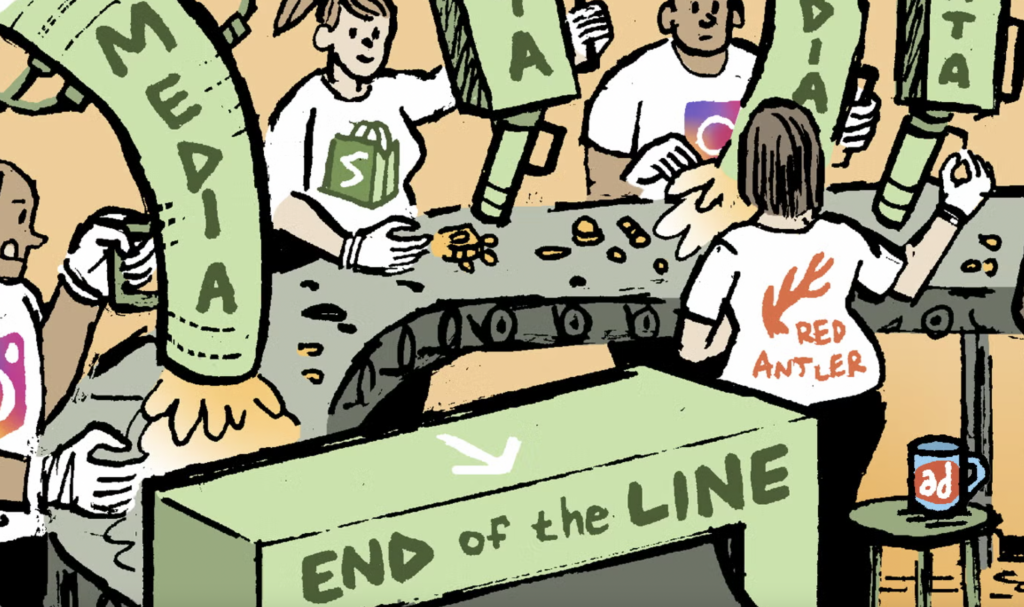
In the past couple of years, there have been the back-to-back-to-back policy changes where Google, then Meta and now Amazon have forbidden the use of credit cards to purchase ads. This was a bit of a cash loophole, which startups used to inflate their rewards points and give themselves a bit of room to pay down campaigns.
Many ecommerce startups need new financing as they expand to new channels, Curtis said, such as social-native brands investing in Amazon sales or jumping to physical retail with some grocery chain.
Ecommerce startups are an “agile crew,” Curtis said, adding that he’s not from the category but from banking and finance.
Legacy brands and all sorts of categories feel the same macro-economic fluctuations and tariff effects. But ecommerce companies depend on Big Tech platforms. “And these third parties can make changes. They’re behemoths,” he said.
Apple has made iOS changes that threw businesses for a loop; Amazon makes changes that push products down the search results; an algorithmic update to Meta’s News Feed swings traffic elsewhere.
“There’s an enormous amount of uncertainty in the world today,” Curtis said. “We see a lot of resilience and sophistication in these DTC ecommerce companies.”
