

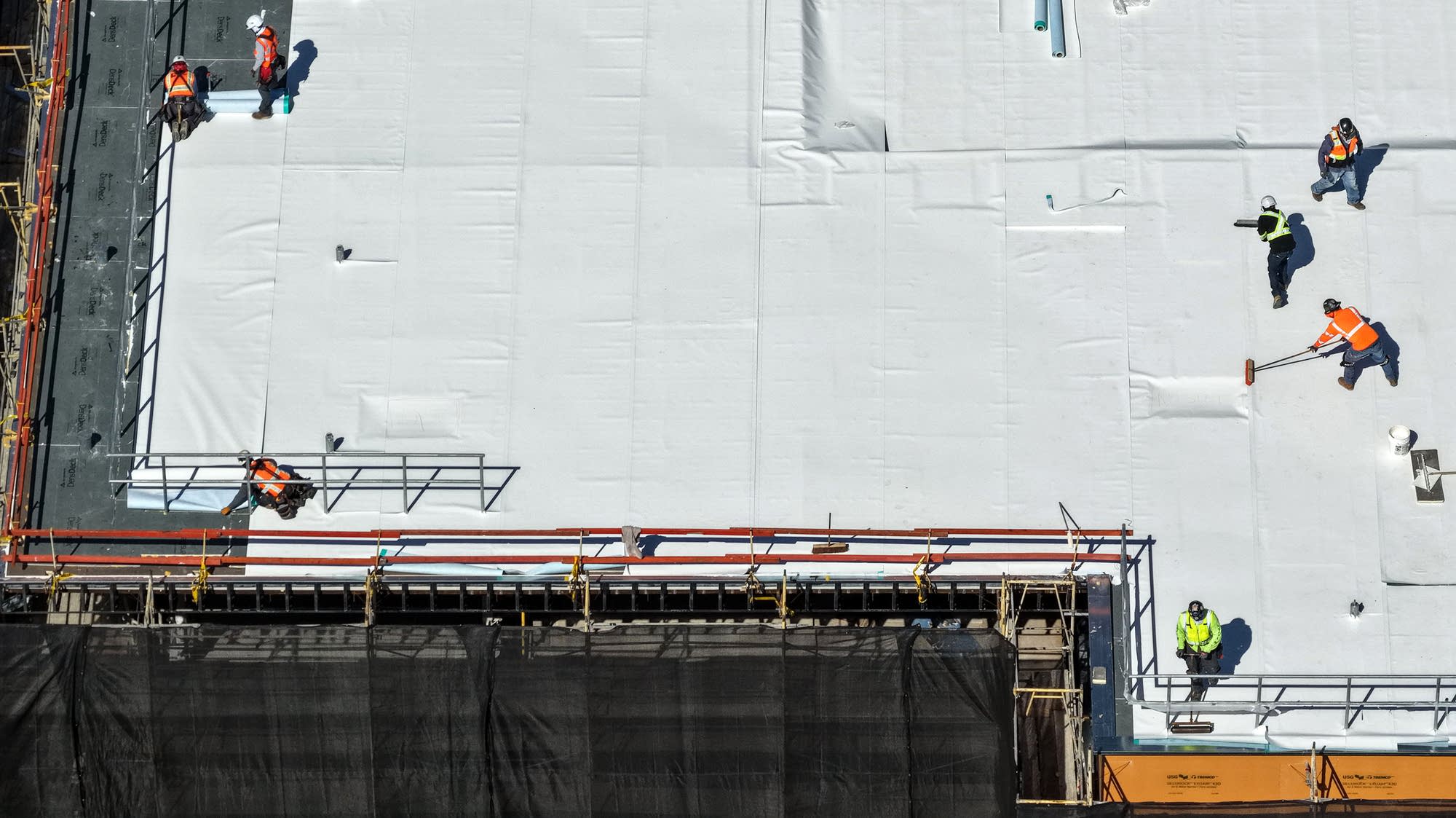
Data center jobs are in high demand, and wage growth in the sector is outpacing the rest of the labor market. But the benefits of that growth are limited.
All of the data center constructionthat’s been happeningover the last year has been pushing up demand for semiconductors, memory chips, and other electronics. It’s also pushing up demand for the labor needed to build these data centers.
Up until last year, construction workers were not in high demand.
“A lot of that had to do with just higher interest rates were really starting to weigh on the extent to which firms in an industry like construction could expand,” said Nicole Cervi, an economist with Wells Fargo.
But last year, job openings in construction started to stabilize. More recently, they’ve been picking up. Meanwhile, average wages in construction are up more than 4% from a year ago, outpacing wage growth overall.

“And if you look beneath the surface, obviously there’s many different types of construction, a lot of that growth in construction payrolls is coming from non-residential construction,” Cervi said.
Courtney Shupert, an economist with MacroPolicy Perspectives, said that’s welcome news for the workers building data centers, because wage gains in construction are outpacing inflation. It also helps that most data centers are being built in rural areas
“Those wage gains go further in a rural area,” Shupert said. “So for those workers and those families, that’s really exciting.”
But those gains aren’t as exciting for the economy overall. Nonresidential construction jobs make up only 3% of the entire labor market, and even though the sector is hiring, it’s not nearly enough to offset all of the other sectors that have been slowing down.
“Information and tech has lost jobs,” Shupert said. “So has finance. So has mining, and trade, transportation, and utilities. So has manufacturing.”
Meanwhile, all of those new data center construction jobs are also reducing how many workers are available to build anything else.
“The fact that there’s so much growth in these non-residential construction projects, they’re taking away workers from the residential construction side,” said Danushka Nanayakkara with the National Association of Home Builders.
Nanayakkara said the home construction industry had been having a hard time finding workers well before this wave of data center construction.
“There is a finite number of workers that we have access to for various reasons,” Nanayakkara said. “We have an aging labor force. We don’t really have young people coming in. About 30% of the labor is foreign-born workers.”
The Trump administration’s crackdown on immigration has also caused the availablepool of workers to shrink.
Courtney Shupert with MacroPolicy Perspectives said all of these constraints on available labor mean fewer projects will get done.
“If you talk about electricians or roofers, or things like that, that is a skilled job,” Shupert said. “And if you don’t have those skilled workers in place when you need them, the entire project gets slowed down.”
And that can clog up the pipeline of new homes and data centers.
