

If you clicked on this article based upon only the title, then it is clear you have bought the current narrative that AI is affecting everything in the market. But, I am sorry to inform you that this is not how markets work.
For those that know me already, you likely know that my view is that market sentiment is the primary driver of markets, especially the metals market. And, over the last 40 years, we have seen many independent market studies published in support of the premise that the psychological side to the market is being recognized more and more as a true driver of markets.
In fact, many articles have been disproving the common view that markets are driven by fundamentals. As just one example, in a 1988 study conducted by Cutler, Poterba, and Summers entitled “What Moves Stock Prices,” they reviewed stock market price action after major economic or other type of news (including major political events) in order to develop a model through which one would be able to predict market moves RETROSPECTIVELY. Yes, you heard me right. They were not even at the stage yet of developing a prospective prediction model.
However, the study concluded that “[m]acroeconomic news . . . explains only about one fifth of the movements in stock market prices.” In fact, they even noted that “many of the largest market movements in recent years have occurred on days when there were no major news events.” They also concluded that “[t]here is surprisingly small effect [from] big news [of] political developments . . . and international events.” They also suggest that:
“The relatively small market responses to such news, along with evidence that large market moves often occur on days without any identifiable major news releases casts doubt on the view that stock price movements are fully explicable by news. . . “
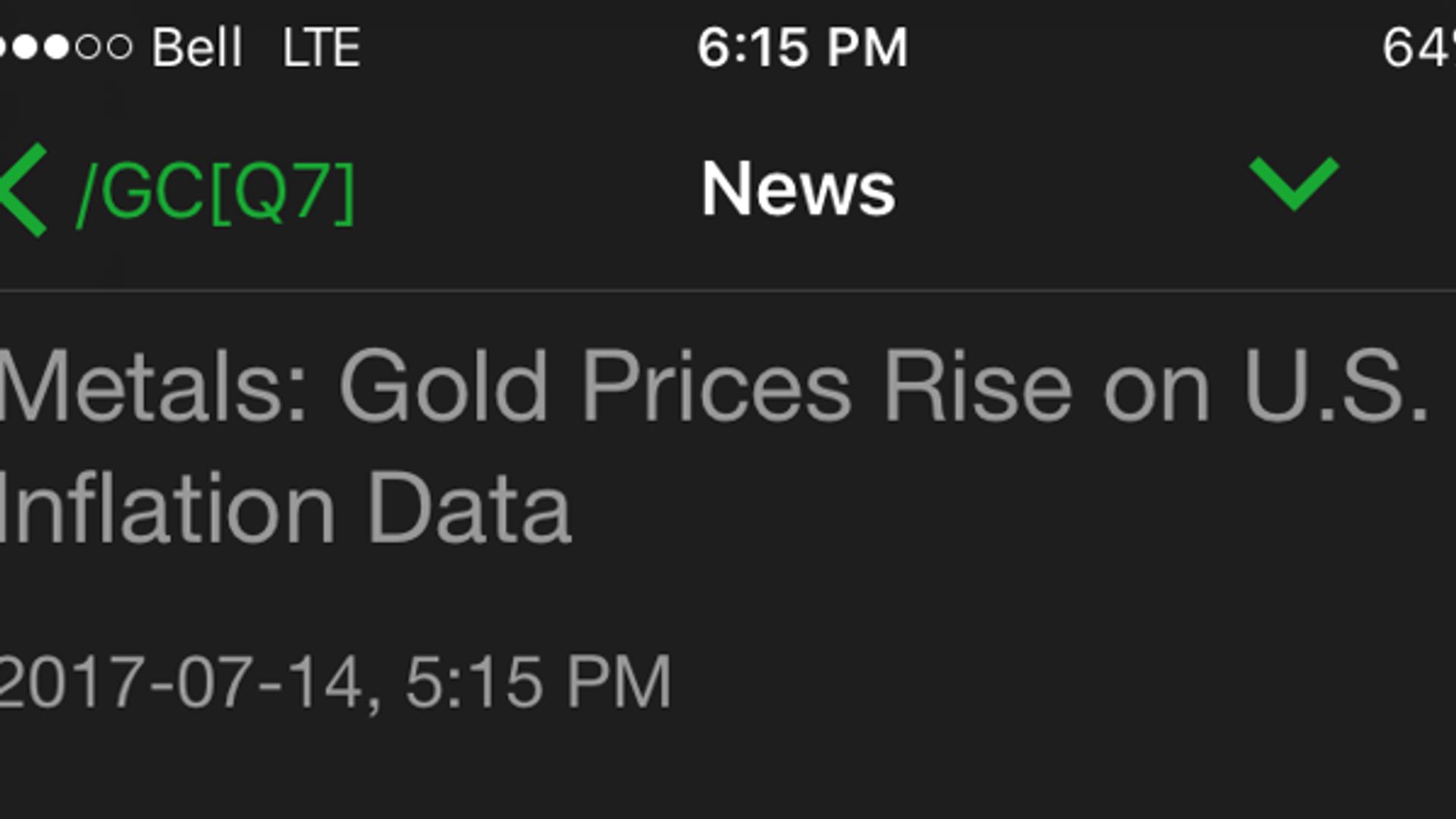
In fact, I took note of how data pointing to inflation supposedly “caused” gold to fall one day and then rise the exact next day:
The problem is that most market participants view markets through the lens of Newtonian physics, as outlined by these three main principles: 1 – a body at rest remains at rest unless acted upon by an external force; 2 – a body in motion remains in motion in a straight line unless acted upon by an external force; and 3 – for every action, there is an equal and opposite reaction.
“During the second half of the nineteenth century new and revolutionary ideas were introduced into physics; they opened the way to a new philosophical view, differing from the mechanical one.”
Yet, even though physics has moved away from the Newtonian viewpoint, financial market analysis has not.
Bob Prechter put it best in his seminal book The Socionomic Theory of Finance (which I strongly encourage for every single investor):
“Observers’ job, as they see it, is simply to identify which external events caused whatever price changes occur. When news seems to coincide sensibly with market movement, they presume a causal relationship. When news doesn’t fit, they attempt to devise a cause-and-effect structure to make it fit. When they cannot even devise a plausible way to twist the news into justifying market action, they chalk up the market moves to “psychology,” which means that, despite a plethora of news and numerous inventive ways to interpret it, their imaginations aren’t prodigious enough to concoct a credible causal story.
Most of the time it is easy for observers to believe in news causality. Financial markets fluctuate constantly, and news comes out constantly, and sometimes the two elements coincide well enough to reinforce commentators’ mental bias towards mechanical cause and effect. When news and the market fail to coincide, they shrug and disregard the inconsistency. Those operating under the mechanics paradigm in finance never seem to see or care that these glaring anomalies exist.”
So, let’s move on to my view on gold right now. If you followed my last article on gold back in mid-June, I suggested buying mining stocks as they looked to me as though they were bottoming. Since that time, many went on very strong runs and gained over 50% from those lows. And, as we were topping in August, I told the members of Elliottwavetrader that I am cashing in half my positions for profit, as I had expected a pullback, and that is what we are seeing right now. But, the pullback is now at a very important juncture, as I am looking to buy back into the market.
In gold futures (the December contract), I have support between 4133-4233. As long as that support holds, I am expecting another rally back up towards to at least the 5100 region next. However, I must warn you. If that support fails and we see a sustained break of that support, then it opens the door for lower lows in gold below the lows struck this past summer. But, that would be an amazing buying opportunity for, thereafter, I would expect that rally to 5100+.
So, the question now all revolves around if the 4133-4233 support holds or not. But, in both cases, I am expecting a rally back to 5100+ as we look to the end of this year and into next. The question is if we get an even better buying opportunity before then or not.
As I say all the time, I am but a simple analyst, as I am not a prophet. But, the market provides to us wonderful parameters around which we can make our buying and selling decisions based upon our fractally-based Elliott Wave analysis, which is supported by Fibonacci mathematics.
Feel free to join us and our 8000 members (approximately 1000 of which are money managers) for a free trial and learn our methods which have proven exceptionally profitable over the last 15 years we have been publishing publicly. You can read what our members have said about us through the years: https://www.elliottwavetrader.net/p/analysis/Insights-From-Investors-And-Money-Managers-All-Around-The-World-202408199241542.html
Avi Gilburt
Avi Gilburt is a widely followed Elliott Wave technical analyst and author of ElliottWaveTrader.net (www.elliottwavetrader.net), a live Trading Room featuring his intraday market analysis (including emini S&P 500, metals, oil, USD & VXX), interactive member-analyst forum, and detailed library of Elliott Wave education.
goldprecious metalsgold mining stocksElliott WaveElliott Wave analysisFibonacci AnalysisArtificial IntelligenceFederal ReserveinflationDecember gold futures
Disclaimer: The views expressed in this article are those of the author and may not reflect those of Kitco Metals Inc. The author has made every effort to ensure accuracy of information provided; however, neither Kitco Metals Inc. nor the author can guarantee such accuracy. This article is strictly for informational purposes only. It is not a solicitation to make any exchange in commodities, securities or other financial instruments. Kitco Metals Inc. and the author of this article do not accept culpability for losses and/ or damages arising from the use of this publication.
