

ByTechnology WisdomPublished 15 days ago•4 min read

Artificial Intelligence Solutions
Artificial intelligence has moved far beyond experimentation.
Just a few years ago, businesses viewed AI as a future technology. Many organizations explored chatbots, automated reporting tools, and predictive analytics without fully integrating them into daily operations.
Today, that reality has changed.
Artificial Intelligence Solutions are becoming deeply embedded within business processes across industries. Companies are no longer asking whether AI is useful. They are asking where AI can create the greatest operational impact.
From customer service and marketing to supply chain management and business intelligence, AI is reshaping how organizations make decisions, allocate resources, and drive growth.
The companies gaining the biggest advantage are not necessarily those investing the most in AI. They are the businesses using AI strategically to solve real operational challenges.
For years, businesses focused on automation primarily to reduce repetitive tasks.
While automation remains important, modern AI solutions are doing much more than replacing manual processes.
Today’s AI systems can:
- Analyze large datasets
- Identify hidden trends
- Forecast outcomes
- Detect operational risks
- Personalize customer experiences
- Support business decision-making
- This shift represents a major evolution.
Businesses are moving from process automation toward intelligent business operations.
Instead of simply completing tasks faster, AI now helps organizations make smarter decisions.
The Rise of Decision Intelligence
One of the most important developments in 2026 is the emergence of decision intelligence.
Many companies generate enormous amounts of data every day. Yet much of that information remains underutilized.
Artificial Intelligence Solutions help organizations transform raw data into actionable insights.
For example:
- A retail company can predict product demand before seasonal spikes occur.
- A logistics provider can identify delivery bottlenecks before they affect customers.
- A marketing team can forecast campaign performance before allocating budget.
- This ability to anticipate outcomes gives businesses a significant competitive advantage.
Customer expectations continue rising.
People expect businesses to understand their preferences, anticipate their needs, and provide relevant experiences across multiple channels.
AI-powered customer intelligence systems help organizations achieve these goals.
Modern businesses use AI for:
- Personalized recommendations
- Customer behavior analysis
- Predictive support systems
- Intelligent product suggestions
- Dynamic content delivery
- Customer sentiment analysis
The result is a more relevant and engaging customer experience.
Organizations that understand customers better often achieve higher retention rates and stronger long-term growth.
Many business leaders initially viewed AI as a technology initiative.
In reality, AI is becoming an operational strategy.
Artificial Intelligence Solutions now influence:
Workforce Productivity
Employees spend less time on repetitive administrative tasks and more time on strategic work.
Business Intelligence
Organizations gain faster access to insights that previously required extensive manual analysis.
Risk Management
AI systems can identify unusual patterns, compliance issues, and potential risks before they become costly problems.
Resource Optimization
Businesses can improve staffing, inventory management, budgeting, and operational planning through predictive analytics.
These improvements create measurable business value across departments.
Marketing teams have become some of the biggest adopters of AI technology.
However, successful organizations use AI for much more than content generation.
Modern marketing applications include:
- Customer segmentation
- Predictive lead scoring
- Conversion optimization
- Marketing performance forecasting
- Audience behavior analysis
- Customer journey mapping
Sales teams also benefit from AI-driven insights.
Rather than relying solely on intuition, businesses can prioritize opportunities based on data-driven recommendations.
This often improves both efficiency and revenue generation.
Many organizations struggle with operational blind spots.
Leaders often lack complete visibility into:
- Workflow inefficiencies
- Customer behavior patterns
- Resource utilization
- Process bottlenecks
- Financial performance trends
Artificial Intelligence Solutions help uncover these hidden areas.
By connecting data across departments, businesses gain a clearer understanding of how operations function as a whole.
This visibility supports better strategic planning and faster decision-making.
Despite growing adoption, not every AI initiative succeeds.
Many businesses encounter problems because they approach AI incorrectly.
Common mistakes include:
Chasing Trends Instead of Problems
Organizations sometimes implement AI because competitors are doing it.
Successful businesses start by identifying operational challenges first.
Expecting Instant Results
AI systems often require data, testing, and continuous optimization before delivering meaningful outcomes.
Ignoring Data Quality
Poor data produces poor insights.
Even advanced AI models struggle when businesses rely on inaccurate or incomplete information.
Lack of Clear Objectives
Organizations that define measurable goals typically achieve stronger results than those pursuing AI without a strategic roadmap.
A common misconception is that AI only benefits large enterprises.
The reality is very different.
Cloud-based AI platforms have made advanced capabilities accessible to businesses of all sizes.
Small businesses now use AI for:
- Customer support automation
- Marketing optimization
- Business forecasting
- Appointment scheduling
- Inventory management
- CRM enhancement
This accessibility is helping smaller organizations compete more effectively in crowded markets.
The next phase of AI adoption will focus less on automation and more on augmentation.
Businesses are discovering that AI works best when it supports human expertise rather than replacing it.
Future growth areas include:
- Predictive business intelligence
- AI-powered decision support systems
- Intelligent workflow optimization
- Industry-specific AI solutions
- Advanced customer analytics
- Autonomous business operations
Organizations that combine human judgment with artificial intelligence capabilities are likely to achieve the strongest outcomes.
As AI adoption accelerates, businesses should avoid focusing solely on technology.
The real opportunity lies in solving business problems.
Organizations should ask:
- Which processes create the most inefficiency?
- Where are decisions being delayed?
- What customer problems remain unresolved?
- Which operational areas lack visibility?
The answers often reveal where AI can generate the greatest value.
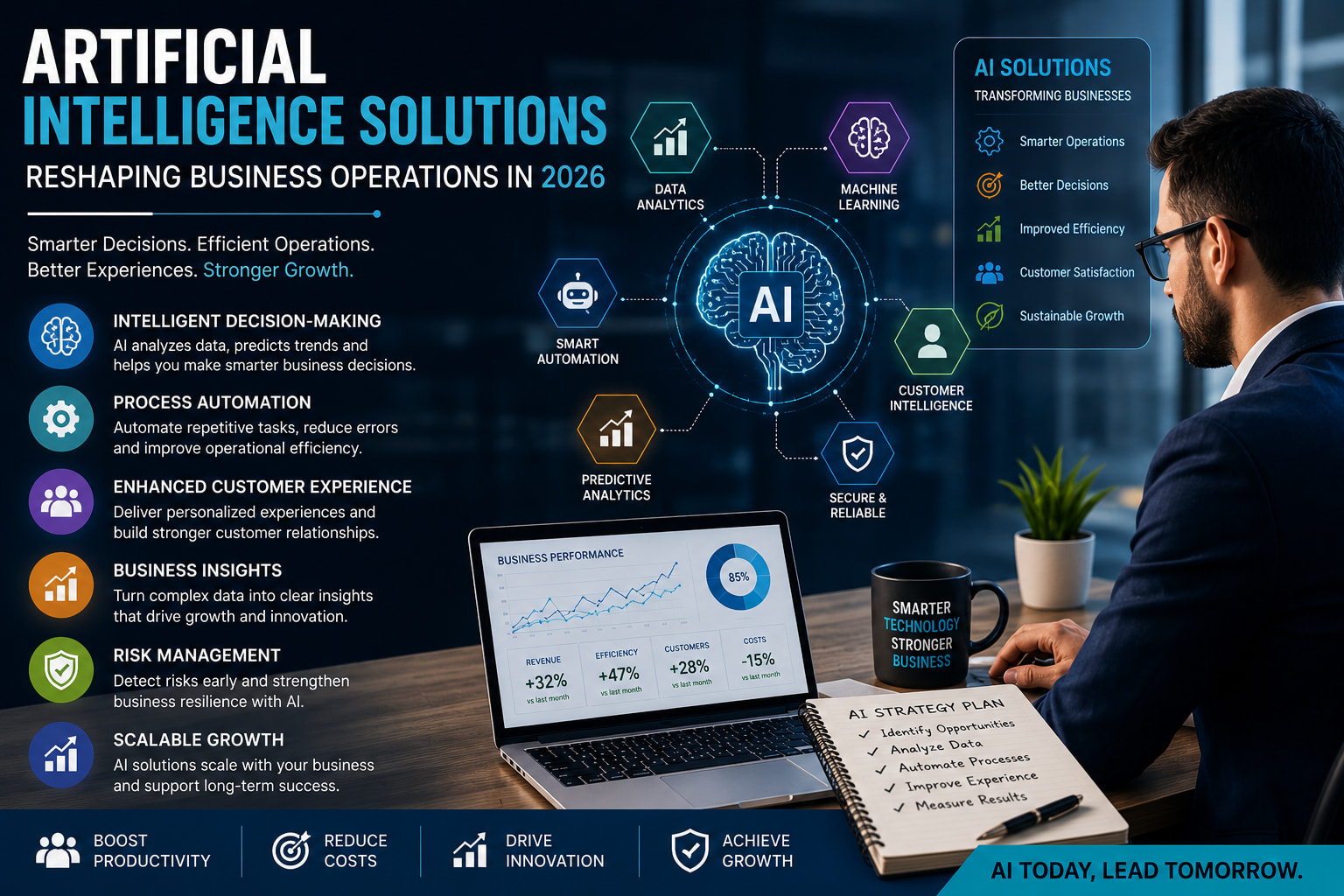
Artificial Intelligence Solutions are reshaping business operations in 2026 by helping organizations make better decisions, improve efficiency, enhance customer experiences, and uncover new growth opportunities.
The most successful businesses are not using AI simply because it is popular. They are using it to solve meaningful operational challenges, improve business intelligence, and create sustainable competitive advantages.
As technology continues evolving, organizations that strategically integrate Artificial Intelligence Solutions into their operations will be better positioned to adapt, innovate, and compete in an increasingly data-driven business environment.
Publishing
