

Add preferred source
Hansae Co. is accelerating its smart factory buildout at its TG Corporation facility in Vietnam’s Tien Giang Province. With the introduction of automated equipment including hanger lines, pattern sewing machines and automated guided vehicles (AGVs), staffing per sewing line has fallen 25% from 60 workers to 45, while the company’s self-developed production management system, HAMS, tracks productivity and quality at each process in real time. The strategy is aimed at countering rising labor costs and worker shortages. Hansae also plans to expand its Guatemala production base and strengthen vertical integration to improve its ability to serve the U.S. market from Central America.
Key Elements

Hansae Co. is accelerating the construction of smart factories at its core production base in Vietnam. In response to rising labor costs and worker shortages, the company is reducing its reliance on manpower through automated equipment while building a system that manages productivity and quality at each process in real time using its self-developed production management system.
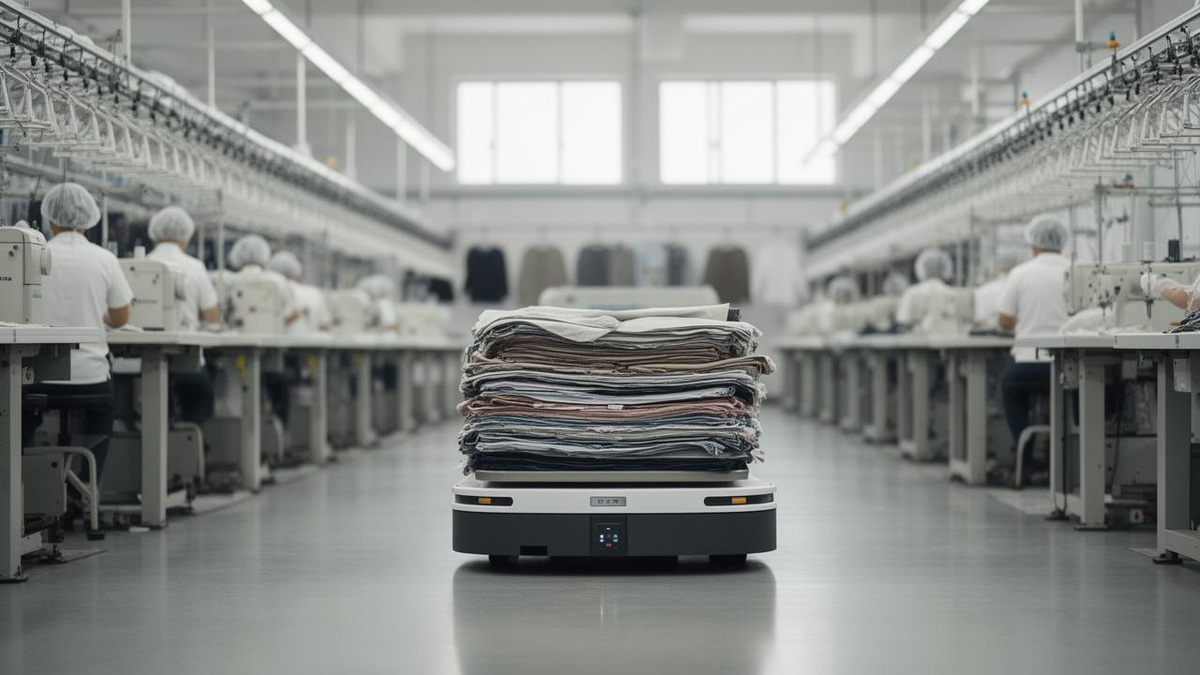
On the 29th of last month (local time), at the Hansae Co. TG Corporation plant in Tien Giang Province, about a 1 hour 30 minute drive from Ho Chi Minh City, Vietnam. Inside Plant No. 7, fabric moved automatically along ceiling rails, and workers stitched the fabric that arrived in front of them with sewing machines without leaving their seats. Semi-finished products that completed a process moved to the next stage with the push of a button. Automated guided vehicles (AGVs) carrying heavy cut pieces and other automated equipment were also in operation throughout the facility. It is a markedly different scene from the sewing factories of the past, where dozens of workers carried fabric by hand.
Founded in 2010, TG Corporation spans about 370,000 square meters (about 110,000 pyeong) and is Hansae Co.’s flagship production base, capable of producing up to 45 million garments a year. About 4,300 employees make products for major U.S. and Japanese apparel brands. It is the largest of the three company-owned plants Hansae Co. operates in Vietnam, and in the first half of this year it produced about 16.05 million garments, accounting for 56% of the total output of Hansae’s Vietnam-owned plants (28.59 million garments).
Vietnam is the backbone of Hansae Co.’s global production network. Including both company-owned plants and outsourced partner factories, it accounts for about 55% of total revenue, with annual output reaching about 100 million garments. Starting with Cu Chi (VN Corporation) in 2001, the company expanded capacity with Tay Ninh (TN Corporation) in 2005 and Tien Giang (TG Corporation) in 2010, and about 9,400 people currently work at the three Vietnam production corporations alone. Roles are also segmented by corporation. VN Corporation handles high-difficulty garments and small-volume orders, TN Corporation handles sportswear and higher-priced apparel, and TG Corporation is the base that reliably handles large-scale orders from major brands.
The most striking feature on site is the automated equipment. Plant No. 7 uses hanger lines that automatically transport fabric to each worker and pattern sewing machines that handle multiple processes with a single machine. The hanger-type production line eliminates the need for workers to carry fabric themselves, giving it 20-30% higher productivity than ordinary manual lines. The AGVs for transporting cut pieces initially followed paths laid on the floor, but second-generation models recognize QR codes, and third-generation equipment that drives along an internal map of the plant once it is input has recently been introduced. Plants No. 1 and No. 7 are also testing the on-site feasibility of map-based autonomous robot vacuum cleaners.
The effect of automation is clearly visible in workforce metrics. Lee Jin-seop, head of Hansae Co.’s Vietnam operations, said, “In the past, a typical sewing line required about 60 people from the fabric warehouse through cutting, sewing and packing, but after going through 55, we now operate at around 45,” adding, “We are raising labor efficiency by introducing automated equipment and a multi-process work system.” Compared with the past, the number of workers deployed has fallen 25%.
He noted that the nature of automation itself has changed. “If automation in the past was pursued to increase output, now we are focusing on automation to replace manpower,” he said, stressing that “as Vietnam’s labor costs continue to rise, automation is essential to maintain production competitiveness.” Indeed, the pattern sewing machines introduced for the first time this year have machines taking over processes that skilled workers had handled by hand, such as attaching the front pockets of hoodies or the inner labels of jackets. Simply placing fabric on the marked position triggers automatic stitching, and output has risen from 34 to 61 pieces per hour for hoodie front pockets and from 89 to 225 pieces for jacket crescent patterns.
The core of plant operations is HAMS (Hansae Advanced Management System), the smart factory system Hansae Co. developed in-house. It integrates and manages the entire process in real time, from fabric receiving through cutting, sewing, quality inspection and shipment of finished goods. It consists of six systems: warehouse management (WMS) for materials, fabric inspection (FIS), cutting process (SMS), sewing productivity control (SFC), quality control (QCS) and machine management (MMS). A barcode is attached the moment fabric is received and linked to the enterprise resource planning (ERP) system so progress at each process can be tracked. If 30 defective items appear while producing 1,000 pieces a day, that information is immediately reflected in the system. Equipment is also barcoded to manage service life and failure history.
Buyer-specific quality control is also carried out in parallel. Plant No. 1, which produces products for Japanese brands, conducts 100% inspection of incoming fabric and additional inspections of finished goods, and repeatedly checks for metal foreign objects before and after packing. Plant No. 7, which serves U.S. brands, has streamlined the process from finished-goods inspection through box packing and radio-frequency identification (RFID) checks, reducing staffing and work time. Smart tape measures and RFID equipment have also improved inspection efficiency. A system that checks each worker’s output and efficiency in real time and pays incentives based on performance is also in place.
Energy cost savings are also cited as an achievement. Solar facilities installed on the roofs of three plant buildings have replaced 55% of total electricity use, and self-supplying 18,000 kW of power a year has saved about 700 million won (approximately $520,000) in costs. The company expects to recover its <a href="https://bitcomme.com/the-defence-sector-is-seeking-investment-italys-dual-use-sector-faces-a-test/” title=”The defence sector is seeking investment; Italy’s dual-use sector faces a test”>investment within four years, from this year through 2029.
Hansae Co. is also expanding automation into processes that absolutely require human hands. Ironing is a prime example. It had been difficult to replace with machines because fabric thickness and size and brand-specific requirements vary, but the company has recently begun attempting to develop its own technology. “The sewing industry is a field where fabric is thin and flexible, making it hard to replace with robots,” Lee said, adding, “We are also reviewing internally the feasibility of automating processes that outside equipment makers have failed to solve.”
Diversification of production bases is also being pursued. Hansae Co. acquired Vietnamese fabric maker Color & Touch (C&T) in 2013 to lay the foundation for vertical integration in Asia, and in 2024 it bought U.S. synthetic fiber manufacturer Texollini. In Guatemala, it plans to complete an integrated production system running from yarn and knitting through dyeing, finishing and sewing. The Guatemala production facility will begin operating in the fourth quarter of this year and ramp up production in earnest starting next year. The Central American base is expected to cut ocean shipping time to the U.S. market by up to about a month compared with Asia.
Kim Ik-hwan, vice chairman of Hansae Co., said, “We have no intention of deliberately reducing the share of production in Vietnam,” adding, “Vietnam remains an important production base, and we will pursue overall growth by expanding revenue in Indonesia and Central America.” Improved profitability from vertical integration is also expected. “In Guatemala we will make high-value-added fabrics that we have not produced until now, which will increase margins further,” he said, stressing that “Central America in particular has no tariffs when exporting to the U.S., so cost competitiveness will also be high.”
Meanwhile, the utilization rate of the Vietnam plants is somewhat lower than before COVID-19. This is because global buyers have diversified production volumes that had been concentrated in certain countries after the pandemic across multiple countries. A company official said, “We have ample capacity to respond to additional orders using our existing production equipment.”
