

InfographicsCompanies
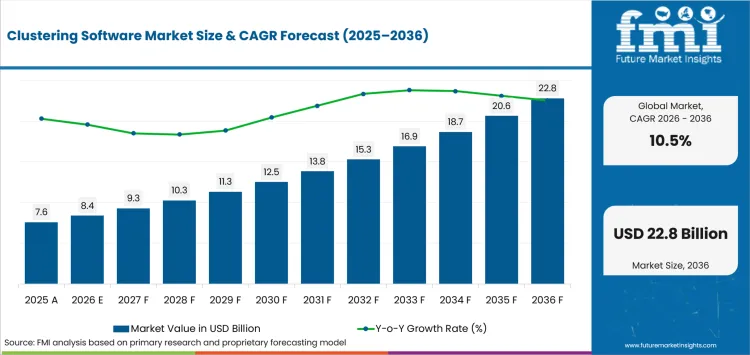
Market Size (2026)
USD 8.4 Bn
Forecast (2036)
USD 22.8 Bn
CAGR (2026 to 2036)
10.5%
How big is the Clustering Software Market in 2026?
USD 8.4 billion in 2026 and USD 22.8 billion by 2036 at a 10.5% CAGR.
Demand for clustering software is projected to expand at 10.5% CAGR between 2026 and 2036, increasing valuation from USD 8.4 billion in 2026 to USD 22.8 billion by 2036. High-performance computing workloads require one control layer across several nodes with predictable service recovery operations.
Data center CPUs and cloud computing pools expose different storage and network behavior, so cluster software must coordinate scheduling and recovery under sustained laboratory workloads. In October 2025, the USA Department of Energy announced an AI supercomputer at Argonne National Laboratory through a partnership with NVIDIA and Oracle. The planned system requires one control layer for accelerator scheduling and service recovery across shared scientific workloads.
Key Takeaways
- AI and distributed applications increase demand for software that coordinates processing and recovery across connected infrastructure environments.
- Cloud-based clustering is estimated at 43.0% in 2026 owing to elastic capacity across public and hybrid environments.
- Big data analytics is projected at 34.0% in 2026 supported by parallel processing across large enterprise datasets.
- Large enterprises are forecast at 41.0% in 2026 due to broad application portfolios with formal recovery requirements.
- Configuration dependence restrains adoption as network and storage behavior must satisfy validated quorum and fencing requirements.
- Microsoft Corporation, IBM Corporation, Oracle Corporation, Red Hat, Inc., Broadcom Inc., Hewlett Packard Enterprise, Cloudera, Inc. and Databricks, Inc. serve distinct clustering software requirements.
Analyst Perspective
“Cluster selection should begin with recovery behavior across the application and storage path instead of advertised node counts. Operational trust depends on visible configuration limits and fewer manual decisions during a tested failure sequence.”
– , Principal Analyst, Future Market Insights
How is the Clustering Software Market segmented?
The clustering software industry is segmented by deployment type, application, end user, distribution channel, software type and region.
The clustering software market is segmented by deployment type, application, end user, distribution channel, software type and region. Deployment covers cloud-based, on-premises, edge and hybrid models, while applications include big data analytics, high-performance computing, AI/ML and database management. End users span large enterprises, IT and telecom companies, government and research organizations and healthcare organizations, while distribution covers direct sales, channel partners, cloud marketplaces and managed services. Software types include high availability, load balancing, distributed computing and storage clustering across connected infrastructure environments.
Why does cloud-based clustering lead the deployment type category?
Cloud-based clustering lets infrastructure teams add compute without locating every node inside one physical facility. Hybrid cloud storage connects capacity across environments with different data-locality rules and egress charges during workload placement. IBM’s April 2026 addition of PowerHA to its cloud automation service gave administrators a managed route for high-availability cluster operations.
- The cloud-based clustering segment is likely to capture 43.0% share in 2026 attributable to elastic capacity across public and hybrid environments.
- Public cloud clusters absorb temporary capacity peaks, while hybrid configurations retain selected data and recovery controls inside established enterprise facilities during intensive demand periods.
Why does big data analytics lead the application category?
Big data workloads divide processing across nodes so large datasets finish within practical operating windows. Cross-cloud analytics increases coordination needs as pipelines span platforms with different failure behavior and resource policies. Common monitoring helps administrators recover failed jobs without restarting completed processing stages during infrastructure disruption.
- Based on application, big data analytics is projected to account for34.0% in 2026 due to parallel processing across large enterprise datasets.
- Long-running pipelines require recoverable job state and consistent data access across connected processing services during infrastructure disruption. Cloudera detailed resilience controls for hybrid data platforms in October 2025 that protect completed work and reduce repeated processing.
Why do large enterprises lead the end user category?
Large enterprises operate broad application portfolios across regions with formal recovery targets and specialized support teams for shared clusters. Data center virtualization places several services on each cluster, so a host failure or incompatible update can affect multiple applications and require repeatable governance testing across business units.
- Large enterprises are set to lead the end user category with 41.0% share in 2026 due to broad application estates and formal continuity controls.
- Multinational organizations standardize cluster policies across regions, but local data rules and platform contracts require separate validation for production approval across shared operating models.
Why does high availability clustering software lead the software type category?
High availability software monitors node health and transfers services through predefined recovery sequences across critical application clusters. Disaster recovery services extend protection beyond local clusters, but quorum and fencing rules must prevent competing nodes from serving one workload. Application teams must test recovery order and state consistency across supported platforms during planned validation exercises worldwide.
- By software type, high availability clustering software is estimated to hold 36.0% in 2026 owing to formal failover requirements for critical applications.
- Active-active configurations reduce interruption during node failure, while failover designs provide simpler recovery paths for applications that cannot safely process concurrent writes.
What are the drivers, restraints and opportunities in the Clustering Software Market?
AI and analytics workloads expand cluster use, configuration dependence slows production approval and managed hybrid delivery broadens practical access.
- Driver: AI training and analytics require coordinated scheduling across connected compute nodes and accelerator pools under shared operating controls.
- Restraint:Production approval requires validated network latency and storage behavior across the complete supported cluster configuration.
- Opportunity:Hybrid deployments and managed services extend clustered capacity to organizations without dedicated administration teams or specialist operating coverage.
Next-generation computing platforms divide AI training and simulation across many nodes, so cluster software must protect completed work and assign resources consistently as processing scale increases. Datacenter infrastructure services depend on validated network latency and storage access across the complete cluster, and Microsoft limits failover support to certified configurations that pass every validation test. Multi-access edge computing places processing near data sources with strict transfer limits, while managed services assign monitoring and recovery responsibilities without requiring a dedicated cluster administration team.
Which country CAGRs are profiled in the Clustering Software Market?

| Country | CAGR |
|---|---|
| United States | 11.0% |
| Japan | 10.8% |
| Germany | 10.7% |
| United Kingdom | 10.5% |
| Canada | 10.3% |
| Australia | 10.1% |
| South Korea | 9.9% |
How do country-level CAGRs compare in the Clustering Software Market?
The country forecasts are tightly grouped across the clustering software market, with only 1.1 percentage points separating the first and last country. The United States, Japan and Germany form a closely aligned upper group, while the United Kingdom, Canada, Australia and South Korea remain within a narrow range. The limited spread suggests that demand for clustering software is expanding at a similar pace across major analytics and AI-driven markets. Growth is supported by increasing use of machine learning, big data analytics and cloud-based data processing platforms.
- The United States benefits from strong adoption of AI and enterprise analytics solutions.
- Japan supports demand through continued investment in advanced computing technologies.
- Germany reflects growing use of data-driven applications across industrial sectors.
- The United Kingdom continues to expand through enterprise digital transformation initiatives.
- Canada benefits from increasing deployment of AI and data science platforms.
- Australia supports market growth through modernization of business analytics capabilities.
- South Korea maintains demand through strong investment in data-centric technologies.
Comparable CAGRs may still reflect different market conditions because AI adoption, cloud infrastructure, enterprise IT spending and data governance requirements vary across countries. The full report provides country-level CAGR analysis across North America, Latin America, Europe, East Asia, South Asia, Oceania and the Middle East and Africa.
Country-wise Analysis
- United States enterprises access clustering software through major cloud marketplaces and national integrators serving research laboratories and commercial data centers, although mixed hardware estates extend configuration approval and recovery testing across varied installations nationwide. The United States’ clustering software outlook is anticipated to advance at 11.0% CAGR over the assessment period, supported by extensive computing capacity despite complex storage and platform combinations across varied legacy enterprise portfolios. In October 2025 the Department of Energy announced two AI supercomputers at Oak Ridge National Laboratory through a public-private partnership that requires coordinated scientific workloads and reliable recovery across shared national research environments.
- Japan combines national supercomputing expertise with domestic hardware partners and trained service teams that maintain tightly controlled research installations, although translated documentation and lengthy compatibility testing delay substantial software changes across urban research centers. RIKEN strengthened this foundation in August 2025 by launching FugakuNEXT with Fujitsu and NVIDIA as an AI-HPC platform requiring coordinated software and algorithm development across domestic research systems and specialized scientific laboratories throughout Japan. Clustering software sales in Japan are forecast to expand at 10.8% CAGR by 2036, reinforced by advanced research infrastructure despite demanding qualification cycles and formal support responsibilities across academic and industrial installations.
- Germany combines established research computing centers with enterprise integration networks that support formal cluster validation across industrial and scientific installations, although scheduler and storage qualification can extend institutional purchasing cycles across multiple operating platforms. Germany is estimated to post 10.7% CAGR over the forecast period, aided by sustained exascale investment despite demanding technical acceptance requirements and limited specialist staffing during major upgrades across regional industrial computing environments. In September 2025 the EuroHPC Joint Undertaking inaugurated JUPITER in Jülich as Europe’s first exascale supercomputer, expanding shared scientific and AI capacity for German research institutions and industrial users supporting advanced manufacturing programs nationwide.
- United Kingdom organizations obtain clustering software through cloud marketplaces and specialist integrators that support public research systems and enterprise infrastructure, although scarce specialists and formal purchasing cycles complicate large computing programs across regional locations. The government expanded that capacity in July 2025 through the UK Compute Roadmap, which targets at least a twentyfold increase in AI Research Resource capacity by 2030 for universities and national research laboratories nationwide. By 2036, the United Kingdom is projected to grow at 10.5% CAGR, driven by broader research access despite demanding governance and shared-resource controls across public computing infrastructure and enterprise deployments with specialist support.
- Canada combines large cloud regions with public research networks and national systems integrators that support clustered deployments across dispersed enterprise and academic environments, although long service distances and sovereign data requirements complicate regional support. Clustering software demand in Canada is forecast to rise at 10.3% CAGR over the forecast period, shaped by sovereign computing investment with limited specialist coverage outside metropolitan centers and support routes to research institutions. In April 2026 the federal government launched a national initiative to build large-scale sovereign AI supercomputing capacity for Canadian researchers and businesses through domestically controlled public infrastructure serving national research and commercial programs.
- Australia relies on concentrated supercomputing centers and cloud regions that serve research and enterprise users across long distances, although limited engineering capacity outside major cities complicates software migrations and recovery testing during platform changes. Pawsey reported in July 2025 that Setonix delivers 50 petaflops and supports more than 200 active research projects each year across Australian institutions and research agencies using shared national computing and accelerated AI capacity. In Australia, clustering software demand is predicted to advance at 10.1% CAGR through 2036, influenced by established research infrastructure despite long service routes between regional users and metropolitan technical teams during upgrades.
- South Korea combines metropolitan technology infrastructure with national research computing programs and local engineering teams that support accelerated clusters, although specialist coverage remains thinner outside established technology corridors and university centers serving regional institutions. The South Korean clustering software sector is projected to record 9.9% CAGR during the assessment period, supported by domestic technical programs despite uneven regional expertise across accelerated computing installations outside major metropolitan service hubs. In March 2026 KISTI announced HANGANG service for the second half of 2026 alongside GPU optimization and researcher training for scientific AI workloads across national research centers and scientific research teams nationwide.
Who are the notable companies in the Clustering Software Market?
Microsoft Corporation, IBM Corporation, Oracle Corporation, Red Hat, Inc., Broadcom Inc., Hewlett Packard Enterprise, Cloudera, Inc. and Databricks, Inc. are notable companies serving the clustering software market.
The field is moderately concentrated around enterprise platform providers with operating-system, database and infrastructure relationships. Competition centers on recovery automation and deployment flexibility across critical workloads with different support requirements. Specialist developers can enter narrow applications, although qualification depth and integration effort raise commercial barriers.
- Microsoft and IBM compete through enterprise recovery platforms, while Oracle and Red Hat focus on database clustering and hybrid infrastructure controls.
- Broadcom manages clustered private cloud infrastructure and Hewlett Packard Enterprise combines failover software with high-performance computing management.
- Cloudera and Databricks compete through distributed analytics platforms that allocate resources and recover long-running workloads across cloud environments.
Competitive Benchmarking: Clustering Software Market
| Company | Native Failover Control | Distributed Workload Control | Deployment Breadth | Geographic Reach |
|---|---|---|---|---|
| Microsoft Corporation | High | High | High | Global cloud and on-premises |
| IBM Corporation | High | Medium | High | Global cloud and enterprise systems |
| Oracle Corporation | High | Medium | High | Global cloud and on-premises |
| Red Hat, Inc. | High | High | High | Global hybrid cloud |
| Broadcom Inc. | High | High | High | Global private cloud |
| Hewlett Packard Enterprise | High | High | High | Global enterprise and HPC |
| Cloudera, Inc. | Medium | High | High | Global cloud and on-premises |
| Databricks, Inc. | Medium | High | High | Global multi-cloud |
Scoring basis: Native failover control is High for automated cluster failover, Medium for service redundancy and Low for verified manual recovery. Distributed workload control is High across several workload families, Medium for one family and Low for verified single-node execution. Deployment breadth is High across on-premises and cloud or hybrid environments, Medium for one environment and Low for one hosted model. Geographic reach records official commercial availability, while missing capability evidence never receives a Low rating.
Key Developments in the Clustering Software Market
- In March 2026, Oracle Corporation made Oracle RAC 26ai available on premises for clustered database operations. The release extends recovery and scaling controls across AI and transaction workloads under one supported architecture.
- In December 2025, Microsoft Corporation announced support for Storage Spaces Direct campus clusters on Windows Server 2025. The configuration adds rack-level resilience across two locations within one supported design for virtual machines and critical applications.
- In June 2025, Broadcom Inc. made VMware Cloud Foundation 9.0 generally available for private cloud infrastructure. The release combines lifecycle automation with virtual machine and container operations across managed production clusters.
Key Players in the Clustering Software Market
Enterprise Availability and Database Platforms
- Microsoft Corporation
- IBM Corporation
- Oracle Corporation
- Red Hat, Inc.
Virtual Infrastructure and HPC Platforms
- Broadcom Inc.
- Hewlett Packard Enterprise
Data and Analytics Cluster Platforms
- Cloudera, Inc.
- Databricks, Inc.
Clustering Software Market – Report Scope
| Coverage field | Report scope |
|---|---|
| Market breakdown | By deployment type, application, end user, distribution channel, software type and region. |
| Quantitative Units | USD billion. |
| Market Definition | Software that configures compute clusters, coordinates distributed workloads and supports failover across connected nodes. |
| Regions Covered | North America, Latin America, Western Europe, Eastern Europe, East Asia, South Asia and Pacific and Middle East and Africa. |
| Countries Covered | United States, Japan, Germany, United Kingdom, Canada, Australia, South Korea and 30+ countries included in the full report. |
| Key Companies Profiled | Microsoft Corporation, IBM Corporation, Oracle Corporation, Red Hat, Inc., Broadcom Inc., Hewlett Packard Enterprise, Cloudera, Inc. and Databricks, Inc. |
| Forecast Period | 2026 to 2036. |
| Approach | Primary and secondary research with market triangulation. |
Clustering Software Market – Research Methodology
| Method | Approach |
|---|---|
| Primary Research | FMI analysts gathered input from manufacturers, service providers, technology developers, distributors, end users, procurement teams, and subject-matter experts. Interviews examined purchasing decisions, product or service evaluation, adoption barriers, approval requirements, pricing considerations, and expectations for technical or commercial support. Respondents were also asked what evidence is required before a trial, pilot, or initial order develops into regular purchasing. |
| Desk Research | Desk research covered government statistics, regulatory publications, trade data, industry associations, technical literature, standards, company filings, product information, and official corporate announcements. Sources were reviewed for relevance, publication date, geographic coverage, and consistency with the defined market scope. Claims relating to performance, applications, approvals, capacity, investment, and commercial activity were retained only when supported by credible public evidence. |
| Market Sizing and Forecasting | The market model combined the baseline value with historical performance, segment structure, pricing and volume indicators, adoption levels, company participation, and country-level demand conditions. Forecast assumptions considered economic activity, investment trends, regulatory developments, technology adoption, purchasing cycles, supply availability, and barriers to wider market use. Segment and regional estimates were reconciled before the final market total was calculated. |
| Data Validation | Estimates were checked against multiple independent indicators, including public data, company activity, trade patterns, industry developments, and findings from primary interviews. Validation also tested whether products, services, applications, and company revenues fell within the defined market boundaries. Adjacent categories, unsupported claims, overlapping revenues, and activities without direct market relevance were excluded to reduce double counting and maintain consistency across segments and countries. |
Clustering Software Market by Segments
Clustering Software Market segmented by Deployment Type:
- Cloud-Based Clustering
- Public Cloud Clustering
- Hybrid Cloud Clustering
- On-Premises Clustering
- High Availability Clusters
- Load Balancing Clusters
- Edge Clustering
- Edge AI Clusters
- Edge Computing Clusters
- Hybrid Deployment
- Multi-Cloud Clusters
- Distributed Hybrid Clusters
Clustering Software Market segmented by Application:
- Big Data Analytics
- Predictive Analytics
- Data Mining
- High Performance Computing (HPC)
- Scientific Computing
- Engineering Simulations
- Artificial Intelligence & Machine Learning
- Model Training
- Deep Learning Workloads
- Database Management
- Database Replication
- Failover Clustering
Clustering Software Market segmented by End User:
- Large Enterprises
- Global Enterprises
- Multinational Organizations
- IT & Telecom Companies
- Cloud Service Providers
- Network Operators
- Government & Research Organizations
- Public Research Institutes
- Defense Organizations
- Healthcare Organizations
- Hospitals
- Research Laboratories
Clustering Software Market segmented by Distribution Channel:
- Direct Sales
- Enterprise Licensing
- Corporate Agreements
- Channel Partners
- Value-Added Resellers
- System Integrators
- Cloud Marketplace
- Public Cloud Marketplaces
- SaaS Platforms
- Managed Service Providers
- IT Managed Services
- Cloud Managed Services
Clustering Software Market segmented by Software Type:
- High Availability Clustering Software
- Failover Clustering
- Active-Active Clustering
- Load Balancing Software
- Application Load Balancing
- Server Load Balancing
- Distributed Computing Software
- Grid Computing
- Parallel Computing
- Storage Clustering Software
- Software-Defined Storage
- Cluster File Systems
Clustering Software Market by Region:
- North America
- United States
- Canada
- Mexico
- Latin America
- Brazil
- Chile
- Rest of Latin America
- Western Europe
- Germany
- United Kingdom
- Italy
- Spain
- France
- Nordics
- Benelux
- Rest of Western Europe
- Eastern Europe
- Russia
- Poland
- Hungary
- Balkan and Baltic States
- Rest of Eastern Europe
- East Asia
- China
- Japan
- South Korea
- South Asia and Pacific
- India
- ASEAN
- Australia and New Zealand
- Rest of South Asia and Pacific
- Middle East and Africa
- Kingdom of Saudi Arabia
- Other GCC Countries
- Türkiye
- South Africa
- Other African Union Countries
- Rest of Middle East and Africa
Research Sources and Bibliography
- USA Department of Energy. (2025, October 27). Energy Department Announces New Public-Private Partnership Model, Two Supercomputers, to Accelerate American Dominance in Science and Technology.
- USA Department of Energy. (2025, October 28). Energy Department Announces New Partnership with NVIDIA and Oracle to Build Largest DOE AI Supercomputer.
- RIKEN. (2025, August 22). RIKEN launches international initiative with Fujitsu and NVIDIA for “FugakuNEXT” development.
- European High-Performance Computing Joint Undertaking. (2025, September 5). JUPITER: Launching Europe’s Exascale Era.
- Department for Science, Innovation and Technology. (2025, July). UK Compute Roadmap.
- Innovation, Science and Economic Development Canada. (2026, April 15). Canada launches national initiative to build large-scale AI supercomputing capacity.
- Nunez, K. (2025, July 2). Pawsey Marks 25 Years of Accelerating Discovery.
- Korea Institute of Science and Technology Information. (2026, March 19). KISTI Expands AI and HPC Collaboration with NVIDIA and HPE Based on Supercomputer No. 6 “HANGANG”.
- IBM. (2026, April 30). Release notes for HA and DR Automation.
- Morrow, J., & O’Loughlin, E. (2025, October 22). Architecting for Data Resilience: Ensuring Business Continuity with Cloudera.
- Microsoft. (2026, February 12). Microsoft support policy for Windows Server failover clusters.
- Oracle. (2025, January 7). Oracle Exadata X11M Delivers Extreme Performance, Increased Efficiency, and Improved Energy Savings for Data and AI Workloads.
- Cattelain, G. (2025, May 20). What’s next? Red Hat Enterprise Linux 10 and beyond.
- Anja, S. (2025, June 17). What’s New in VMware Cloud Foundation 9.0.
- Hewlett Packard Enterprise. (2025, December 9). HPE Serviceguard for Linux Operational Guide for Workloads and Solutions.
- Hewlett Packard Enterprise. (2025, June 24). HPE unveils new AI factory solutions built with NVIDIA to accelerate AI adoption at global scale.
- Sujitha. (2025, February 5). Serverless Compute for Notebooks, Workflows and Pipelines is now Generally Available on Google Cloud.
- Nair, A. (2026, March 10). Oracle RAC 26ai: Unlocking Resilient, Scalable, and AI-Driven Applications.
- Hindman, R. (2025, December 10). Announcing Support for S2D Campus Cluster on Windows Server 2025.
- SIOS Technology Corp. (2025, December 8). SIOS LifeKeeper v10: Expanding Control and Streamlining HA/DR Management for System Admins.
- Nutanix, Inc. (2025, May 7). Nutanix Announces Cloud Native AOS to Extend the Enterprise Value of its Data Platform to Kubernetes Anywhere.
- Gouin, J.-P. (2025, November 14). Stop Cluster Sprawl: Introducing SUSE Virtual Clusters for Cost-Effective, Certified Multi-Tenancy.
- SIOS Technology Corp. (2025, December 1). SIOS Technology Achieves AWS Resilience Competency in the Design Category.
- SUSE. (2026, July 9). Release Notes | SUSE Linux Enterprise High Availability 15 SP7.
This bibliography is provided for reader reference and is not exhaustive. The full report contains the complete reference list and detailed citations.
This Report Answers
- What is the clustering software market size in 2026 and what revenue is projected by 2036?
- Which deployment type represents the largest clustering software share in 2026?
- Why does big data analytics account for the largest application share in 2026?
- Which end-user category represents the largest clustering software share in 2026?
- What operating factors support clustering software adoption across AI and high-performance computing workloads?
- Which configuration constraints can delay clustering software deployment across enterprise environments?
- How do country-level CAGRs compare across the seven profiled national markets?
- Which companies compete across availability, virtual infrastructure and distributed analytics platforms?
Frequently Asked Questions
The clustering software market is estimated at USD 8.4 billion in 2026 and USD 22.8 billion by 2036. Distributed analytics and AI workloads support expansion as enterprises require coordinated processing with formal recovery controls.
What is the forecast CAGR for the clustering software market?
The clustering software market is projected to grow at 10.5% CAGR from 2026 to 2036 across the full interval. Expansion depends on distributed workloads and verified recovery controls across networking and storage configurations worldwide.
Which deployment type holds the largest share in 2026?
Cloud-based clustering is estimated to hold 43.0% share by deployment type across the market in 2026. Elastic capacity supports adoption although data locality and egress charges remain material during intensive workload peaks.
Which application accounts for the largest share in 2026?
Big data analytics is projected to account for 34.0% share by application across the market in 2026. Distributed processing shortens large analytical jobs as recoverable state protects completed work across long-running pipelines.
Which companies are profiled in the clustering software market?
The assessment profiles eight companies across enterprise availability, virtual infrastructure and distributed analytics platforms serving clustered workloads. Microsoft, IBM, Oracle and Red Hat are included alongside Broadcom, Hewlett Packard Enterprise, Cloudera and Databricks.
How much revenue is projected to be added between 2026 and 2036?
The clustering software market is projected to add USD 14.4 billion between 2026 and 2036 across the forecast interval. Added revenue reflects wider coordination of AI and analytics workloads across connected enterprise computing environments.
Which end-user category holds the largest share in 2026?
Large enterprises are forecast to capture 41.0% of end-user demand across the clustering software market in 2026. Their broad application estates require formal recovery targets and consistent operating controls across distributed regional infrastructure.
What materially restrains clustering software adoption?
Configuration dependence materially restrains clustering software deployment across critical enterprise environments with formal continuity targets. Production approval requires network latency and storage behavior to align with quorum design and fencing rules for each configuration.
Preview the report firsthand – request a free sample
Get the brochure for pricing and purchase details.
