

InfographicsCompanies
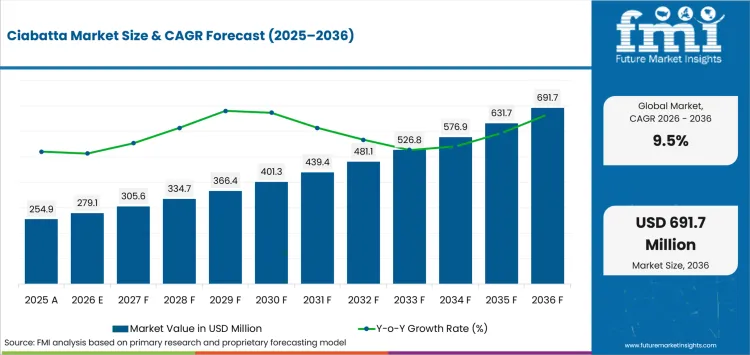
Market Size (2026)
USD 279.1 Mn
Forecast (2036)
USD 691.7 Mn
CAGR (2026 to 2036)
9.5%
How big is Ciabatta Market in 2026?
USD 279.1 million in 2026 and USD 691.7 million by 2036 at a 9.5% CAGR.
Demand for ciabatta is projected to expand at 9.5% CAGR between 2026 and 2036, increasing valuation from USD 279.1 million in 2026 to USD 691.7 million by 2036. Restaurant and foodservice activity favors bakery products with artisan texture, consistent portions and no need for full dough production at each outlet. In February 2026, the National Restaurant Association projected USA restaurant and foodservice sales at USD 1.55 trillion for 2026.
Route economics explain why country conversion differs. The Dubai Media Office reported in February 2026 that Dubai welcomed 19.59 million international overnight visitors in 2025. Gulf hospitality therefore rewards frozen bakery supply held close to hotels. European and Japanese channels apply tighter price and texture tests, so repeat purchasing depends on freezer stability, case yield and distributor coverage.
Key Takeaways
- Foodservice sandwich menus and premium retail meals support ciabatta demand, provided suppliers preserve artisan texture without adding difficult kitchen steps.
- Classic / original is projected to account for 30.0% of product type in 2026, owing to broad filling compatibility and familiar sensory cues.
- Conventional is estimated to hold 57.0% of claim / nature in 2026, driven by mainstream price points and established bakery controls.
- Fresh is set to capture 30.0% of format in 2026, attributable to crust, aroma and crumb quality at the point of purchase.
- Staling, excess waste and high-hydration process variation can weaken repeat purchase if case yield or storage performance misses buyer targets.
- Some of the key players in this market include Grupo Bimbo, Flowers Foods, Aryzta, Lantmannen Unibake, Vandemoortele, Yamazaki Baking, Warburtons, King’s Hawaiian, Europastry and St Pierre Groupe.
Analyst Perspective
“Ciabatta earns its premium only if crust, open crumb and portion yield survive the buyer’s storage and finishing routine. Commercial value comes from lowering waste and kitchen labor without asking distributors or operators to carry unnecessary inventory.”
– , Principal Consultant, Future Market Insights
How is the ciabatta market segmented?
The ciabatta market is segmented by product type, claim / nature, format, packaging format, sales channel and region.
Product type covers classic / original, whole grain & seeded, flavored & filled, mini & snacking formats and premium / artisan. Claim / nature covers conventional, clean label, organic, gluten-free and high-protein / fortified. Format covers fresh, frozen, ambient packaged, chilled and par-baked / thaw-and-serve. Packaging format covers multipack, single-serve, family / loaf pack and bulk foodservice. Sales channels include supermarkets & hypermarkets, artisan & specialty bakeries, convenience & forecourt, online & DTC and foodservice distributors.
What makes classic / original central to the product type category?
Classic / original ciabatta gives sandwich and hospitality kitchens a neutral bread base for hot or cold fillings without changing menu identity. USDA Economic Research Service reported in June 2026 that food away from home represented 56.3% of total USA food expenditures in 2025. The service base rewards one bread that can cover panini, table bread and prepared sandwiches.
- Classic / original accounts for 30.0% of product type in 2026, owing to broad menu compatibility and familiar crust-and-crumb expectations.
- Cafés and distributors can change fillings or portion sizes without requalifying the bread base, which limits SKU proliferation and kitchen retraining.
Why does conventional lead the claim / nature category?
Conventional ciabatta keeps the widest addressable base because mainstream bakeries can revise bakery ingredients without entering certified organic or gluten-free controls. In July 2025, Grupo Bimbo stated that 99% of its daily-consumption portfolio, including bread, buns and rolls, was already free from artificial flavors and colorants.
- Conventional represents 57.0% of claim / nature in 2026, attributable to mainstream price points, familiar production controls and broad retail acceptance.
- Large bread programs can adjust selected bread improvers without changing throughput or texture. Bakery mixes can simplify dosing while existing purchasing specifications remain useful. That lets mainstream accounts adopt reformulation without entering a new certification tier.
How does fresh retain the lead in the format category?
Fresh ciabatta wins where crust condition and aroma can be protected from bread production facility to shelf or service counter. Lantmannen Unibake announced a new bread production facility in Örebro in May 2025 at a site producing more than two million bun pieces per day. The expansion illustrates the production control and route density needed for frequent fresh-bakery replenishment.
- Fresh holds 30.0% of format in 2026, driven by immediate sensory quality in bakery, deli and same-day prepared-food occasions.
- Daily volume, short replenishment routes and controlled sell-through are practical requirements because weaker rotation shifts the economics toward frozen or par-baked bread.
What supports multipack within the packaging format category?
Multipack ciabatta fits planned household meals because shoppers often buy enough packaged bread for several sandwiches or shared table use. WRAP’s 2025 household food-management findings for Wales noted that more than 80% of respondents bought larger packs for value. Unit economics therefore influence pack selection alongside household size and expected use.
- Multipack accounts for 34.0% of packaging format in 2026, supported by repeat-use value and portion planning for households and smaller hospitality users.
- The pack performs best if units separate cleanly and storage guidance protects unused bread, since weak resealability can turn a value pack into avoidable waste.
Why do supermarkets & hypermarkets lead the sales channel category?
Supermarkets & hypermarkets can place ciabatta in bakery, packaged bread, chilled meal, or frozen sections, giving one account several merchandising routes. INSEE reported in June 2026 that French supermarket activity rose 2.2% in volume during 2025. French supermarket growth favors bakeries that can manage several pack sizes without losing shelf economics.
- Supermarkets & hypermarkets hold 41.0% of sales channel in 2026, owing to household reach and room for fresh, ambient and bake-off offers under one retailer.
- Private label, promotion calendars and centralized replenishment can widen distribution quickly, but listings depend on date life, case efficiency and service levels.
What are the drivers, restraints and opportunities in the Ciabatta Market?
Foodservice menu demand supports volume, staling and production variability limit repeat purchase and par-baked supply offers the clearest route to lower kitchen labor.
- Driver: Restaurant and prepared-food menus need distinctive sandwich carriers that preserve speed, portion control and reliable case economics.
- Restraint: Staling, household waste and high-hydration process variation reduce margin if products miss their shelf-life or shape targets.
- Opportunity: Frozen and par-baked supply can shift difficult dough work upstream and let operators finish crust close to service.
Restaurant operators need sandwich carriers that feel differentiated without slowing high-volume preparation. In August 2026, the National Restaurant Association reported that USA eating-and-drinking-place sales were 5.0% above the prior July, showing a large service channel still competing for traffic and menu value. Ciabatta converts that demand if bakeries supply consistent slice geometry, crust recovery and case yield that chains can cost before rollout.
Ciabatta loses margin if a premium loaf stales before sale or high-hydration dough misses its intended shape. WRAP’s March 2026 survey found self-reported waste of bread, milk, chicken and potatoes fell from 21% in 2024 to 18.8% in 2025, with bread showing the strongest improvement. Retailers can protect sell-through with clearer portioning, freezing guidance and replenishment that matches household use.
Par-baked bread shifts mixing, fermentation and shaping to a bakery while final crust develops near service. ARYZTA opened a new Perth bakery in August 2026, adding local convenience-bakery production in Australia and shortening the distance between production and customer accounts. Frozen dough and finished frozen cases reduce scratch preparation, but each ciabatta specification still needs clear finishing instructions and enough local stock to prevent emergency substitutions.
Which country CAGRs are profiled in the Ciabatta Market?

| Country | CAGR |
|---|---|
| UAE | 10.8% |
| Saudi Arabia | 10.5% |
| South Korea | 10.2% |
| USA | 9.9% |
| Germany | 9.5% |
| UK | 9.2% |
| France | 8.9% |
| Japan | 8.6% |
How do country-level CAGRs compare in the Ciabatta Market?
The 2.2-percentage-point spread from UAE at 10.8% to Japan at 8.6% separates three faster service-led markets from mature bakery channels. UAE, Saudi Arabia and South Korea exceed 10.0%, while USA and Germany form the middle. UK, France and Japan grow more slowly. The range is narrow enough that channel fit should guide rollout before CAGR ranking.
- UAE rewards Gulf-held frozen inventory.
- Saudi programs require halal-ready import distribution.
- South Korean menus reward compact trials.
- US chains prioritize case yield.
- German listings scrutinize price and traceability.
- UK retailers scrutinize shelf-life performance.
- French bakery density raises sensory expectations.
- Japanese channels favor compact portions.
Similar CAGRs can hide different channel costs. The full report provides country-level CAGR analysis across North America, Latin America, Western Europe, Eastern Europe, East Asia, South Asia and Pacific and Middle East and Africa.
Country-wise Analysis
- Hotel and premium-grocery accounts in the UAE rely on importers that hold frozen stock near Dubai and Abu Dhabi, where international menus change frequently and weekend demand can shift case requirements quickly. The Ministry of Economy and Tourism reported in April 2026 that UAE hotels hosted 32.34 million guests in 2025; ciabatta demand is predicted to advance at 10.8% CAGR through 2036 owing to sustained hospitality turnover and menu variety. Gulf cold storage lowers kitchen labor for short-bake formats, yet fragmented orders and heavy imported-bread competition compress case margins, so distributors need clear thawing instructions, scheduled replenishment and account training before trial quantities become routine purchasing.
- Saudi hotels and restaurant groups source specialty bread through importers that manage halal documentation, Arabic labeling and inland delivery to major tourism destinations where international menus raise demand for sandwich formats. Distributor coverage gives large hospitality accounts a workable supply route, though cold-chain cost and uneven outlet training can damage thaw-and-finish consistency and make staged launches safer outside Riyadh, Jeddah and major resort areas. By 2036, Saudi Arabia is projected to grow at 10.5% CAGR helped by tourism-led menu expansion; the General Authority for Statistics counted 115.9 million domestic and inbound tourists in 2024 in its 2025 livability report.
- Rapid menu turnover in South Korea pushes urban cafés, delivery-led food concepts and convenience channels to test compact bakery quantities before wider rollout, especially for premium sandwich and brunch menus. Statistics Korea documented 14.6% year-over-year growth in online food-service transactions for March 2025; South Korea is estimated to post 10.2% CAGR over the forecast period tied to rapid digital ordering and product testing. Local distributors can place small launch volumes efficiently, but fast SKU rotation and strict portion expectations shorten the proof window and favor sliced formats with localized toppings, reliable thawing instructions and cautious inventory expansion beyond metropolitan accounts.
- National restaurant chains in the USA qualify sandwich bread through broadline distributors and direct bakery programs that test slice recovery, case yield, reheating tolerance and service consistency before approving a multi-unit specification. USDA Economic Research Service data published in June 2026 put food-away-from-home spending at 4.9% of disposable personal income in 2025, giving ciabatta a large but cost-sensitive commercial channel with strong distributor reach. The USA outlook is anticipated to advance at 9.9% CAGR over the assessment period because pre-sliced frozen rolls fit multi-unit kitchens. Freight distance and reheating losses still penalize weak specifications and require common finishing instructions plus disciplined inventory placement before national rollout.
- Concentrated grocery purchasing in Germany puts case price, traceability, replenishment reliability and documentation under scrutiny before a new bakery SKU receives space, while foodservice accounts also test finishing time against labor cost. Germany is estimated to post 9.5% CAGR over the forecast period given established bake-off use and European frozen-bakery capacity, although discount pressure makes slow-moving lines difficult to defend. Destatis reported in July 2026 that real German gastronomy turnover in May was 7.1% below the prior year, which raises price sensitivity and favors smaller cases plus nearby EU production that shortens replenishment and protects crust quality during routine service.
- UK supermarkets manage bread against shelf life, promotion, waste and online availability while packaged bakery competes with fresh in-store lines for the same shopping trip and foodservice operators weigh frozen cases against daily labor. ONS data released in January 2026 show online spending values at food stores rose 8.4% in the fourth quarter of 2025 from a year earlier, widening digital reach without removing date-life pressure. Ciabatta sales in the UK are forecast to expand at 9.2% CAGR by 2036 on the back of grocery and foodservice demand. Resealable packs and frozen cases reduce waste exposure for accounts that cannot sustain daily fresh replenishment.
- Independent French bakeries set a high sensory benchmark, while lunch service gives artisan points of sale frequent sandwich occasions that industrial ciabatta must match on crust, portion size and service speed. Adoption of ciabatta in France is estimated to expand at 8.9% CAGR through 2036 attributable to prepared-lunch demand; INSEE’s August 2026 local-data release counted 48,344 bakery and pastry shops in metropolitan France for 2025. Dense local comparison gives entrants a route through bakery-led prepared food, but baguette habits reward localized crust and smaller sandwich units, making distributor-led account tests more safely staged than one national specification during launch.
- Dense convenience, supermarket and bakery networks in Japan renew products frequently, favor compact portions and test premium texture against short selling windows, which puts strong pressure on launch timing and freshness control. Japan’s Statistics Bureau reported in February 2026 that real consumption spending among two-or-more-person households rose 0.9% in 2025, a modest backdrop that keeps premium bakery value tests strict. Demand in Japan is forecast to rise at 8.6% CAGR over the forecast period supported by premium sandwich occasions.
Who are the notable companies in the Ciabatta Market?
Grupo Bimbo, Flowers Foods, Aryzta, Lantmannen Unibake, Vandemoortele, Yamazaki Baking, Warburtons, King’s Hawaiian, Europastry and St Pierre Groupe are notable companies serving this market.
Competition separates into frozen bake-off specialists, packaged-bread networks and specialty brands. Aryzta, Lantmannen Unibake, Vandemoortele and Europastry have the clearest frozen-bakery position. Grupo Bimbo, Flowers Foods, Yamazaki Baking and Warburtons bring broad retail routes. King’s Hawaiian and St Pierre occupy specialty positions. St Pierre is part of Grupo Bimbo. Entry barriers center on consistency and account qualification.
- Aryzta, Lantmannen Unibake, Vandemoortele and Europastry concentrate on frozen, bake-off, or foodservice bakery supply.
- Grupo Bimbo, Flowers Foods, Yamazaki Baking and Warburtons bring scaled bread production and retail distribution.
- King’s Hawaiian and St Pierre Groupe compete for premium sandwich and specialty-bread shelf space.
Competitive Benchmarking: Ciabatta Market
| Company | Frozen / Bake-off Capability | Retail & Foodservice Coverage | Bread Portfolio Depth | Geographic Reach |
|---|---|---|---|---|
| Grupo Bimbo | Low | High | High | Global |
| Flowers Foods | Medium | Medium | High | United States |
| Aryzta | High | High | High | Europe, Asia, Australia and New Zealand |
| Lantmannen Unibake | High | High | High | Europe and 60+ markets |
| Vandemoortele | High | High | High | Europe, United States and exports |
| Yamazaki Baking | Medium | High | High | Japan, Asia, North America and Europe |
| Warburtons | Low | Medium | High | United Kingdom |
| King’s Hawaiian | Low | High | Medium | North America and Japan |
| Europastry | High | High | High | Europe, Americas and international markets |
| St Pierre Groupe | Low | High | Medium | UK, USA, Europe and Middle East |
Scoring basis: High frozen capability requires multiple documented frozen or bake-off operations. Medium requires one route and Low denotes documented activity without a dedicated bake-off platform. Channel coverage is High for both retail and foodservice or wholesale, Medium for one primary route and Low for limited access. Portfolio depth is High at three bread families, Medium at two and Low at one.
Key Developments in the Ciabatta Market
- In January 2026, Aryzta announced a new bun bakery in Portugal as part of its 2026 capacity program for convenience bakery production.
- In September 2025, Lantmannen Unibake acquired Boboli Benelux, adding a Netherlands bakery and Mediterranean flatbread capability spanning focaccia, pizza, bake-off and chilled technologies.
- In February 2025, Vandemoortele acquired Lizzi in Italy, adding four production sites serving retail and HoReCa customers with bread, pizza, focaccia and other frozen bakery products.
Key Players in the Ciabatta Market
Frozen and Bake-off Bakery Platforms
- Aryzta
- Lantmannen Unibake
- Vandemoortele
- Europastry
Scaled Packaged Bakery Networks
- Grupo Bimbo
- Flowers Foods
- Yamazaki Baking
- Warburtons
Premium Specialty Bread Brands
- King’s Hawaiian
- St Pierre Groupe
Ciabatta Market – Report Scope
| Coverage field | Report scope |
|---|---|
| Market breakdown | By product type, claim / nature, format, packaging format, sales channel and region. |
| Quantitative Units | USD million. |
| Market Definition | Commercial ciabatta bread sold through retail, foodservice, bakery, distribution and online channels in fresh, frozen, ambient, chilled and par-baked formats. |
| Regions Covered | North America, Latin America, Western Europe, Eastern Europe, East Asia, South Asia and Pacific and Middle East and Africa. |
| Countries Covered | USA, Germany, France, UK, Saudi Arabia, UAE, Japan, South Korea and 20+ countries included in the full report. |
| Key Companies Profiled | Grupo Bimbo, Flowers Foods, Aryzta, Lantmannen Unibake, Vandemoortele, Yamazaki Baking, Warburtons, King’s Hawaiian, Europastry and St Pierre Groupe. |
| Forecast Period | 2026 to 2036. |
| Approach | Primary and secondary research with market triangulation. |
Ciabatta Market – Research Methodology
| Method | Approach |
|---|---|
| Primary Research | FMI analysts gathered input from manufacturers, service providers, technology developers, distributors, end users, procurement teams and subject-matter experts. Interviews examined purchasing decisions, product or service evaluation, adoption barriers, approval requirements, pricing considerations and expectations for technical or commercial support. Respondents were also asked what evidence is required before a trial, pilot, or initial order develops into regular purchasing. |
| Desk Research | Desk research covered government statistics, regulatory publications, trade data, industry associations, technical literature, standards, company filings, product information and official corporate announcements. Sources were reviewed for relevance, publication date, geographic coverage and consistency with the defined market scope. Claims relating to performance, applications, approvals, capacity, investment and commercial activity were retained only when supported by credible public evidence. |
| Market Sizing and Forecasting | The market model combined the baseline value with historical performance, segment structure, pricing and volume indicators, adoption levels, company participation and country-level demand conditions. Forecast assumptions considered economic activity, investment trends, regulatory developments, technology adoption, purchasing cycles, supply availability and barriers to wider market use. Segment and regional estimates were reconciled before the final market total was calculated. |
| Data Validation | Estimates were checked against multiple independent indicators, including public data, company activity, trade patterns, industry developments and findings from primary interviews. Validation also tested whether products, services, applications and company revenues fell within the defined market boundaries. Adjacent categories, unsupported claims, overlapping revenues and activities without direct market relevance were excluded to reduce double counting and maintain consistency across segments and countries. |
Ciabatta Market by Segments
Ciabatta Market segmented by Product Type:
- Classic / original
- Whole grain & seeded
- Flavored & filled
- Mini & snacking formats
- Premium / artisan
Ciabatta Market segmented by Claim / Nature:
- Conventional
- Clean label
- Organic
- Gluten-free
- High-protein / fortified
Ciabatta Market segmented by Format:
- Fresh
- Frozen
- Ambient packaged
- Chilled
- Par-baked / thaw-and-serve
Ciabatta Market segmented by Packaging Format:
- Multipack
- Single-serve
- Family / loaf pack
- Bulk foodservice
Ciabatta Market segmented by Sales Channel:
- Supermarkets & hypermarkets
- Artisan & specialty bakeries
- Convenience & forecourt
- Online & DTC
- Foodservice distributors
Ciabatta Market by Region:
- North America
- United States
- Canada
- Latin America
- Brazil
- Mexico
- Argentina
- Chile
- Western Europe
- Germany
- France
- United Kingdom
- Italy
- Spain
- Benelux
- Nordics
- Eastern Europe
- Poland
- Czech Republic
- Romania
- Hungary
- East Asia
- China
- Japan
- South Korea
- South Asia and Pacific
- India
- ASEAN
- Australia and New Zealand
- Middle East and Africa
- GCC Countries
- South Africa
- Türkiye
- Israel
Research Sources and Bibliography
- National Restaurant Association. (2026, February 11). State of the Restaurant Industry 2026.
- Dubai Media Office. (2026, February 9). Dubai’s tourism industry achieves third successive record-breaking year.
- USA Department of Agriculture, Economic Research Service. (2026, June 11). Total USA food spending reached $2.51 trillion in 2025.
- Grupo Bimbo. (2025, July 29). We are committed to removing artificial colorants from all our products by the end of 2026.
- Lantmännen. (2025, May 28). Lantmännen makes strategic and long-term investment in new production facility for bread.
- WRAP. (2025). Household Food Management Survey in Wales 2025.
- INSEE. (2026, June 18). Le compte du commerce en 2025.
- National Restaurant Association. (2026, August 14). Total restaurant industry sales.
- WRAP. (2026, March 9). Understanding household food waste in the UK: the Household Food Management Survey 2025.
- ARYZTA. (2026, August 26). New Perth bakery officially opened.
- Ministry of Economy & Tourism – UAE. (2026, April 13). Emirates Tourism Council discusses new action plans to enhance the growth and resilience of the sector in the coming period.
- General Authority for Statistics. (2026). Livability in Saudi Cities 2025.
- Statistics Korea. (2025, May 1). Online Shopping in March 2025.
- USA Department of Agriculture, Economic Research Service. (2026, June 1). USA consumers spent 9.7 percent of their disposable personal income on food in 2025.
- Federal Statistical Office of Germany. (2026, July 21). Gastgewerbeumsatz im Mai 2026 real 2,0 % niedriger als im Vormonat.
- Office for National Statistics. (2026, January 23). Retail sales, Great Britain: December 2025.
- INSEE. (2026, August 27). Full set of local data – France métropolitaine.
- Statistics Bureau of Japan. (2026, February 6). Family Income and Expenditure Survey: 2025 Yearly Average.
- ARYZTA. (2026, January 22). Full year 2025 targets achieved; revenue growth and improved performance expected in 2026; new bun bakery in Portugal.
- Lantmännen. (2025, September 1). Lantmännen Unibake expands in savoury with acquisition of Boboli Benelux B.V..
- Vandemoortele. (2025, February 14). Vandemoortele acquires Lizzi in Italy, a specialty player in frozen bakery.
- Flowers Foods. (2026). Flowers Foods 2025 Annual Report.
- ARYZTA. (2026, March 2). ARYZTA AG 2025 annual results.
- Lantmännen. (2026). Annual Report with Sustainability Report 2025.
- Vandemoortele. (n.d.). Conscious Nutrition.
- Yamazaki Baking. (2026). Company Profile.
- Yamazaki Baking. (2026). Overseas Operations.
- Warburtons. (2026). Our Family and Company.
- King’s Hawaiian. (2026). Frequently Asked Questions.
- Europastry. (2026). Group: frozen bakery operations and international reach.
- Grupo Bimbo. (n.d.). About us.
- St Pierre. (n.d.). Contact.
- Lantmännen. (2025, December 23). Lantmännen Unibake signs agreement to expand in Italy.
- Europastry. (2026, June 23). Europastry to acquire Highland Baking Company to strengthen its presence in North America.
- Flowers Foods. (2025, October 27). Flowers Foods taps into higher-protein and sourdough trends with new products.
- Warburtons. (2026). Packaging Redesign Unveiled.
- King’s Hawaiian Japan. (2025, October 7). First pop-up KING’S ORANGE ISLAND special site opens.
- Grupo Bimbo. (2026, May 12). We achieved Positive Nutrition across 98% of our daily consumption portfolio.
- Flowers Foods. (2025, April 16). Flowers Foods launches new products and line expansions to meet consumer needs.
- ARYZTA. (2026, June 23). ARYZTA acquires French distribution business.
- Lantmännen. (2026, March 2). Lantmännen completes the acquisition of Leipurin.
- Vandemoortele. (2026, August 20). Meet our newest healthy hero: the High Protein Bun.
- King’s Hawaiian Japan. (2025, May 12). 日本向けサイトオープン!.
This bibliography is provided for reader reference and is not exhaustive. The full report contains the complete reference list and detailed citations.
This Report Answers
- How large is ciabatta in 2026 and 2036?
- What supports the 9.5% CAGR through 2036?
- Why does classic / original lead product type?
- Why does conventional lead claim / nature?
- Why does fresh lead format?
- Why do supermarkets & hypermarkets lead sales channels?
- Which profiled countries grow fastest through 2036?
- Which companies hold material ciabatta positions?
Frequently Asked Questions
How big is the ciabatta market in 2026?
The ciabatta market is valued at USD 279.1 million in 2026 and is projected to reach USD 691.7 million by 2036. Foodservice sandwiches and premium retail meals support expansion.
What is the CAGR of the ciabatta market from 2026 to 2036?
The ciabatta market is projected to grow at a CAGR of 9.5% between 2026 and 2036. Expansion depends on artisan texture that fits standardized foodservice preparation and retail distribution.
Which product type leads the ciabatta market?
The classic / original segment is expected to hold 30.0% of the ciabatta market by product type in 2026, driven by broad filling compatibility. Its neutral flavor lets buyers use one bread base for several meal occasions.
Which countries are projected to record the highest growth in the ciabatta market?
UAE is projected to grow at 10.8% CAGR, followed by Saudi Arabia at 10.5% and South Korea at 10.2% through 2036. Hospitality demand, restaurant expansion and rapid menu renewal shape the faster profiled markets.
Which companies are active in the ciabatta market?
Key companies operating in the market include Grupo Bimbo, Flowers Foods, Aryzta, Lantmannen Unibake, Vandemoortele, Yamazaki Baking, Warburtons, King’s Hawaiian, Europastry and St Pierre Groupe. Their positions differ by frozen bakery capability, retail reach, foodservice access and specialty-bread focus.
Preview the report firsthand – request a free sample
Get the brochure for pricing and purchase details.
