

Abstract
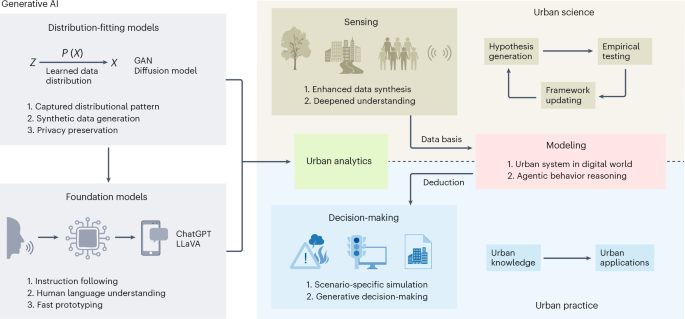
Cities are changing faster than the tools used to understand them. A new generation of AI can now synthesize images, model aspects of human behavior and reason across heterogeneous data—capabilities that are beginning to reshape how researchers and practitioners observe, model and support decisions about urban life. Here, in this Review, we explore what these tools can genuinely offer, where the evidence is strong and where it remains thin. The answer depends less on technical novelty than on whether generative AI can be evaluated honestly, validated in context and deployed in ways that keep human judgment and accountability at the center.
This is a preview of subscription content, access
Access options
- Purchase on SpringerLink
- Instant access to the full article PDF.
Prices may be subject to local taxes which are calculated during checkout
References
-
Bettencourt, L. M. A. Introduction to Urban Science: Evidence and Theory of Cities as Complex Systems (MIT Press, 2021).
-
Batty, M. The Computable City: Histories, Technologies, Stories, Predictions (MIT Press, 2024).
-
Batty, M. Big data, smart cities and city planning. Dialogues Hum. Geogr.3, 274–279 (2013).
-
Stiny, G. & Gips, J. Shape grammars and the generative specification of painting and sculpture. In IFIP Congress vol. 2, 125–135 (Citeseer, 1971).
-
Alexander, C., Ishikawa, S. & Silverstein, M. A Pattern Language: Towns, Buildings, Construction (Oxford Univ. Press, 1977).
-
White, R. & Engelen, G. Cellular automata and fractal urban form: a cellular modelling approach to the evolution of urban land-use patterns. Environ. Plann. A25, 1175–1199 (1993).
-
Schelling, T. C. Dynamic models of segregation. J. Math. Sociol.1, 143–186 (1971).
-
Zhang, Y. et al. Metacity: data-driven sustainable development of complex cities. Innovation6, 100775 (2025).
-
Goodfellow, I. J. et al. Generative adversarial nets. In Advances in Neural Information Processing Systems27, 2672–2680 (NeurIPS, 2014).
-
Ho, J., Jain, A. & Abbeel, P. Denoising diffusion probabilistic models. Adv. Neural Inf. Process. Syst.33, 6840–6851 (2020).
-
Wang, Q. et al. Generative ai for urban planning: synthesizing satellite imagery025)
-
Ouyang, L. et al. Training language models to follow instructions with human feedback. Adv. Neural Inf. Process. Syst.35, 27730–27744 (2022).
-
Achiam, J. et al. GPT-4 technical report. Preprint at https://arxiv.org/abs/2303.08774 (2023).
-
Gao, C. et al. Large language models empowered agent-based modeling and simulation: a survey and perspectives. Humanit. Soc. Sci. Commun.11, 1259 (2024).
-
Wang, J. et al. Large language models as urban residents: an LLM agent framework for personal mobility generation. In Proc. 38th Annual Conference on Neural Information Processing Systems, 124547–124574 (NeurIPS, 2024).
-
Zhou, Z., Lin, Y., Jin, D. & Li, Y. Large language model for participatory urban planning. Preprint at https://arxiv.org/abs/2402.17161 (2024).
-
Huang, L. et al. A survey on hallucination in large language models: principles, taxonomy, challenges, and open questions. ACM Trans. Inf. Syst.43, 1–55 (2025).
-
Agarwal, M. et al. General geospatial inference with a population dynamics foundation model. Preprint at https://arxiv.org/abs/2411.07207 (2024).
-
Tuia, D. et al. Artificial intelligence to advance earth observation: a review of models, recent trends, and pathways forward. IEEE Geosci. Remote Sens. Mag.13, 119–141 (2025).
-
Batty, M. Digital twins in city planning. Nat. Comput. Sci.4, 192–199 (2024).
-
Zheng, Y. et al. Spatial planning of urban communities23)
-
Fu, X., Li, C., Quan, S. J., Yigitcanlar, T. & Wasserman, D. Large language models in urban planning. Nat. Cities2, 585–592 (2025).
-
Taeihagh, A. Governance of generative ai. Policy Soc.44, 1–22 (2025).
-
Kronblad, C., Essén, A. & Mähring, M. When justice is blind to algorithms: multilayered blackboxing of algorithmic decision-making in the public sector. MIS Quart.48, 1637–1662 (2024).
-
Wilson, A. G. A family of spatial interaction models, and associated developments. Environ. Plann. A3, 1–32 (1971).
-
Ben-Akiva, M. E. & Lerman, S. R. Discrete Choice Analysis: Theory and Application to Travel Demand Vol. 9 (MIT Press, 1985).
-
Bonabeau, E. Agent-based modeling: methods and techniques for simulating human systems. Proc. Natl Acad. Sci. USA99, 7280–7287 (2002).
-
Lighthill, M. J. & Whitham, G. B. On kinematic waves II. A theory of traffic flow on long crowded roads. Proc. R. Soc. A229, 317–345 (1955).
-
Sheffi, Y. Urban Transportation Networks: Equilibrium Analysis with Mathematical Programming Methods (Prentice-Hall, 1985).
-
Arnfield, A. J. Two decades of urban climate research: a review of turbulence, exchanges of energy and water, and the urban heat island. Int. J. Climatol.23, 1–26 (2003).
-
Marchau, V. A., Walker, W. E., Bloemen, P. J. & Popper, S. W. Decision Making under Deep Uncertainty: From Theory to Practice (Springer, 2019).
-
Bettencourt, L. M. A. Recent achievements and conceptual challenges for urban digital twins. Nat. Comput. Sci.4, 150–153 (2024).
-
Khanna, S. et al. DiffusionSat: a generative foundation model for satellite imagery. In The 12th International Conference on Learning Representations, 5586–5604 (ICLR, 2024).
-
Yu, Z., Liu, C., Liu, L., Shi, Z. & Zou, Z. MetaEarth: a generative foundation model for global-scale remote sensing image generation. IEEE Trans. Pattern Anal. Mach. Intell.47, 1764–1781 (2024).
-
Xu, E. et al. A survey of physics-informed AI for complex urban systems. Inf. Fusion129, 104012 (2026).
-
Jankovic, B., Jangirova, S., Ullah, W., Khan, L. U. & Guizani, M. UAV-assisted real-time disaster detection using optimized transformer model. In 2025 IEEE Symposium on Computers and Communications 1–7 (IEEE, 2025).
-
Berke, A., Doorley, R., Larson, K. & Moro, E. Generating synthetic mobility data for a realistic population with rnns to improve utility and privacy. In Proc. 37th ACM/SIGAPP Symposium on Applied Computing 964–967 (2022).
-
Feng, J. et al. CityBench: evaluating the capabilities of large language models for urban tasks. Proc. 31st ACM SIGKDD Conference on Knowledge Discovery and Data Mining, 5413–5424 (ACM, 2025).
-
Xuan, W. et al. DynamicVL: benchmarking multimodal large language models for dynamic city understanding. In The 39th Annual Conference on Neural Information Processing Systems Datasets and Benchmarks Track, https://neurips.cc/virtual/2025/loc/san-diego/poster/121371 (Curran Associates, 2025).
-
Zhan, Y., Xiong, Z. & Yuan, Y. Skyeyegpt: unifying remote sensing vision–language tasksgramm. Remote Sens.221, 64–77 (2025)
-
Yuan, Y., Wang, H., Ding, J., Jin, D. & Li, Y. Learning to simulate daily activities23, 906–916 (Association for Computing Machinery, 2023)
-
Zhang, Y., Ma, R., Zhang, X. & Li, Y. Perceiving urban inequality from imagery using visual language models with chain-of-thought reasoning. In Proc. ACM on Web Conference 2025, 5342–5351 (Association for Computing Machinery, 2025).
-
Paolanti, M. et al. Ethical framework to assess and quantify the trustworthiness of artificial intelligence techniques: application case in remote sensing. Remote Sens.16, 4529 (2024).
-
Koldasbayeva, D. et al. Challenges in data-driven geospatial modeling for environmental research and practice. Nat. Commun.15, 10700 (2024).
-
Manvi, R., Khanna, S., Burke, M., Lobell, D. B. & Ermon, S. Large language models are geographically biased. In Proc. 41st Int. Conf. Mach. Learn. 235, 34654–34669 (PMLR, 2024).
-
Hall, M. et al. Towards geographic inclusion in the evaluation of text-to-image models. In Proc. 2024 ACM Conference on Fairness, Accountability, and Transparency, 585–601 (Association for Computing Machinery, 2024).
-
Ma, Y., Chen, S., Ermon, S. & Lobell, D. B. Transfer learning in environmental remote sensing. Remote Sens. Environ.301, 113924 (2024).
-
Cheng, Y. et al. Exploring large language model based intelligent agents: definitions, methods, and prospects. Preprint at https://arxiv.org/abs/2401.03428 (2024).
-
Sun, Y. Q. et al. Can AI weather models predict out-of-distribution gray swan tropical cyclones? Proc. Natl Acad. Sci. USA122, e2420914122 (2025).
-
Papyshev, G. & Yarime, M. Exploring city digital twins as policy tools: a task-based approach to generating synthetic data on urban mobility. DataPolicy3, e16 (2021).
-
Hofmann, J. & Schüttrumpf, H. Floodgan: using deep adversarial learning to predict pluvial flooding in real time. Water13, 2255 (2021).
-
Camps-Valls, G. et al. Artificial intelligence for modeling and understanding extreme weather and climate events. Nat. Commun.16, 1919 (2025).
-
Zeng, J. et al. Opencarbon: a contrastive learning-based cross-modality neural approach for high-resolution carbon emission prediction using open data. In Proc. 34th International Joint Conference on Artificial Intelligence 9999–10007 (IJCAI, 2025).
-
Gao, J. et al. GenFusion: crafting future urban building layouts(2025)
-
Li, Y. et al. Generative models in decision making: a survey. Preprint at https://arxiv.org/abs/2502.17100 (2025).
-
Ding, W., Chen, B., Xu, M. & Zhao, D. Learning to collide: an adaptive safety-critical scenarios generating method. In 2020 IEEE/RSJ International Conference on Intelligent Robots and Systems, 2243–2250 (IEEE, 2020).
-
Yuan, Y., Ding, J., Wang, H. & Jin, D. Generating daily activities with need dynamics. ACM Trans. Intell. Syst. Technol.15, 1–28 (2024).
-
Yuan, Y., Ding, J., Jin, D. & Li, Y. Learning the complexity of urban mobility with deep generative network. PNAS Nexus4, pgaf081 (2025).
-
Park, J. S. et al. Generative agents: interactive simulacra of human behavior. In Proc. 36th Annual ACM Symposium on User Interface Software and Technology (eds Follmer, S. et al.) 1–22 (ACM, 2023).
-
Piao, J. et al. AgentSociety: large-scale simulation of LLM-driven generative agents advances understanding of human behaviors and society. Preprint at https://arxiv.org/abs/2502.08691 (2025).
-
Tao, Y., Viberg, O., Baker, R. S. & Kizilcec, R. F. Cultural bias and cultural alignment of large language models. PNAS Nexus3, pgae346 (2024).
-
Park, J. S. et al. Social simulacra: creating populated prototypes for social computing systems. In Proc. 35th Annual ACM Symposium on User Interface Software and Technology, 1–18 (Association for Computing Machinery, 2022).
-
Yan, Y. et al. Opencity: a scalable platform to simulate urban activities with massive LLM agents. Preprint at https://arxiv.org/abs/2410.21286 (2024).
-
Yang, Z. et al. Oasis: open agent social interaction simulations with one million agents. Preprint at https://arxiv.org/abs/2411.11581 (2024).
-
Chopra, A., Kumar, S., Kuru, N. G., Raskar, R. & Quera-Bofarull, A. On the limits of agency in agent-based models. In Proc. 24th International Conference on Autonomous Agents and Multiagent Systems, 500–509 (International Foundation for Autonomous Agents and Multiagent Systems, 2025).
-
Hüllermeier, E. & Waegeman, W. Aleatoric and epistemic uncertainty in machine learning: an introduction to concepts and methods. Mach. Learn.110, 457–506 (2021).
-
Kashinath, K. et al. Physics-informed machine learning: case studies for weather and climate modelling. Philos. Trans. R. Soc. A379, 20200093 (2021).
-
Kapoor, S. et al. Reforms: consensus-based recommendations for machine-learning-based science. Sci. Adv.10, eadk3452 (2024).
-
Xu, H. et al. Leveraging generative ai for urban digital twins: a scoping review on the autonomous generation of urban data, scenarios, designs, and 3D city models for smart city advancement. Urban Inform.3, 29 (2024).
-
Zheng, Y. et al. A survey of machine learning for urban decision making: applications in planning, transportation, and healthcare. ACM Comput. Surv.57, 1–41 (2024).
-
Ravuri, S. et al. Skilful precipitation nowcasting using deep generative models of radar. Nature597, 672–677 (2021).
-
Otal, H. T., Stern, E. & Canbaz, M. A. LLM-assisted crisis management: building advanced LLM platforms for effective emergency response and public collaboration. In 2024 IEEE Conference on Artificial Intelligence, 851–859 (IEEE, 2024).
-
Zhang, G., Yu, Z., Jin, D. & Li, Y. Physics-infused machine learning for crowd simulation. In Proc. 28th ACM SIGKDD Conference on Knowledge Discovery and Data Mining, 2439–2449 (Association for Computing Machinery, 2022).
-
Chen, L. et al. Strategic COVID-19 vaccine distribution can simultaneously elevate social utility and equity. Nat. Hum. Behav.6, 1503–1514 (2022).
-
Zhang, J., Ao, W., Yan, J., Jin, D. & Li, Y. A GPU-accelerated large-scale simulator for transportation system optimization benchmarking. Preprint at https://arxiv.org/abs/2406.10661 (2024).
-
Zhang, H. et al. Cityflow: a multi-agent reinforcement learning environment for large scale city traffic scenario. In The World Wide Web Conference, 3620–3624 (Association for Computing Machinery, 2019).
-
Chen, H. et al. DiffLight: a partial rewards conditioned diffusion model for traffic signal control with missing data. In Proc. 38th Annual Conference on Neural Information Processing Systems (NeurIPS), 123353–123378 (NeurIPS, 2024).
-
Hu, X. et al. Dual-stage flows-based generative modeling for traceable urban planning. In Proc. 2024 SIAM International Conference on Data Mining (eds Shekhar, S. et al.) 370–378 (SIAM, 2024).
-
Busuioc, M. Accountable artificial intelligence: holding algorithms to account. Public Adm. Rev.81, 825–836 (2021).
-
Green, B. The flaws of policies requiring human oversight of government algorithms. Comput. Law Secur. Rev.45, 105681 (2022).
-
Alon-Barkat, S. & Busuioc, M. Human–AI interactions in public sector decision making: automation bias and selective adherence to algorithmic advice. J. Public Adm. Res. Theory33, 153–169 (2023).
-
Raji, I. D. et al. Closing the ai accountability gap: defining an end-to-end framework for internal algorithmic auditing. In Proc. 2020 Conference on Fairness, Accountability, and Transparency, 33–44 (Association for Computing Machinery, 2020).
-
Suresh, H. & Guttag, J. A framework for understanding sources of harm throughout the machine learning life cycle. In Proc. 1st ACM Conference on Equity and Access in Algorithms, Mechanisms, and Optimization, 1–9 (Association for Computing Machinery, 2021).
-
Chattopadhyay, A. & Hassanzadeh, P. Long-term instabilities of deep learning-based digital twins of the climate system: the cause and a solution. Preprint at https://arxiv.org/abs/2304.07029 (2023).
-
Baykurt, B. Algorithmic accountability in US cities: transparency, impact, and political economy. Big Data Soc.9, 20539517221115426 (2022).
-
Rong, C., Ding, J., Liu, Y. & Li, Y. A large-scale dataset and benchmark for commuting origin–destination flow generation. In The 13th International Conference on Learning Representations, https://neurips.cc/virtual/2025/loc/san-diego/poster/121846 (NeurIPS, 2025).
-
Feng, J. et al. Citygpt: empowering urban spatial cognition of large language models. In Proc. 31st ACM SIGKDD Conference on Knowledge Discovery and Data Mining V.2, 591–602 (Association for Computing Machinery, 2025).
-
Feng, J., Wang, S., Liu, T., Xi, Y. & Li, Y. UrbanLLaVA: a multi-modal large language model for urban intelligence with spatial reasoning and understanding. In Proc. IEEE/CVF International Conference on Computer Vision, 6209–6219 (IEEE, 2025).
-
Karniadakis, G. E. et al. Physics-informed machine learning. Nat. Rev. Phys.3, 422–440 (2021).
-
United Nations, Department of Economic and Social Affairs, Population Division. World urbanization prospects 2018: highlights. un.orghttps://population.un.org/wup/assets/WUP2018-Highlights.pdf (2019).
-
Bettencourt, L. M. & Marchio, N. Infrastructure deficits and informal settlements in sub-Saharan Africa. Nature645, 399–406 (2025).
-
Kuffer, M., Pfeffer, K. & Sliuzas, R. Slums from space—15 years of slum mapping using remote sensing. Remote Sens.8, 455 (2016).
-
da Silva, J. P., Rodrigues-Jr, J. F. & de Albuquerque, J. P. On the power of CNNs to detect slums in Brazil. Comput. Environ. Urban Syst.121, 102306 (2025).
-
Brelsford, C., Martin, T., Hand, J. & Bettencourt, L. M. A. Toward cities without slums: topology and the spatial evolution of neighborhoods. Sci. Adv.4, eaar4644 (2018).
-
Gevaert, C. M., Buunk, T. & Van Den Homberg, M. J. Auditing geospatial datasets for biases: using global building datasets for disaster risk management. IEEE J. Sel. Top. Appl. Earth Obs. Remote Sens.17, 12579–12590 (2024).
-
Chamberlain, H. R. et al. Building footprint data for countries in Africa: to what extent are existing data products comparable?. Comput. Environ. Urban Syst.110, 102104 (2024).
-
Herfort, B., Lautenbach, S., Porto de Albuquerque, J., Anderson, J. & Zipf, A. A spatio-temporal analysis investigating completeness and inequalities of global urban building data in openstreetmap. Nat. Commun.14, 3985 (2023).
-
Lacoste, A. et al. GEO-Bench: toward foundation models for Earth monitoring. Adv Neural Inf. Proc. Syst.36, 51080–51093 (2023).
-
Hong, D. et al. Cross-city matters: a multimodal remote sensing benchmark dataset for cross-city semantic segmentation using high-resolution domain adaptation networks. Remote Sens. Environ.299, 113856 (2023).
-
Vergara-Perucich, J. F. Ai-driven deconstruction of urban regulatory frameworks: unveiling social sustainability gaps in santiago’s communal zoning. Urban Sci.9, 186 (2025).
-
Xie, Y. et al. Fairness by where: a statistically-robust and model-agnostic bi-level learning framework. Proc. AAAI Conf. Artif. Intell.36, 12208–12216 (2022).
-
Gebru, T. et al. Datasheets for datasets. Commun. ACM64, 86–92 (2021).
-
Liu, Y., James, J. Q., Kang, J., Niyato, D. & Zhang, S. Privacy-preserving traffic flow prediction: a federated learning approach. IEEE Internet Things J.7, 7751–7763 (2020).
-
Li, X. & Dang, A. The disruptive effect of ai on urban planning. Nat. Cities2, 568–570 (2025).
-
Sanchez, T. W., Brenman, M. & Ye, X. The ethical concerns of artificial intelligence in urban planning. J. Am. Plann. Assoc.91, 294–307 (2025).
-
Choi, S. L. et al. eGridGPT: Trustworthy AI in the Control Room.NREL/TP-5D00-87440 (National Renewable Energy Laboratory, 2024).
Funding
Y. Li discloses support for the research of this work from The National Key Research and Development Program of China (grant number 2024YFC3307605) and The National Natural Science Foundation of China (grant number 62472241).
Authors and Affiliations
Contributions
Y. Li, Q.R.W., E.M., Y.Y., Y. Liu, D.F., P.G., L.M.A.B. and M.B. conceived the research framework and initial design of the study. Y.Z., F.X. and Y. Li wrote the original draft of the manuscript. F.X. and Y. Li formulated the conceptual framework regarding the emergence of generative AI. M.B. contributed to the historical review of generative models. Y.Y., B.C., Y. Liu and P.G. developed the urban sensing section. Q.R.W., E.M. and D.F. developed the urban modeling section. H.W. developed the decision-making section. Y.Y. and L.M.A.B. contributed to the challenges and future directions sections. Y.Z. integrated inputs from all co-authors and managed the revision process. All authors provided critical revisions and approved the final version of the paper.
Ethics declarations
Competing interests
The authors declare no competing interests.
Peer review
Peer review information
Nature Cities thanks Riccardo Di Clemente, Orlando Woods and the other, anonymous, reviewer(s) for their contribution to the peer review of this work.
Additional information
Publisher’s note Springer Nature remains neutral with regard to jurisdictional claims in published maps and institutional affiliations.
Rights and permissions
Springer Nature or its licensor (e.g. a society or other partner) holds exclusive rights to this article under a publishing agreement with the author(s) or other rightsholder(s); author self-archiving of the accepted manuscript version of this article is solely governed by the terms of such publishing agreement and applicable law.
About this article
Cite this article
Zhang, Y., Xu, F., Wang, Q.R. et al. Generative AI in urban science and practice.
Nat Cities3, 688–699 (2026). https://doi.org/10.1038/s44284-026-00492-2
-
Version of record:05 August 2026
-
DOI
:https://doi.org/10.1038/s44284-026-00492-2
