

Finnish nuclear technology startup Steady Energy is heading for the stock market. The company has just announced that it will combine with investment company 3North Partners (3NP), which will acquire all Steady Energy shares through a share exchange. The combined company then plans an initial public offering on Nasdaq First North Growth Market Finland, the Helsinki exchange’s segment for growth companies. It will be renamed Steady Energy Plc.
Alongside selling complete plants, Steady Energy is betting on a heat-as-a-service (HaaS) model, in which the company owns and operates the reactor itself and sells only the heat it produces to customers such as municipal utilities.
Well over €100 million in funding is lined up for the deal. Institutional and strategic investors have made binding commitments to subscribe for new shares worth around €69.8 million. They include Finnish pension insurers Elo, Ilmarinen and Varma, energy group Fortum, Polish oil company Orlen through its venture capital arm, Finnish state-owned investor Tesi, as well as Mininvest, Move Energy and Yes VC. On top of that comes a convertible loan of up to €40 million from the European Investment Bank (EIB).
Shares at €10 Each
In the IPO itself, 3NP plans to offer up to 500,000 new shares to individuals and companies in Finland, raising up to €5 million. The subscription price is €10 per share. Investors will receive one bonus share for every 15 shares allocated to them.
Once all transactions are complete, there are expected to be around 33.25 million series A shares. Roughly 77 percent will go to Steady Energy’s existing owners and the remaining 23 percent to the new investors. At the offer price of €10, that implies a valuation of around €330 million. If the share price stays above €15 or €25 for a sustained period, the previous owners will each time receive almost 5 million additional shares. The three founders, Tommi Nyman, Hannes Haapalahti and Petteri Tenhunen, have agreed to hold their shares for 36 months, with limited exceptions.
Pekka Lundmark, the former CEO of Nokia, will chair the board. 3NP is backed by well-known names from Finland’s tech scene, including Supercell founder Ilkka Paananen and investor Timo Ahopelto. “With this strong funding and listing behind us, we can focus on finalising the LDR-50 technology and on our first customer projects,” said Steady Energy CEO Tommi Nyman.
The EIB’s First Bet on Small Modular Reactors
The EIB’s €40 million marks the EU lender’s first financing for a company working on small modular reactors (SMRs). The loan will be paid out in two tranches of €30 million and €10 million, carries zero interest and runs for 20 years. The EIB can convert its claim into shares of the listed company. The financing is backed by the EU’s InvestEU programme.
There is a notable Austrian angle: the investment was announced by EIB Vice-President Karl Nehammer, a former chancellor of a country that has rejected nuclear power for decades. “We are actively looking to support Europe’s most promising SMR pioneers,” Nehammer said, according to the EIB. Alongside renewables, he argued, SMRs could supply stable, low-carbon energy and reduce Europe’s reliance on fossil fuels and volatile energy prices.
A Reactor Built Only for District Heating
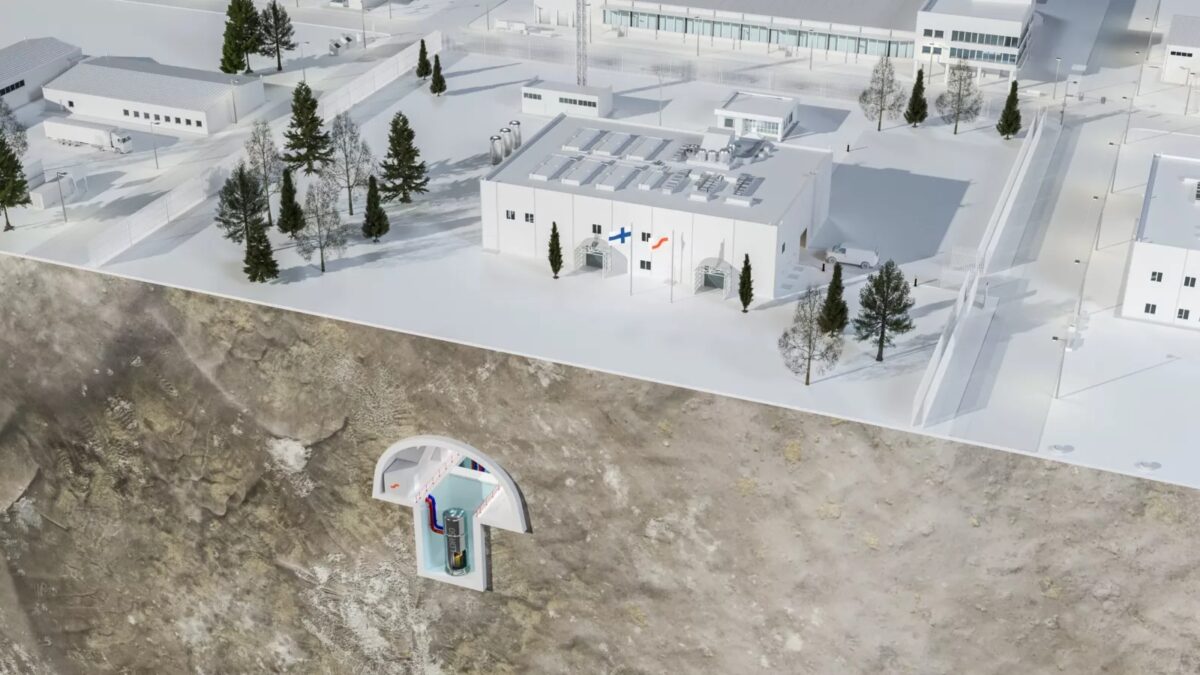
Steady Energy was founded in 2023 as a spin-off from the state-owned Technical Research Centre of Finland (VTT), where the LDR-50 reactor has been under development since 2019. The company now employs around 75 people. The 50-megawatt reactor is designed to supply heat exclusively to district heating networks, whereas most other SMR concepts focus on generating electricity.
Technically, Steady Energy relies on proven light-water technology operating at low temperature and low pressure. Because turbines and generators are not needed, the reactor is meant to be simpler, cheaper and faster to license. Passive safety systems and underground construction are intended to add further safety. The company is currently building a non-nuclear pilot facility in Helsinki, where key safety systems are set to be tested from 2027.
The timeline is ambitious. A political decision-in-principle from the Finnish government for the first commercial plant is expected in 2027 or 2028, followed by a construction license application in 2028 or 2029. Steady Energy aims to start building its first reactor by 2029 or 2030.
What Heat as a Service Means
Steady Energy plans to make money in two ways. Under the classic EPC model (engineering, procurement and construction), it delivers turnkey plants, typically with up to four reactors, to larger utilities, which then own and operate them.
The second model is heat as a service. Here the reactor remains owned by Steady Energy through a dedicated project company. Steady Energy handles licensing, operations and nuclear waste management and simply sells the heat to its customers. Municipal and smaller utilities thus get low-carbon baseload heat without having to own, operate or take responsibility for a nuclear facility. For Steady Energy, this widens the pool of potential customers, since many municipal utilities lack the expertise or the appetite to run a nuclear plant. It also creates recurring revenue over the lifetime of the plants.
The ambitions are big. Steady Energy targets revenue of more than €500 million by 2035 and €1 billion by 2040, with an operating margin of 35 to 40 percent. Management’s scenario assumes 70 reactors that could be delivered between 2033 and 2045, around one third of them under the HaaS model. By 2045, HaaS is expected to account for about half of revenue. Its core markets are Finland, Sweden, Poland and the Czech Republic, where district heating is widespread. There, the company sees potential for 230 to 300 reactors and a market worth around €30 billion. The first preliminary agreements are planned for 2027 or 2028. So far, Steady Energy has no binding orders, and all targets are based on management assumptions.
Austria’s SMR Hope Is Already Listed
In Austria, another SMR company has already tapped the capital markets. Graz-based Emerald Horizon has been listed on the Vienna Stock Exchange since early summer and is valued at around €1.2 billion Emerald Horizon is developing the SMRX, a modular, subcritical, thorium-based energy system. A container-sized module is designed to deliver 25 megawatts of thermal and around 10 megawatts of electrical power and to run for 20 years without refuelling
Emerald Horizon recently started building its so-called power loop in Eindhoven together with Dutch VDL Groep, a long-standing supplier to chip equipment maker ASML. In this high-temperature circuit, molten salt is set to circulate at up to 900 degrees Celsius. A prototype is planned for 2029, with series production from 2031. Research and development will stay in Graz, yet no reactors will run in Austria: the country’s 1978 nuclear ban law prohibits their operation there. For context, no commercial thorium molten salt reactors are in operation anywhere in the world, and the company’s technical claims have not yet been independently verified.
What the EU Is Putting Into SMRs
The EIB loan is part of a broader strategy by the European Commission. In the spring, the Commission presented a plan to bring Europe’s first SMRs and advanced modular reactors (AMRs) online by the early 2030s. By 2050, it considers SMR capacity of 17 to 53 gigawatts in the EU possible. Beyond power generation, it sees applications in district heating, industrial heat, hydrogen production and supplying data centres.
Direct EU funding committed so far is comparatively modest. According to an analysis by Think Tank Europa, the strategy provides around €215 million in targeted support: a temporary €200 million top-up of the InvestEU guarantee for the first commercial units and €15 million for safety research under Euratom. That compares with estimated investment needs of €241 billion for nuclear power across the EU by 2050. Industry association nucleareurope welcomed the plans but stressed that more financial support will be needed.
Most of the money is therefore expected to come from elsewhere: member states, private investors and broader instruments such as the planned Scaleup Europe Fund or potential IPCEI projects. The Commission also offers regulatory relief under the Net-Zero Industry Act, including regulatory sandboxes for SMR projects, as well as so-called “SMR Valleys” to build European supply chains. Austria remains an outlier in this debate: according to Think Tank Europa, it is the only EU country with a clear majority opposed to nuclear power.

Aus Datenschutz-Gründen ist dieser Inhalt ausgeblendet. Die Einbettung von externen Inhalten kann in den Datenschutz-Einstellungen aktiviert werden:
