

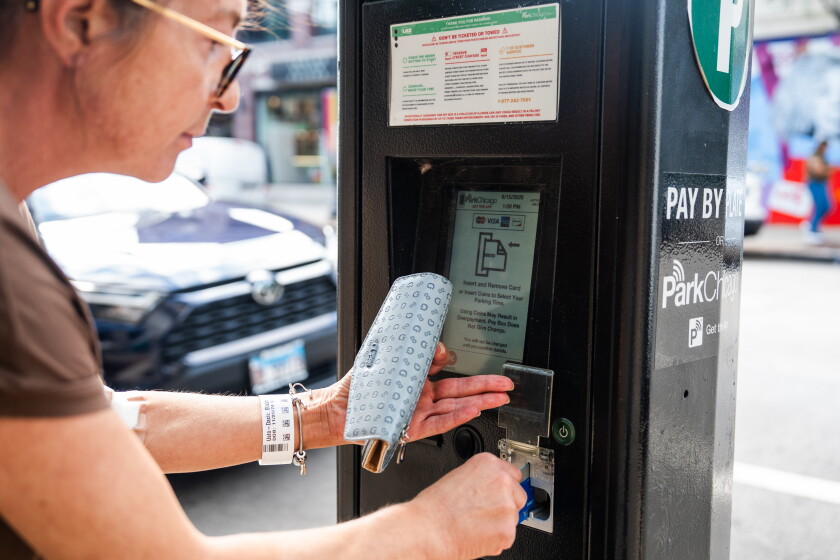
The City Council’s Finance Committee on Thursday approved New York investment firm Stonepeak Partners’ $2.53 billion bid to acquire Chicago parking meters,along with a compromise aimed at making the widely despised meter deal less onerous for taxpayers.
“We were handed a lemon and we made lemonade,” Finance Chair Pat Dowell (3rd), one of a handful of City Council leaders who helped broker the deal, told fellow committee members.
Calling former Mayor Richard M. Daley’s 2008 decision to lease Chicago parking meters to private investors for 75 years “an example of what not to do,” Dowell said Chicagoans from “every corner of the city have become increasingly disillusioned” with a deal that allowed private investors from as far away as Abu Dhabi to recoup their $1.15 billion investment two-fold with 57 years to go on the deal.
The committee passed the measure, with only two Council members, Budget Committee Chair Jason Ervin (28th) and Ald. William Hall (6th) voting against it. The full City Council must still approve the proposed deal.
“Today is a historic day,” Dowell said. “Today, we have the opportunity to not only apologize” to taxpayers who got the short end of the deal, “but back it up with real tangible benefits for the first time.”
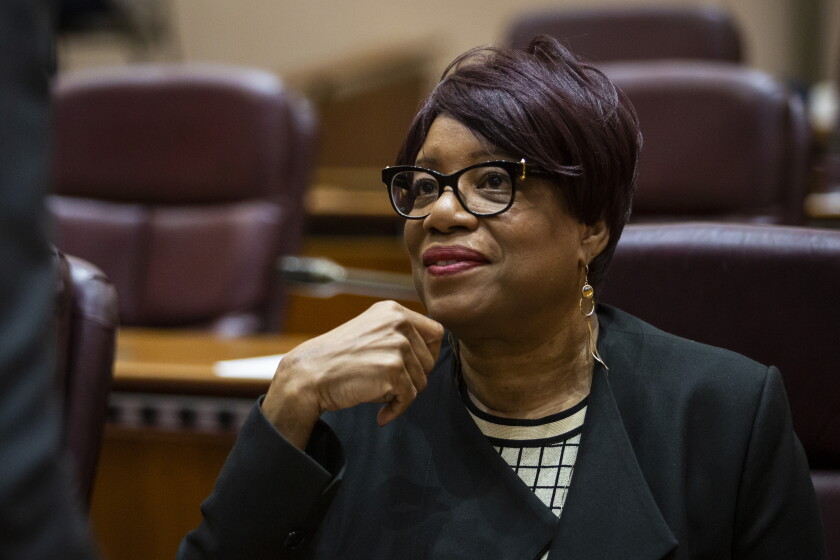
Downtown Ald. Bill Conway (34th), an investment banker, rained on Dowell’s parade. He argued that after Stonepeak deducts interest expenses and adds the potential for depreciation, the estimated benefit for Chicago taxpayers has been “wildly overstated by more than $100 million.”
“It’s still a win, but not as big a win as I thought it was,” Conway said.
Ald. Anthony Beale (9th) applauded his colleagues for doing what they could to level the playing field, but he said, “It’ll take a lot of sugar to get this [sour] deal sweet.”
Beale also demanded a guarantee that Stonepeak’s promise to pay the city $75 million up-front and 5% profit-sharing — or $376.2 million over the course of the agreement — be earmarked to chip away at Chicago’s $36 billion mountain of unfunded pension liabilities. The deal also would reduce costly compensation the city is required to pay for every space taken out of service.
The City Council is facing a Sept. 30 deadline to either approve Stonepeak Partners’ $2.5 billion bid to acquire Chicago parking meters, or roll the dice in arbitration and in court.
Before casting that controversial vote, City Council leaders brokered a compromise after Mayor Brandon Johnson submitted four bids to take back the meters for as much as $3.2 billion — only to later abandon those efforts.
With no direction from the mayor, Dowell said she and a handful of other veteran alderpersons “took the bull by the horns and did the work” to make the deal better. Stonepeak also agreed to sell Omni Air International, an airline that has provided long-haul deportation flights for the Department of Homeland Security during President Donald Trump’s deportation campaign.
And it agreed to explore creating entire non-metered city blocks as “potential electric vehicle charging stations with charging revenues shared with the city.”
Dowell told her colleagues that the “divestiture certificate” from Stonepeak pledging to unload Omni International was available for them to see.
The promise to sell Omni International was not enough to satisfy Ervin, who played the role of naysayer throughout Thursday’s hearing after pushing an 11th-hour plan to create a public infrastructure trust to take back the parking meters.
He demanded to know the value of Omni and wondered whether Stonepeak was “willing to walk away at a loss to do this” and what would happen if the selling price turns out to be too low. “What do we do then?” asked Ervin.
Losing patience, Dowell said, “You’ve made your point. You don’t like this deal. Let’s move on.”
Ervin also questioned why the city didn’t hold out for a share of Stonepeak’s gross revenues instead of settling for net revenues. When retiring Corporation Counsel Mary Richardson-Lowry noted that the compromise she helped to negotiate delivered “dollars the city never had before,” Ervin said, “And may never get.”
Ald. Nick Sposato (38th) offered a counterpoint to Ervin’s remarks. “This is a major coup for us… I am jumping for joy and giddy about this. I’m glad I’m part of a major accomplishment on our watch as opposed to what happened almost twenty years ago,” Sposato said.
In 2008, Daley leased the city’s 36,000 parking meters for 75 years to a private investment consortium for $1.15 billion. He used those proceeds to avoid raising property taxes at a time when city employee pension funds were sinking deeper in the hole. The lopsided deal sold off an asset that was generating revenue for the city. Motorists paid the price with steep rate hikes.
The Chicago Parking Meters LLC consortium formed by Morgan Stanley, Allianz and Sovereign Wealth recouped their initial $1.15 billion investment by 2019 — roughly 11 years into the 75-year lease.
The deal also required the city to compensate Chicago Parking Meters LLC for every parking space taken out of service, either for a special event or construction project. That part of the deal alone has tied the city’s hands and cost Chicago taxpayers tens of millions of dollars.
The compromise isn’t perfect. Ald. William Hall (6th) complained Thursday that African-American contractors were getting the short end of the stick. Ald. Andre Vasquez (40th) said there is “nothing there” in the divestiture certificate other than an email “stating an intent to sell” adding, “What happens if they don’t?”
But the compromise does make the 2008 parking meter deal a bit less onerous.
“Every year, this asset has made a great deal of money for the purchasing party. We anticipate a little bit of that coming our way,” Richardson-Lowry said.
The sale to Stonepeak and the compromise attached to it still must be approved by the full City Council — either at a meeting scheduled for Friday, or on Tuesday if the transaction is deferred and published. If the Council rejects the deal or fails to meet the revised Sept. 30 deadline, the risk to Chicago taxpayers is great. It could cost the city millions.
The Morgan Stanley-led investment group could first ask an independent arbitrator to order the City Council to approve the sale or pay an exorbitant penalty, then file a lawsuit.

Fran Spielman
Chicago Sun-TimesCity Hall reporter
Mayoral allies stall measure that would make it harder for city to take on more debt
‘Broadview Six’ judge to hold crucial hearing next week as she weighs consequences of feds’ misconduct
Bitter fight over Chicago police discipline heads to state Supreme Court
Finance Committee backs $201.6M subsidy for Foundry Park megaproject
Great Lakes senators call on Trump to stop delaying invasive carp barrier
Mayoral hopeful Bill Quinlan sues in bid to shrink field of candidates
