

New Orleans staged wrecks trial: Jury hears money trail tied to disbarred attorney, accused hitman

The prosecution in a wide-ranging New Orleans staged wrecks murder trial continued calling witnesses Tuesday.
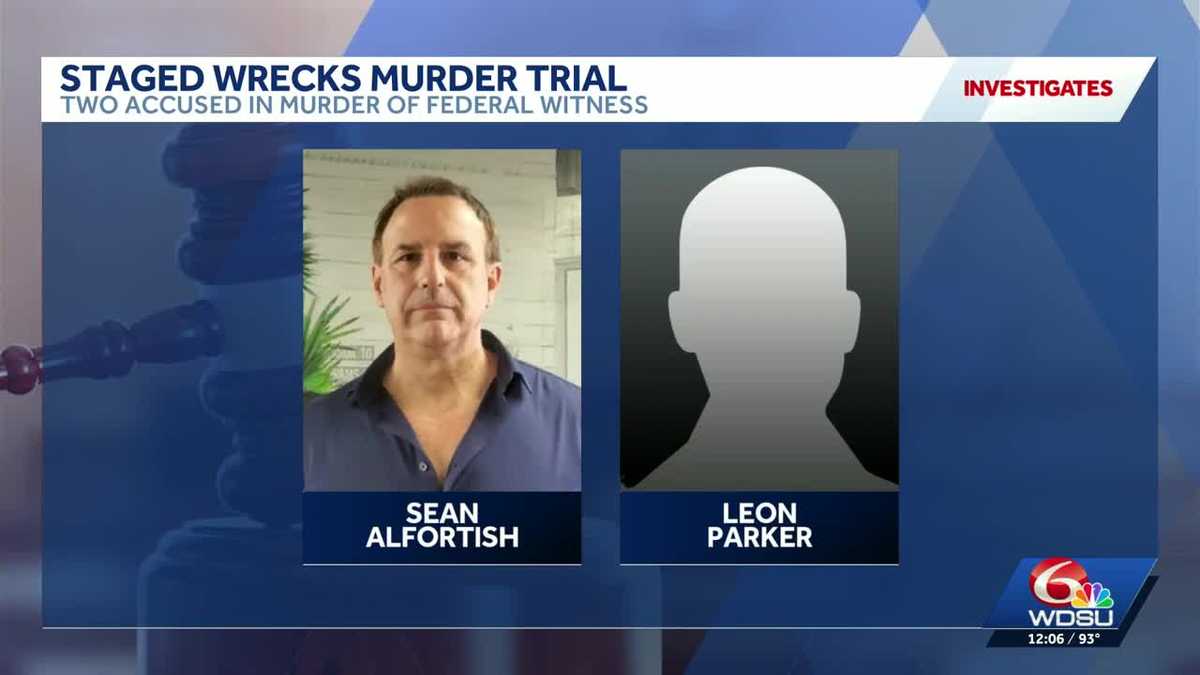
Disbarred attorney Sean Alfortish and accused hitman Leon Parker are facing charges related to the 2020 killing of federal witness Cornelius Garrison in the staged wrecks investigation.
On Tuesday, the jury heard from an FBI forensic accountant who testified that she combed through hundreds of thousands of financial records that revealed payments to alleged participants in the scheme.
Lisa Ferrara testified that she reviewed bank, investment, retirement, cryptocurrency, personal and business records spanning more than a decade that were linked to Alfortish, Affiliated Management, the JA Trust and Leon Parker.
Investigators reviewed Alfortish’s accounts at eight banks from March 2012 through December 2024, she testified.
Ferrara testified that money was moving in and out of multiple accounts.
According to Ferrara, she traced deposits in the account linked to Affiliated Management, which is a company tied to Alfortish.
She said that deposits increased from about $91,000 in 2015 to $306,000 in 2016.
According to Ferrara, in 2017 there was more than $800,000 in the account. By 2018, deposits had reached $1.4 million.
“Then it skyrockets,” Ferrara said on the stand.
About 25% of the 2018 deposits came from Alfortish’s fiancée, Vanessa Motta, according to the testimony. Memos on checks included terms such as “loans,” “advances” and “advertising,” as well as the names of plaintiffs in crashes prosecutors allege were staged.
Ferrara said Garrison began receiving payments in May 2017. Affiliated Management’s payments to him stopped in May 2018, around the time insurance companies began raising the red flag on the claims.
Deposits into Affiliated Management fell significantly in 2019, and its bank accounts closed in 2020, which was the year Garrison was killed.
According to Ferrara, Affiliated Management made 188 payments totaling $406,750 to people prosecutors identified as “slammers” and “spotters.”
The terms refer to people accused of causing staged wrecks or recruiting participants.
Some payments were issued on the same date. Records also showed payments to Garrison on Aug. 10 and Aug. 16, 2017, each one day after a collision
From 2015 through 2020, Affiliated Management paid approximately $295,000 to Alfortish, $279,000 toward an Alfortish American Express account and $194,000 to Garrison
A construction contractor received about $59,000, and the company contributed to expenses associated with Motta’s home, Ferrara said.
She also described JA Medical Management as an entity used to pay medical expenses associated with injuries from wrecks.
After 2019, Alfortish’s business activity shifted from Affiliated Management to the JA Trust, which had been established for his daughter
“The JA Trust served as an umbrella,” she said on the stand.
Her presentation traced money from the sale of a property at 525 Clay St., which brought in more than $200,000. Ferrara described the property as a location where Motta and Alfortish operated and where alleged slammers and spotters brought plaintiffs.
Ferrara also discussed differences between original trust documents held in a Fidelity account and documents later presented to Gulf Coast Bank. Prosecutors said the documents were altered to make the trust appear able to operate as a separate business entity.
Ferrara’s testimony also focused on a property at 4936 Newlands St. A $204,000 cashier’s check was used in connection with its purchase.
“Within the trust, Motta and Alfortish appear to go in together to purchase a property,” Ferrara said.
Between September and November 2020, Alfortish’s mother, Sylvia Alfortish, wrote JA Trust checks to herself and cashed them at a bank teller, Ferrara testified. The checks totaled $30,200 and were reportedly connected to the Newlands property.
The property sold for more than $300,000 in December 2020, with Sylvia Alfortish listed on the closing documents. The proceeds entered the JA Trust account, and Motta later received $100,000 from the trust
WDSU spoke with Alfortish’s mother outside court about the checks. She said she just did what her son told her to do.
Ferrara separately reviewed Parker’s financial accounts, including money from crashes prosecutors said were staged.
According to Ferrara’s testimony, $837,000 was awarded from a settlement tied to a crash on Jan. 17, 2016.
His attorney fees totaled about $300,000 Parker received $100,000
Ferrara said Parker withdrew $39,000 in cash the day before Garrison was killed. Another account showed a withdrawal of more than $8,000.
According to Ferrara, she did not see a cash withdrawal of that size anywhere else in Parker’s financial records and called the withdrawal “very unusual.”
She testified that she did not find evidence of large deposits from Alfortish into Parker’s accounts.
About six months later, Parker received a $20,365 Paycheck Protection Program loan after identifying himself as a self-employed painter and reporting $100,315 in business receipts, according to a court filing.
An IRS transcript reportedly showed no 2020 tax return on file.
Parker also received disability payments, and his bank records showed a deposit of about $48,000 in July 2020.
Two other deposits were made from PPP funds, including $30,144 from Teshana Jones and a $34,256 cashier’s check tied to another crash prosecutors said was staged.
Ferrara also analyzed records from a March 2021 crash involving Parker’s wife and another witness as claimants.
According to Ferrara, each received about $30,000. Parker’s wife transferred her share to his account, while the other claimant directed most of her proceeds to Parker through a cashier’s check and kept $2,000, according to her testimony.
Ferrara said Motta represented Parker in another crash in December 2021, and said he received more than $46,000.
Alfortish’s and Parker’s attorneys cross-examined Ferrara, saying the records did not prove guilt.
FBI special agent Michael Heimbach also took the stand and testified to how difficult the investigation was in the early stages of Garrison’s murder probe.
Heimbach said investigators reviewed surveillance footage and collected location data but still struggled to develop credible leads.
Heimbach said he has served as the lead agent on the homicide investigation for the past four years.
He described an investigation that eventually focused on burner phones, firearm-related messages and communications involving Ryan Harris and Parker.
Heimbach said the NOPD first responded to the scene in the 1500 block of Foy Street the night of the killing. That’s when the NOPD later notified the FBI.
According to Heimbach, agents canvassed the neighborhood for witnesses and surveillance video. Investigators also reviewed footage from the city’s Real-Time Crime Center.
“The victim’s mother described a vehicle in her 911 call,” Heimbach said. “However, Mrs. Garrison was unable to provide a description of a suspect.
Investigators later obtained several warrants searching for electronic evidence, including a Google geofence warrant intended to identify devices near the crime scene.
They also collected cell tower records and used an address-search warrant to determine whether anyone had searched online for the location of the crime.
“There were no credible leads from those warrants,” Heimbach said during his testimony.
Investigators collected DNA swabs from the victim’s body, a doorknob and shell casings. The casings were submitted to NOPD for analysis, but those also did not produce an immediate lead.
“Every time a firearm is fired, those casings have unique markings,” Heimbach said. “Think of it like a fingerprint.”
The investigation shifted after agents examined Garrison’s phone records. Those records indicated Garrison had arranged to meet a woman at approximately 8:30 p.m. the night he was killed.
Heimbach said investigators identified a device referred to as “Burner Phone 1,” which had communicated with Garrison.
According to his testimony, the phone had contact with only two people: Garrison and one other person.
The phone was purchased at a Family Dollar in New Orleans East on Sept. 21, 2020, which was one day before Garrison was killed.
Heimbach said investigators later obtained surveillance footage of the purchase.
The FBI alleges Harris purchased the burner phone after exchanging messages with Parker on Sept. 22.
In those text messages, Parker wrote, “I am here,” and Harris responded, “Pulling up.” In another exchange, Harris wrote, “Ima be there around 7:30.” Parker asked, “Same spot,” and Harris replied, “Yea.”
Heimbach said a second burner phone was purchased on Aug. 26, 2020, at 1:41 p.m. According to Heimbach’s testimony, the device was associated with a staged wreck that month and was also linked to Harris.
Harris was arrested in November 2020. Investigators determined that a license-plate reader had recorded his Jeep Gladiator near Garrison’s house
Searches of Harris’s apartment produced electronic devices, ammunition and financial records. At his mother’s home in Slidell, investigators found a sweatshirt that Heimbach said resembled the one he wore in the surveillance footage.
Investigators also found 9mm ammunition at a business on Cleary Avenue that was described in the testimony as matching evidence from the crime scene.
According to Heimbach, a search warrant for Harris’ iCloud accounts uncovered messages that appeared to arrange meetings through a burner phone, including meetings on the night before Garrison’s murder.
The records also included discussions about a car and a gun Harris was trying to buy
An image recovered from the account showed Harris holding a gun.
Messages between Harris and Parker referred to a “Scorpion,” described during the testimony as the firearm’s make or type.
“Man that thing nice almost look like mine(s) how much,” Parker wrote in one message.
“$1,000,” Harris responded.
“Let me know when you get your hands on that thing,” Parker wrote.
Harris ultimately wasn’t able to purchase the gun
Heimbach called the exchange an important lead because it showed Harris discussing a gun with someone near where the killing happened.
Heimbach said investigators obtained Google records associated with Parker, including data connected to the email address bigboycowboy55.
Before the homicide, Heimbach testified that the account was used to search several variations of the name Cornelius Garrett, according to the testimony. One search for “Corlinus Garrett” occurred at 3:24 p.m. on Sept. 6, 2020. A search for “Cornelius Garret” and two other similar searches were conducted the same day.
Investigators also reviewed Parker’s financial records, which showed significant bank withdrawals on the day before the killing.
