

The Scoop
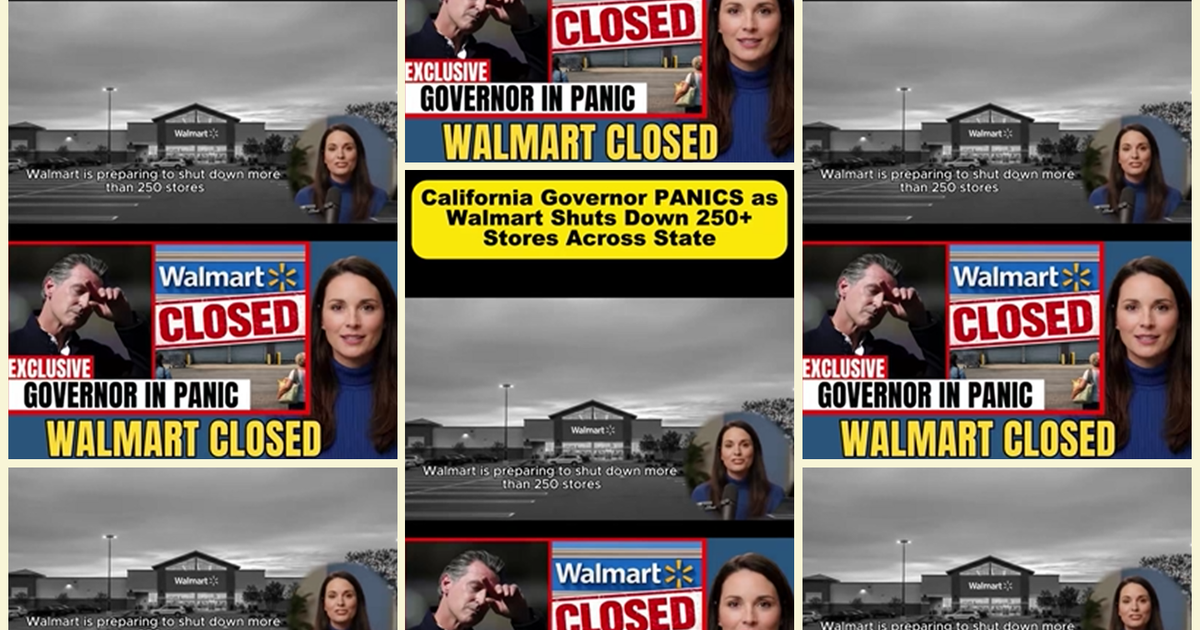
In January, President Donald Trump posted two clips from a popular YouTube account sharing some dramatic news: Walmart was closing hundreds of California stores.
It wasn’t true. But as California Gov. Gavin Newsom’s communications team pushed back against the posts on X, what alarmed them more than the falsehoods themselves (dubious social media claims from Trump are nothing new) was the lack of clarity about the form these videos were taking and where they were coming from, according to two Newsom staffers. They’re concerned that this growing wave of AI-assisted spam — much of which has been aimed at Newsom, a likely presidential candidate in 2028 — is only a taste of what’s to come as the technology and the political operatives wielding it become even more sophisticated.
@MeganWright62, the YouTube channel that posted the claim, was mostly populated by sensational AI-generated videos that purported to show various companies leaving California, grocery stores running out of food, and school teachers quitting en masse. The channel’s videos, cobbled together by AI and generated at scale with little regard for accuracy, look decent enough that some segment of the public — or, at least, YouTube commenters — doesn’t seem to realize or care that they were assembled by AI.
The account was one of hundreds that the governor’s team has been pushing to get taken down in recent months as it focuses increasingly on AI-generated spam content in its media monitoring mix. Much of that work, staff said, has consisted of attempts to fight back against AI-narrated videos that spread false claims, like that Kroger is shutting down a California distribution center, that Costco and Shell are closing their stores and gas stations, or that GM and Ford plants in California are shuttering (neither company has had factories in the state in decades).
Newsom’s office says it worked with YouTube to identify more than 700 accounts since January that were subsequently removed for violating the company’s terms of service through its “likeness protection” program, a new support system for public figures, creators, and journalists that flags when someone’s face is used without their permission in deepfakes. More than 100 of those accounts were populated with AI-generated content with what Newsom’s team said was false or highly misleading information about Newsom and California’s decline.
“Right now, algorithms are rewarding lies and bad actors are taking advantage — particularly those who want to see a divided America,” Brandon Richards, a spokesperson for the governor, told Semafor. While Richards said that major tech platforms like YouTube “have been a helpful and willing partner in this fight,” he argued that “the combination of bots and increased access to powerful AI, coming at a time with the doomscroll nature of our content consumption habits, has made it easier than ever to push rage-bait and false narratives that are believed on sight.”
“Unless there is a significant systemic change from all platforms, this issue will continue and is likely going to get worse,” Richards said.
Know More

A screenshot of a Tax Evaders video, one example of anti-blue-state AI slop.
Over the past year, YouTube has become increasingly concerned about the sophisticated AI-generated videos flooding its platform. The videos have largely consisted of engagement-bait aimed at capturing ad dollars, and have nothing to do with news or politics. But increasingly, political and news content is running afoul of the company’s AI spam filters.
Still, it’s easy to find rabbit holes of AI-generated or heavily assisted political videos showcasing the economic collapse of Democrat-run states like California, New York, and Illinois. While many accounts that post these videos get little traction, and seem to pop up and go inactive quickly, other accounts, like @MeganWright, @PumpScore, and @TaxExodus, rack up tens or hundreds of thousands of views.
While many of the accounts creating this content were among the 1.6 million that YouTube removed last year for spam, some still slipped through the cracks.
One example: New York Reports, a YouTube account that began posting earlier this year. First, the account attempted to run videos with an AI-generated avatar sharing news about an economic collapse supposedly prompted by New York Mayor Zohran Mamdani. But in recent months, the account began posting error-riddled videos with what appeared to be real narration with repetitive, AI-enhanced stock imagery.
A screenshot from New York Reports.
Earlier this year, the account published a video titled Governor of California SHOCKED as Wells Fargo LEAVES to Florida Taking 16 Billion. The video, a mash-up of a series of unrelated local news stories about a Wells Fargo branch in Iowa closing and a Bloomberg article about the bank opening up a large office in South Florida, included a thumbnail that implied Newsom said “We are so Fucked!” The narrator of the video does not appear on-camera, and the footage largely consisted of stock images, local news clips, and B-roll of customers walking into a bank and people moving out of an apartment complex. On Wednesday, when Semafor viewed the video, it had nearly 300,000 views and 1,300 comments.
A Gmail address associated with the account did not return a request for comment.
Another March video from the channel with 90,000 views blared: Mayor Of New York ERUPTS After Target SHUTS DOWN All Locations In New York. It was unclear where the claims originated; the retail giant maintains three locations in the city.
The account then published Mayor Mamdani LOSES IT After JP Morgan OFFICIALLY Exits New York For Good! — a video full of AI narration and stock images and video that got 200,000 views. (The mayor hasn’t weighed in on the bank’s decision to decrease the number of staff in the city, where it maintains its global headquarters.)
A screenshot from Pump Scope, which posts AI slop.
After Semafor flagged New York Reports, Pump Scope, Tax Exodus, and similar accounts to YouTube on Friday, a company spokesperson confirmed that they had been removed for violating the company’s spam policies, which prohibit using automated tools or AI to churn out high volumes of repetitive content with minimal changes.
The View From San Bruno
While YouTube remains the most dominant social video platform, AI poses a real challenge. Like all tech companies, YouTube has raced into AI, making new tools for YouTube Shorts, and rolling out AI-generated summaries, transcripts, and interactive chat features.
But the ease of generating cheap, low-quality video has the potential to flood the platform with garbage, a threat that has been on the minds of company executives intent on making YouTube feel more, not less, premium. In a public letter earlier this year, YouTube CEO Neal Mohan called combating AI slop a “top priority.”
“To reduce the spread of low quality AI content, we’re actively building on our established systems that have been very successful in combatting spam and clickbait, and reducing the spread of low quality, repetitive content,” Mohan wrote.
Over the last several months, the platform has tightened the rules around monetizing “inauthentic content,” such as repetitive or template-based videos, AI-generated videos with no clear narrative, and content where AI personas are used to discuss sensitive topics. Rather than taking down individual videos, the company has largely focused on accounts that post AI slop at scale, attempting to trick users and harvest cheap views for ad revenue.
According to video editing company Kapwing, more than 20% of videos that YouTube’s algorithm shows to new users are this sort of low-quality AI-generated content, comprising a growing share of views on the platform as a whole.
Political content seems at the moment to be a relatively small slice of that. But its effects can be significantly dicier for platforms hoping to stay far away from heated controversy.
During the COVID-19 pandemic, for example, YouTube and other platforms faced criticism for their role in the proliferating number of videos with health misinformation, occasionally resulting in account demonetization or removal. This prompted backlash from critics, who felt that the platforms were stifling free speech or putting their thumb on the scale politically.
YouTube has taken a more careful approach towards removing or demonetizing AI-generated content focused on public figures. The company has emphasized that it applies its community guidelines consistently, regardless of political ideology. Many of the company’s efforts have focused on targeting deepfakes, which violate its privacy policy.
YouTube has encouraged public officials, celebrities, journalists, and creators to participate in the likeness protection program, which automatically detects videos featuring the participant’s likeness and allows them to petition the platform for removal.
“We tackle low-quality or deceptive AI content using the systems we’ve developed over years to fight spam and clickbait,” a YouTube spokesperson told Semafor. “As this technology advances, we’re building on those systems with industry-first tools to protect creators’ likenesses, and automatically applying labels to realistic AI content for transparency.”
Max’s view
In the lead-up to the last presidential election, academics and tech observers were concerned about the increasing potency of deepfakes, believing that synthetic images and replications of political figures would sow chaos on and offline. Those concerns turned out to be largely overblown then; the election was defined much more by the influence of ascendant alternative new media than by deepfakes. But the increasing sophistication of AI images, and their ability to proliferate quickly and easily across social platforms, is becoming a much bigger concern for today’s political hopefuls — including Newsom, one of the more digitally conscious leaders in the Democratic Party.
YouTube is betting that it can beat AI-generated spam and slop of all varieties by improving its ability to detect unauthorized uses of public figures’ likeness, and by training its own tech to automatically spot obvious AI-generation and label it. It will have to monitor huge tranches of content without letting too many garbage videos proliferate or accidentally squashing legitimate content from users already sensitive to perceived censorship.
Of course opponents of Newsom and Democrats can already turn to a conservative media complex that’s been churning out bespoke, human-made content like this for years.
In an email to Semafor, Columbia researcher Camille François said the question of what political slop was on platforms like YouTube and where it comes from was “a complicated and fascinating topic.”
She pointed Semafor to a recent reportshe and other academics assembled on the emergence of low-quality AI-generated videos and how the tech platforms are reacting. The report cited steps YouTube had taken to discourage slop-like content.
“These measures suggest that modest adjustments to ranking signals, monetization thresholds, or eligibility rules can alter creator incentives without requiring a categorical ban on generative content itself,” the report said
Notable
- YouTube is not alone in its concern about AI’s ability to overwhelm platforms with low-quality user-generated content.Instagram CEO Adam Mosseri told Semafor this year that the platform was concerned about AI slop, as did Reddit CEO Steve Huffman.
- In an interview with Semafor last month, California Republican nominee for governor Steve Hiltonpushed backagainst conservative media’s “dystopian hellhole” depiction of California.
- On Semafor’s Mixed Signals podcast in July, former Surgeon General Vivek Murthyreflected on whether the Biden administration took the right approach to public health communication by urging the tech platforms to regulate health misinformation.
- Thus far, Republicans have been much more willing to embrace AI in advertising and messaging. Democratic candidates seem to be politically boxed out of using AI. During his failed mayoral bid, Andrew Cuomo’s campaign faced backlash among his own party after deploying AI ads.
- Long before AI deepfakes, people were churning out “shallow fakes” on YouTube to similar ends using a video game, Semafor’s Graph Massara writes.
