

The signature program of the Griggs Innovators Nexus at Mizzou, Entrepreneur Quest (EQ) offers participants access to resources and mentors, training them to translate their ideas into scalable start-ups.
Mizzou Engineering students are among the 10 finalist projects competing for seed funding for their ventures during EQ’s final pitch competition Nov. 17. Here are their projects.
Digitus Labs
Entrepreneur: Electrical engineering majorAkbarjon Kamoldinov
Product: Volar, a wearable data glove designed to capture hand movement and contact-force information while the wearer does everyday tasks and save it as synchronized data that robot-learning teams can train on directly.
Benefit: Robots learn much of their manipulation by watching humans, but cameras lose the fingers at the exact moment the hand closes around an object and cannot measure how hard someone is gripping. Volar captures what video misses, so an ordinary task like picking up a cup becomes data a robot can learn from. Video can be scraped from the internet, but grip force can only be recorded on the hand.
Target market: Data-collection and robot-learning teams at humanoid and robotics companies, starting with those in the Bay Area and data collectors from international markets.
Lessons learned: Kamoldinov worked as founding engineer alongside Digitus Labs CEO Malika Vahobova. “The biggest lesson from EQ has been to let potential customers and people in the field correct our assumptions,” Kamoldinov said. “We first thought the glove could replace camera footage, but robotics labs told us they still need video because the robot sees through cameras when it operates. That changed how we think about Volar: it works alongside video and adds what video cannot capture.”
“Another lesson is that a three-minute pitch leaves no room for anything vague, which pushed us to be clear about what we have built so far and what comes next,” he said.
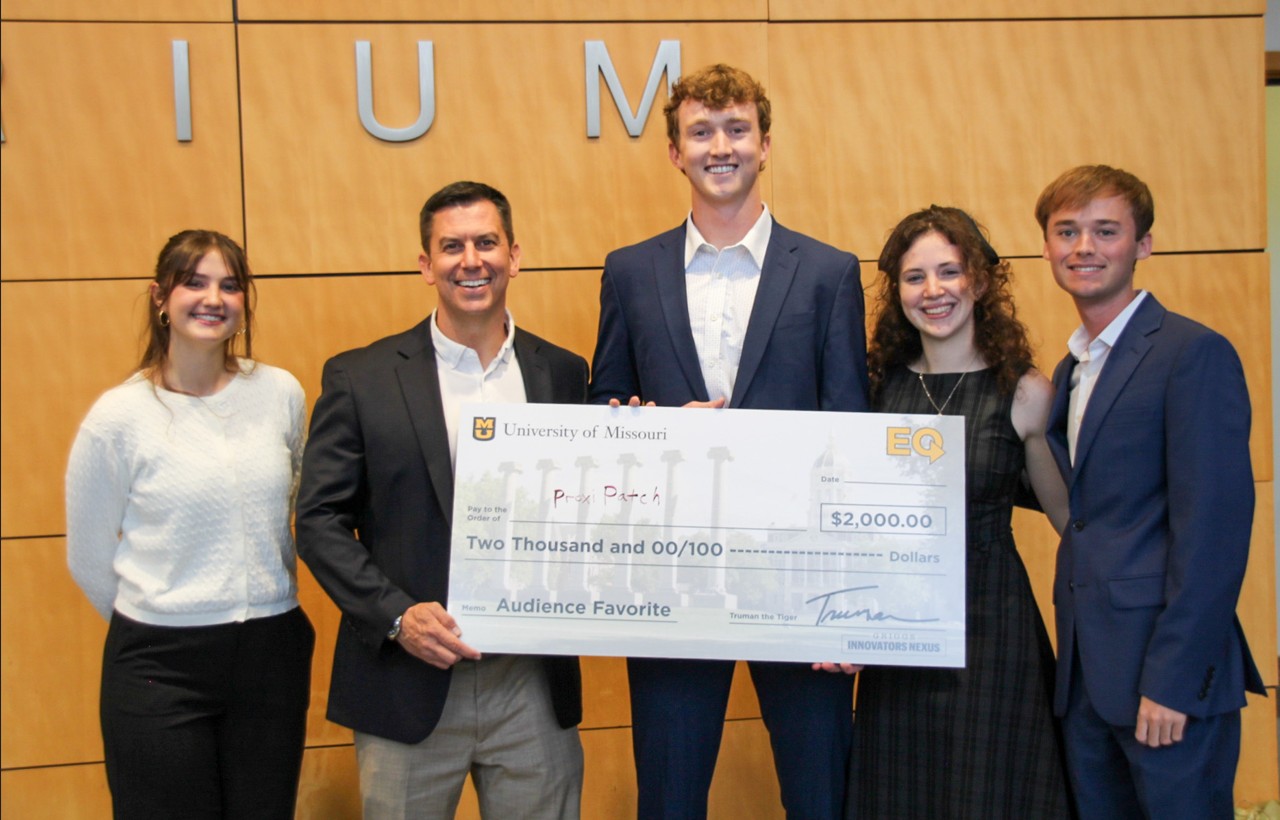
ProxiPatch
Entrepreneurs: Biomedical engineering majors Andy Brown, Riley Dycus, Emmie Hachenberger, Delaney Rapp and Koen Straub
Product: ProxiPatch is a skin-safe sensor patch for infants in the neonatal intensive care unit (NICU). It combines sensor electronics and a gentle, temperature-responsive hydrogel adhesive in a single patch that releases cleanly with a cooling mechanism instead of being peeled off. The patch connects to the bedside monitor through a magnetic breakaway connector, so if the cord is pulled, it disconnects before that force reaches the baby’s skin. It also alerts clinicians if the patch loses skin contact or the cord disconnects.
Benefit: Protects the most fragile skin in the hospital while giving clinicians readings and alarms they can actually rely on.
Target market: NICUs and hospitals.
Lessons learned: What it takes to turn an idea into something real. “ProxiPatch started as a concept our team built in 48 hours at the National Medical Device Make-a-Thon last spring, where it took first place out of 35 teams,” Straub said. “EQ is where we’ve started watching that idea become a venture. We’re learning how intellectual property protection and patents work, and what it takes to build the business behind a medical device. Each step sets off the next, like gears catching one another.”
Judges will award seed funding to three teams for their ventures in the final pitch competition Nov. 17.
