

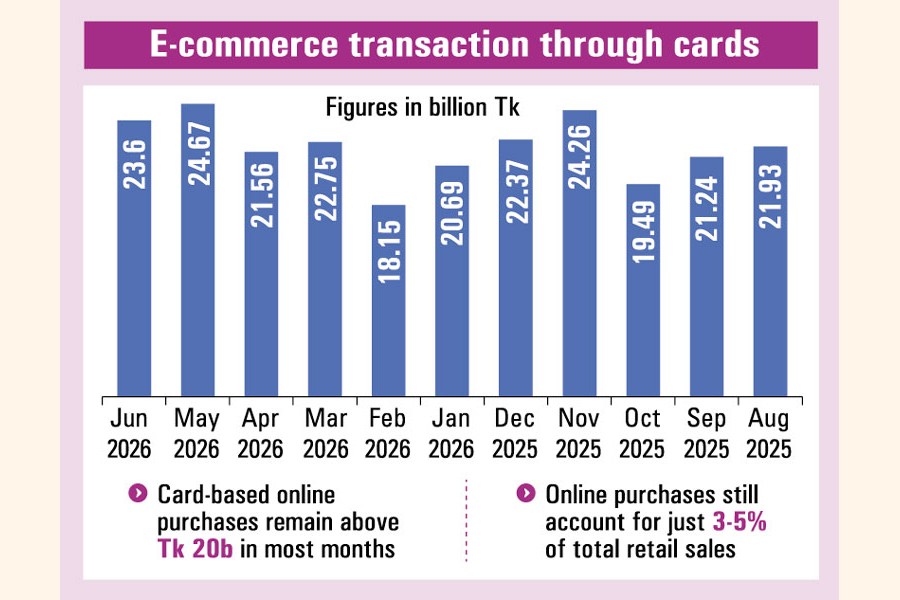
Bangladesh’s e-commerce economy is becoming an increasingly established part of everyday consumer life, with card-based online purchases staying above Tk 20 billion in most months.

The resilience highlights the growing role of digital commerce as consumers gradually shift from cash to electronic payments, industry stakeholders said.
According to the experts, the country’s e-commerce market has evolved from a niche digital business into a major economic driver. Valued at approximately US$6.9 billion in 2023, the market expanded to nearly US$7.5 billion in 2024 and is projected to reach US$9.8 billion by 2028.
Despite this growth, online purchases currently account for only around 3-5% of total retail sales, leaving significant room for further digital expansion while highlighting the sector’s vulnerability as it remains in the relatively early stages of growth.
Recent data from Bangladesh Bank illustrates both the scale and the volatility of this fast-growing market. Card-based e-commerce transactions reached Tk 23.60 billion in June, 4.3 per cent down from Tk 24.67 billion in May.
However, June’s spending remained 9.5 per cent higher than in April and roughly 14 per cent above January, suggesting that short-term declines have not derailed the broader expansion of digital consumption.
The latest figures indicate that e-commerce is no longer driven solely by occasional bursts of online shopping. Instead, digital purchases are becoming a more regular feature of consumer spending, although monthly volumes remain sensitive to seasonal demand and household purchasing power.
The data shows a pattern of fluctuation rather than uninterrupted growth, with spending hitting a low of Tk 18.15 billion in February before recovering to Tk 22.75 billion in March, Tk 21.56 billion in April, and peaking at Tk 24.67 billion in May.
Dr Masrur Reaz, chairman of Policy Exchange Bangladesh, said the sustained volume of card-based e-commerce transactions indicates that digital consumption has become an increasingly important part of the economy.
“Despite month-to-month fluctuations, spending has remained at a relatively high level, indicating that consumers are gradually becoming more comfortable with online purchases and digital payments,” he said.
He noted that the June decline should not necessarily be viewed as a reversal of the trend, as e-commerce spending is influenced by seasonality, household purchasing power, major festivals and changes in consumer behaviour.
“Therefore, a single month’s movement does not provide a complete picture of the underlying trajectory,” he added.
Over the 11-month period from August 2025 to June 2026, monthly card-based e-commerce transactions averaged approximately Tk 21.85 billion, highlighting the scale at which consumers are increasingly using cards for online purchases.
The pattern also shows that the expansion of digital commerce does not necessarily translate into uninterrupted month-on-month growth. Spending fluctuated between roughly Tk18 billion and Tk25 billion during the period, reflecting changing consumer demand.
For Bangladesh, this trend extends far beyond the e-commerce industry itself. The rising volume of card payments signals a wider transition toward formal digital financial services, creating ripple-effect opportunities for online retailers, financial institutions, payment gateway providers, and logistics companies.
As more transactions move through formal channels, businesses can reach consumers more efficiently while building a stronger digital transaction ecosystem.
However, industry experts warn that monthly fluctuations indicate the sector remains sensitive to broader economic conditions and household purchasing power.
The recent June dip may simply reflect a normalization following the strong spending recorded in May, rather than a weakening of underlying demand.
Need for stronger digital ecosystem Moving forward, the challenge for businesses and payment providers will be converting this growing digital adoption into sustained, long-term growth.
“What is more important is the broader trend,” Dr. Reaz emphasized. “The sustained volume of card-based e-commerce transactions reflects a structural shift in consumer behaviour from cash-based transactions toward formal digital channels. This transition can improve transparency, strengthen the digital economy, and create opportunities for businesses to reach consumers more efficiently.”
However, Bangladesh needs to move beyond simply increasing transaction volumes, he said.
“The next phase should focus on building consumer confidence, strengthening digital payment infrastructure, improving cybersecurity and expanding access to digital commerce outside the major urban centres,” he added.
To achieve this, Dr. Reaz called for a coordinated effort among all stakeholders. “The government, banks, payment service providers, and e-commerce platforms need to work together to create an environment where digital transactions are secure, affordable and convenient.”
“If these issues are addressed, the continued expansion of digital payments could become a vital driver of Bangladesh’s broader digital economy and financial inclusion,” he added.
