

Add Us On GoogleAdd as a preferred source on Google
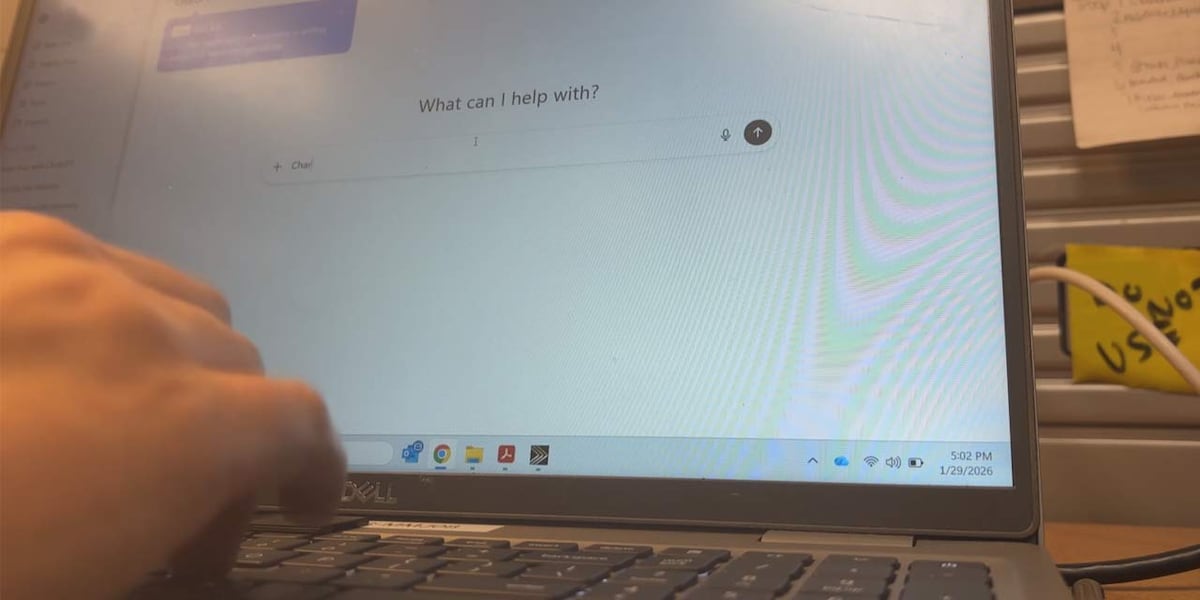
CHARLESTON, S.C. (WCSC) — While many colleges are banning generative artificial intelligence tools like ChatGPT, professors at the College of Charleston School of Business are taking a different approach: teaching students how to use them.
The message in at least one accounting classroom isn’t “don’t use AI.” It’s learning how to use it ethically, accurately and with professional judgment.
Roy Martin, an assistant professor of accounting at the College of Charleston, built a class project around the way accounting firms are already using AI and what they expect from new hires.
“I’m modeling AI uses in the way they’ll do it as public accountants in the field,” Martin said. “What that means is I’m trying to get them to use it in a way that magnifies their learning.”
The project had three parts. Students first completed an AI-prompting course from accounting firm EY, covering prompting strategies and AI ethics. Then they worked through a complex tax scenario using AI, submitting their prompting strategy, the AI output and their own analysis of that output. Finally, they edited the AI-generated content into a client-ready report.
“AI can maybe do 80% of the heavy lifting for them,” Martin said. “But that final 10% to 20% of what we might call professional judgment it’s on them. They’re responsible for making sure what the AI puts out is correct.”
Ally Evans, an accounting student at the College of Charleston, said the project changed how she thinks about the technology.
“It gave me a chance to kind of have an outline as to what I would provide to the client, but then I could go back in and kind of edit it as I saw fit,” Evans said. “It was definitely more efficient, but it wasn’t something that it just spit out, and I could just hand to the client.”
Evans said the project made clear that AI requires human oversight, especially in a field like accounting, where precision matters.
“Having it laid out for you in a way that looks like it could be correct and then having to really get into the nitty-gritty and looking at how it exactly applied, even the wording has to be so specific, especially in tax,” she said.
She added that the experience reshaped how she views AI’s role in her future career.
“AI is not going to be correct, just like anyone coming out of college. We’re going to make multiple mistakes on every engagement, but it’s going to be the same as AI,” Evans said. “So instead of just having full faith in AI, I think we need to learn how to adjust to this new technology and use it effectively. And I think that starts with universities and colleges implementing it in classes.”
Martin said he compared exam results from students who completed the AI project to those from the previous year, when the project did not exist.
“The students who did the AI project scored probably twice as much, twice as better, on average, on those two questions, than their cohorts did the year before when I didn’t use AI,” Martin said. “What that’s telling me is that it’s helping them learn this material a little better.”
Student feedback also pointed in the same direction. On a survey asking how valuable they would rate the project on a scale of one to 10, Martin said the average score came in just under nine.
“No student has said they hated it or that they don’t want to be using AI,” he said.
Martin said his motivation for building the project came from a tax research conference where senior managers and executives from major accounting firms said they expect new hires to arrive knowing how to use AI.
“The biggest accounting firms, and even the midsize accounting firms, they’re all using AI,” Martin said. “It was very important for these students coming out.”
He said students who enter the profession with AI experience will have an advantage.
“When you get into the profession, it’s going to put you in front of managers and partners faster than you ever would have,” Martin said. “They’re going to come to you and look to see how you’re using it. The more you can help with that conversation, the faster your career develops.”
Martin said he does not believe AI will replace the accounting profession, but that it will change how professional work is completed.
Evans agreed that the technology is not going away and said schools need to keep pace.
“I think with AI advancing so quickly, a lot of people are worried about job security, especially in accounting,” she said. “I think we have to continue to implement this in schools so that we have that educational background so that when we do enter the workforce, we understand that we have the knowledge to review things done by AI.”
Copyright 2026 WCSC. All rights reserved.
