

For years, many investors in Bangladesh have judged listed companies mainly by earnings, dividends, and share prices. But a more important warning may be sitting in a place they rarely read carefully: the audit report.

A review of 1,709 audit reports of listed companies between 2020 and 2025 shows a clear shift after 2023. Clean audit opinions declined sharply, while Emphasis of Matter (EOM) paragraphs, qualified opinions, and hybrid audit warnings increased. This does not mean every company receiving an EOM is financially weak. But it means auditors are paying more attention to uncertainty, litigation, liquidity pressures, regulatory issues, provisioning gaps, going-concern risks, and other unresolved matters.
In simple terms, the market is receiving fewer clean signals and more warning labels.
A clean or unmodified audit opinion indicates that the financial statements fairly present the company’s financial position and performance in accordance with applicable reporting standards. An EOM does not modify the auditor’s opinion. Instead, it tells readers to pay special attention to a matter already disclosed in the financial statements because that issue is important to understanding the company’s condition. A qualified opinion is more serious because it indicates that the auditor has found a material issue, although not serious enough to make the entire financial statements unreliable.
The distinction is important. An EOM is not the same as a qualified opinion, but it is also not a decorative paragraph. It is a cautionary signal.
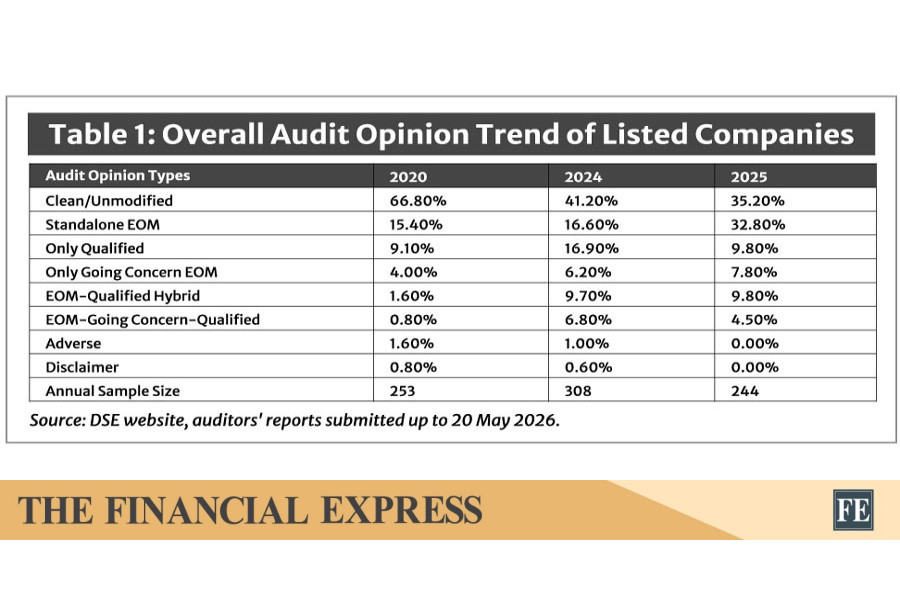
The data shows how quickly the audit landscape changed. Clean or unmodified opinions declined from 66.80 per cent in 2020 to 35.20 per cent in 2025. Standalone EOM reports rose from 15.40 per cent to 32.80 per cent during the same period. Hybrid reports involving EOM, going concern matters, and qualified opinions also increased significantly. In contrast, adverse and disclaimer opinions remained rare and nearly disappeared in 2025.
The numbers suggest this is no longer an isolated company-level issue. It is becoming a market-wide reporting trend. The decline in clean opinions may partly reflect stronger audit scrutiny and greater transparency, which would be positive. But if EOMs are increasingly used as a softer alternative to stronger audit modifications, the market may be moving from hidden risk to softened risk.
The concern is more serious in the banking sector. Banks are not ordinary listed companies. Their balance sheets affect depositors, borrowers, investors, and the wider economy. In 2025, clean opinions in the banking sector were almost absent, while EOMs reached their highest level. Qualified opinions remained relatively low. This pattern suggests auditors may rely more on emphasis-of-matter reporting than on direct modification of opinions.
Many banks have received repeated EOMs regarding provisioning shortfalls, deferred recognition of losses, weak asset quality, issues with the Capital-to-Risk-Weighted-Assets Ratio, negative equity, potential liquidity pressure, and regulatory forbearance. This does not mean every EOM is suspicious. In many cases, an EOM may be justified and useful. But when the same issues appear year after year, the warning should not be treated as routine disclosure.
Delayed recognition of financial weakness often makes future correction more painful. If provisioning gaps, classified loans, weak internal controls, or regulatory non-compliance are repeatedly highlighted but not resolved, investors may underestimate the true risk. The result is a grey zone in which financial statements appear technically acceptable yet still raise major unresolved concerns.
Other sectors also show declining clean opinions and increasing EOM usage. Therefore, the post-2023 shift should be viewed not only as a banking-sector issue but also as a broader signal about financial reporting quality, market discipline, and investor protection.
The key question is not whether EOMs are good or bad. The key question is whether they are leading to corrective action.
Several improvements are needed.
- First, companies need to provide clear public explanations for every major EOM. The explanation should include the exact reason, the amount of money involved, management’s response, the expected timeline for resolution, and whether the issue is recurring.
- Relevant authorities should jointly review repeated EOM cases. If the same issue appears year after year, it should no longer be treated as a simple disclosure matter.
- Banks need to publish a separate reconciliation of provisioning gaps, expected credit losses, regulatory provisioning and any deferred amounts. This would reduce confusion and improve comparability across banks.
- Audit committees must become more active. Independent directors should ask why an EOM was issued and whether a qualified opinion would have been more appropriate. Audit committees should also publish a brief statement in annual reports explaining how they addressed major audit matters.
- An EOM should not become a comfortable middle path between silence and qualification. Where financial statements materially depart from applicable accounting standards, the audit opinion should reflect that clearly.
- Investors, analysts, credit-rating agencies and brokerage houses should stop treating all “unqualified with EOM” reports as safe. Recurring EOMs, qualification history, going-concern warnings, and Z-category risk should be assessed separately in market research and investment analysis.
More transparent reporting can improve investor awareness and market discipline. But transparency is useful only when readers understand the warning. Many EOMs are written as short audit-report references to notes in the financial statements. Retail investors often do not read those notes. As a result, important warnings about going-concern uncertainty, litigation, related-party transactions, regulatory non-compliance, cash-flow pressure or operational shutdowns may remain unnoticed.
Bangladesh’s capital market needs stronger confidence, and confidence depends on credible financial reporting. The decline of clean audit opinions may be a healthy sign if it reflects stronger scrutiny. But if routine EOMs are replacing stronger audit responses without corrective action, the market is not solving risk. It would be merely renaming it.
An EOM is not a decorative paragraph. It is a warning label. Investors, regulators, audit committees and company boards should treat it accordingly.
[Disclaimer: The observations presented in this article are based on preliminary analysis of publicly available annual reports and audit disclosures. The author’s ongoing research is subject to further statistical testing, robustness analysis, and peer review. Therefore, the findings discussed herein should be interpreted as analytical observations rather than definitive empirical conclusions.]
