

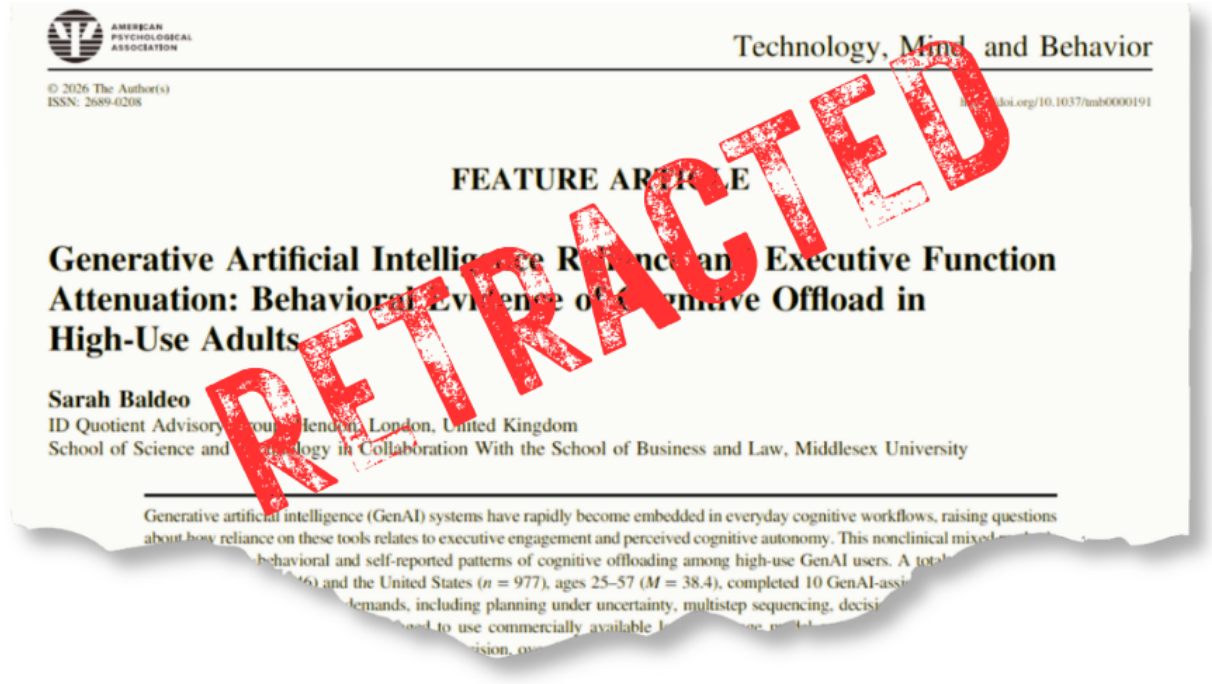
A psychology journal has retracted a paper on how using generative AI can affect confidence in work tasks after its sole author refused to share data with the editors.
The April paper, published in Technology, Mind, and Behavior, which is published by the American Psychological Association (APA), purported to describe the results of a survey of 1,923 adults recruited online to perform AI-assisted tasks. The paper was featured in an APA press release and articles in TIMEand Futurism.
As we wrote in June, experts in the field began flagging issues with the paper’s data on PubPeer shortly after it was published. Sandra Grinschgl, who studies human-technology interaction at the University of Bern in Switzerland, was the first to do so, and later enlisted the help of colleagues Ian Hussey and Malte Elson. Their concerns included inconsistencies in graphs and results, study design, “erroneous” references and a lack of ethics approval.
According to the Aug. 31 retraction notice, the journal requested data as part of its investigation, and the author of the paper, Sarah Baldeo, and the approving research ethics body, ID Quotient Advisory Group, declined. According to the notice, Baldeo and ID Quotient said “the requested transfer of both anonymized participant-level materials and analytic syntax was not authorized under the participant-consent and Canadian [Research Ethics Board] framework governing the study either publicly or under a data-use agreement.”
Baldeo is the founder and CEO of ID Quotient Advisory Group, which provides “neuroscience-enabled IT & AI consulting,” according to its website. A self-described AI neuroscientist, she is also a Ph.D. candidate in AI and neuroscience at Middlesex University in England.
Baldeo told Retraction Watch “the article should be removed from that specific journal record because the journal’s requested post-publication verification pathway was incompatible with the participant-consent and Canadian REB framework governing the study.” She also said she does “not agree with all characterizations in the retraction notice.”
Grinschgl told us she, Elson and Hussey have not heard from the journal, despite flagging their concerns directly
“Empirically, not sharing data is unfortunately normal and under the Canadian consent/REB framework there might be genuine limits on releasing participant-level data,” Grinschgl said. “However, even where participant data can’t be shared, that doesn’t extend to demonstrating the platform the study was run on, or to sharing the statistical/analytic code, neither of which should contain participant data.”
“Withholding those is not normal, it is odd to us. We still doubt that the data collection platform ever existed,” Grinschgl said. “Further, it seems like a remarkable loophole to us that an author can set up a company to grant their own ethics approval.”

Hussey helped create the INSPECT-SR reproducibility checklist for research papers, and psychologist Elson has been involved in assessing the trustworthiness of published research for over a decade. His work previously led to the retraction of a high-profile paper about the psychological impact of first-person shooter video games.
Richard Landers, the editor-in-chief of Technology, Mind, and Behavior, and Christopher Ferguson, the article’s action editor, both declined our request for comment.
The notice also states Middlesex “formally indicated that the research was not approved, conducted, or supervised by the University, and requested withdrawal of its affiliation from the article.” In a now-deleted LinkedIn postarchived here, the university wrote about Baldeo’s “landmark study” and said it was “proud to see #TeamMDX leading the conversation on how AI is shaping the way we think and work.”
In a Bluesky thread about the retraction, Hussey flagged Baldeo’s book, 100 Ways to Future-Proof Your Brain, for containing possible hallucinated references. The book’s publisher, Arc & Edge, was acquired by ID Quotient, Baldeo’s company, on September 8, as announced in a press release written by the group, “Canadian Bestselling Author Buys Her Publisher.” Her book appears to be the only one published by Arc & Edge; however, she denied she owned the publisher before her company acquired it.
When we asked about the alleged fake references, she said she was “not able to respond to generalized social-media allegations.”
She also said she requested a retraction of the paper on June 1 “if correction was not available because I could not authorize disclosure of participant-protected materials outside the participant-consent framework and Canadian TCPS 2 research-ethics principles – which were disclosed pre-publication in January and February 2026 to the APA journal.”
Like Retraction Watch? You can make a tax-deductible contribution to support our work, follow us on X or Bluesky, like us on Facebook, follow us on LinkedIn, add us to your RSS reader, or subscribe to our daily digest. If you find a retraction that’s not in our database, you can let us know here. For comments or feedback, email us at [email protected].
