

Best Open
Cem Dilmeganiwith Ezgi Arslan, PhD.
updated onAug 21, 2026
See ourethical norms
Cite This Research
Open can still play an important role in the future of automation. Its main advantages are transparency, flexibility, and the absence of licensing costs. Below, we list six open-
For a starting point, see our data-driven guides on Python RPA tools, no-code RPA & Python RPA library.
List of open-
Open-e, enabling users to modify and customize the bot code to their needs. The following list includes the top open-
Benchmark results of Open-
We have successfully executed our scenarios using:
- Robot Framework
- TagUI
- OpenRPA
- Log in to the mail
- Search for “refund”
- Open and read emails
- Generate an AI-based response based on company policy.
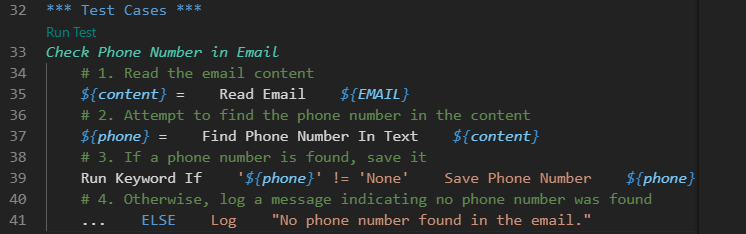
Robot Framework
Robot Framework is an open-oundation and continuously developed through community contributions. It can be used for Acceptance Testing, ATDD, and BDD. Using a single framework for mobile, web, API, and accessibility testing provides significant flexibility
With the Robot Framework, users can use various programming languages such as Python, Java, and .NET.
Robot Framework offers an online editor for users to try out the framework and provides detailed documentation to support learning and implementation.
- Extensive ecosystem of libraries: A wide range of ready-to-use libraries (e.g., SeleniumLibrary, RequestsLibrary, MailClientLibrary) makes handling different automation tasks straightforward.
- Open-source & vibrant community: Maintained on GitHub with an active developer and user community, offering forums and continuous contributions.
- Test-driven approach: Clearly defined test cases and keywords improve the readability and maintainability of automation scenarios.
- Outdated or unsupported libraries: Some community-contributed libraries may no longer be actively maintained (e.g. IMAPLibrary)
- Complex environment setup: New users may find it tricky to coordinate multiple components (Selenium drivers, Python versions).
TagUI
TagUI is an RPA tool supported by open- language scripting, which supports more than 20 languages, and cross-platform compatibility to simplify automation tasks
Its integration with R and Python and support for visual and web automation makes it suitable for a wide range of applications. It is compatible with multiple platforms, including Windows, macOS, and Linux, offering flexibility for diverse operating environments.
TagUI’s natural language-like syntax makes it easy to develop, deploy, and use for automation tasks.
TagUI also has a comprehensive YouTube learning series.
- Easy command syntax: Simple, script-based scripts can be prepared with clear commands such as type, click, js begin, and js finish.
- Terminal-based operation: TagUI supports running commands directly through a script or command line, which can be efficient for users comfortable with terminal environments.
- Lack of drag-and-drop interface: Compared to GUI-based RPA tools, the learning curve can be steeper for non-command typing users.
- Sensitivity to dynamic interface updates: The script may require frequent maintenance as ID/XPath changes in Yahoo or other services.
- Limited debug and log: While switching to “debug” mode for error analysis is possible, encountering errors instead of detailed messages can be challenging for beginners.
Open RPA
OpenRPA has a drag-and-drop interface supported by an active developer community. Its low-code design makes it accessible to both experienced programmers and users with limited coding experience. The platform provides an orchestration layer through the OpenFlow component.
- Founder is active: The project’s founder actively participates in the community and development.
- Drag-and-drop interface: Users can design automation workflows using a visual drag-and-drop interface.
- Integration with Node-RED: OpenRPA is compatible with Node-RED and allows users to visualize flows.
- Weak documentation: The available documentation can be less comprehensive, making it harder for new users to get started or troubleshoot.
Previously available open-
Automagical
Automagica provided an open-tomagica was a free, open-oftware if you were going to use it for business. The company was acquired, and the software is no longer open-source
AI-driven open-
Skyvern
Skyvern is an open-instead of fixed selectors. It is licensed under AGPL-3.0 and had about 22,000 GitHub stars in June 2026.1
Selector-based bots break when a page layout changes. Skyvern reads the screen as an image, finds the target element, and acts on it. A workflow keeps running after a site redesign, with no script rewrite.
It works with several model providers, including OpenAI, Anthropic, Google Gemini, and local models through Ollama. It offers a Playwright-compatible SDK for developers and a no-code workflow builder for non-developers.
Before investing in an open-ystem. Our up-to-date research on the future of open
- Open source does not yet have the momentum to shape RPA, as no big corporations have embraced open-source projects
- Current RPA providers face an innovator dilemma as open source will cause them to reduce their prices
- As the RPA market grows, projected to reach $38B by 2032, so will the open-source market2
- The future of RPA will involve more open-source tools.
Get our team to automate one of your business processes with AI agents, free of charge.
Automate a process
The future of open-
1. Open
Open-e to their benefit. Some, like Android and Chromium, are started by these companies, while others, like Linux and WordPress, are adopted for their competitive edge. However, this has not happened in Robotic Process Automation (RPA) yet
In the modern software world, all four major cases of open-
Successful openpart of their offering:
Linux: Without vendors like Red Hat, acquired by IBM in 2018 for $ 34B, the Linux ecosystem would be different today. Though Linux was not founded by a for-profit company, its growth relied heavily on enterprise software vendors. This was a win-win situation.
These vendors could access a competent server operating system for free to reduce the total cost of ownership for their enterprise customers and still make healthy profits by offering support services. Linux ecosystem also benefited as these vendors contributed to the software.
WordPress: WordPress, the content management software powering ~30% of the web, is commercialized by numerous companies. 3 The most prominent company commercializing WordPress is Automattic, founded by the founders of WordPress. Automattic was valued at >3bn in 2019. 4
Android: Google launched Android to reduce Apple’s control over mobile operating systems and to support its mobile advertising business.
To grow adoption quickly, Google made Android openson to adopt it. Android became widely used and now holds a large share of the global mobile operating system market
Chromium (the code on which Google Chrome is based): Chromium is the open-d’s, but in the browser market. At the time, Microsoft had a dominant position
In contrast, large RPA vendors have been slower to adopt open-
This could change if a mature and reliable open-lities of closed- to clients
This approach could lower software costs for customers and make RPA accessible to a wider range of organizations.
2. The future of RPA is likely to involve more open-source
As technologies like operating systems matured, open-hich Apple’s proprietary iOS kickstarted, is now dominated by Android in terms of the number of users
There are a few driving factors to increasing open-source adoption as solutions mature. As solutions mature,
– Core functionality becomes clear, and in most cases, it becomes easier to replicate. As a software component matures, it becomes easier to build it from scratch using modern tools
– Solutions need to rely more on outside developers for components to cover the needs of specific customer segments. Both customers and component developers don’t want to get locked into a proprietary system and support open source efforts as technologies mature.
We see this trend happening in RPA as well.
3. Python RPA has gained more importance
Python RPA has gained more attention than open-. Python provides a wide range of tools, is easy to integrate with existing systems, and has a strong community support. This makes it a preferred choice for tasks in data science, automation, and web development
As companies focus on scalable and flexible automation solutions, Python’s ability to adapt meets these changing needs better than other technologies.
4. Open-
While RPA was a standalone solution until a few years ago,there is now a wide range of companies, including process mining and AI vendors, that are crucial for RPA deployments. For example, process mining vendors enable companies to easily identify automation opportunities.
Open-
Don’t miss our benchmarks and data-driven insights. The button opens Google; selecting AIMultiple confirms that you wish to see AIMultiple more often in Google search results.
Add as preferred source
For many small and mid-sized companies, the initial cost of licensing can be a barrier to starting an RPA initiative. In such cases, open-mpanies, open-y overlook, such as Python automation
Robotic process automation is still in its early adoption stages in many organizations, leading to a potential synergy between open-
There is no one-size-fits-all solution; therefore, focus on understanding the benefits and value of RPA and selecting tools that can maximize this value within your budget. As initiatives progress, a combination of commercial and open-en
RPA, or robotic process automation, is an easy-to-use business process automation technology. RPA has 100+ use cases and many business benefits.
In the open-source RPA, there has been a rapid rise in general web automation solutions, allowing businesses to automate repetitive tasks across standard web browsers.
Some open-source RPA tools provide extensive automation capabilities that can integrate with visual automation tools. These solutions offer the ability to scale across multiple platforms, with support from leading cloud providers, ensuring smooth execution of process automation.
Beyond basic task automation, open-source RPA also provides advanced features such as web scraping and remote management, making it ideal for handling tasks like processing complex accounting rules and conducting web testing.
The integration of machine learning and text recognition technology enhances the potential for intelligent automation. This is particularly useful in enterprise-level robotics applications, where security is crucial and enterprise-grade security is a top priority. As the industry grows, rapid prototyping is key to exploring new use cases, especially in an emerging market where the competition between open-source solutions and commercial vendors continues to evolve.
Openatures such as drag-and-drop interfaces, enabling non-developers to easily automate tasks like form filling and simple web automation without coding. Additionally, the availability of community editions and comprehensive documentation further supports non-technical users, helping businesses increase efficiency without additional costs
Image recognition is a critical feature within many open-processing, such as screen navigation, UI interaction, or handling graphical data. Integrating image recognition enhances intelligent automation, expands use cases, and allows users to build more versatile automation workflows, further reducing manual effort and operational costs
For more on RPA
For more info on RPA, feel free to read our research on:
Cite this research
Pick the format that matches where you’re publishing. Pasting the link version into your CMS preserves the backlink.
Cem Dilmegani and Ezgi Arslan, PhD. (2026) – “Best Opengust 21, 2026, from: https://aimultiple.com/open-ugust 21). Best Opena
@misc{dilmegani2026,
  author = {Dilmegani, Cem and PhD., Ezgi Arslan,},
  title  = {{Best Open Source RPA Tools}},
  year   = {2026},
  month  = aug,
  howpublished    = {url{https://aimultiple.com/open-source-rpa}},
  note   = {AIMultiple. Retrieved August 21, 2026}
}
Cem Dilmegani
Principal Analyst
Follow On
Cem has been the principal analyst at AIMultiple since 2017.
Cem’s work at AIMultiple has been cited by leading global publications including Business Insider, Forbes, Morning Brew, and Washington Post, global firms like Deloitte and HPE, NGOs like World Economic Forum, and supranational organizations like European Commission. [1], [2], [3], [4], [5]
Throughout his career, Cem served as a tech consultant, tech buyer and tech entrepreneur. He advised enterprises on their technology decisions at McKinsey & Company and Altman Solon for more than a decade. He also published a McKinsey report on digitalization.
He led technology strategy and procurement of a telco while reporting to the CEO. He has also led commercial growth of deep tech company Hypatos that reached a 7 digit annual recurring revenue and a 9 digit valuation from 0 within 2 years. Cem’s work in Hypatos was covered by leading technology publications like TechCrunch and Business Insider.
Cem regularly speaks at international technology conferences. He graduated from Bogazici University as a computer engineer and holds an MBA from Columbia Business School.
View Full Profile
Researched by
Ezgi Arslan, PhD.
Industry Analyst
Follow On
Ezgi holds a PhD in Business Administration with a specialization in finance and serves as an Industry Analyst at AIMultiple. She drives research and insights at the intersection of technology and business, with expertise spanning sustainability, survey and sentiment analysis, AI agent applications in finance, answer engine optimization, firewall management, and procurement technologies.
View Full Profile
