

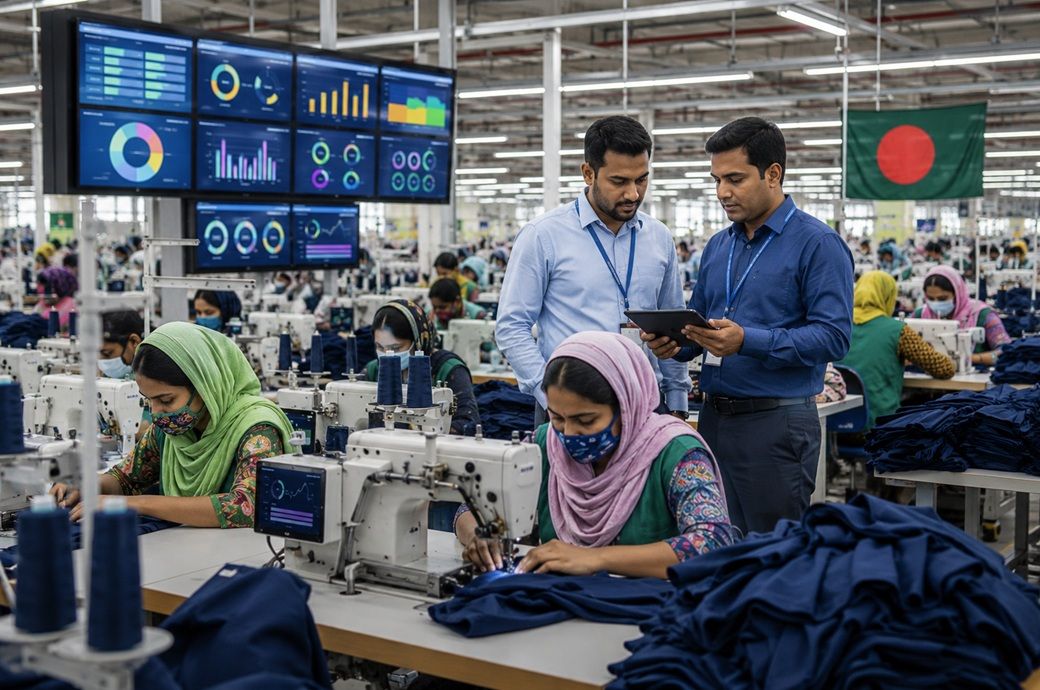
Bangladesh’s RMG sector bets on technology for a productivity edge
Insights
- Bangladesh apparel exporters are adopting digital monitoring, data-driven production and AI tools to raise productivity, reduce downtime and improve quality.
- Some factories report gains of up to 25 per cent versus manual monitoring, though results vary by technology, conditions and measurement.
- The shift also raises concerns over worker pressure, privacy and fair sharing of productivity gains.
For Bangladesh’s apparel industry, digitisation and technology are rapidly shifting from an efficiency-enhancing option to a business imperative. With exports at a critical crossroads, manufacturers are confronting intensifying global competition, thin margins and an increasingly fluid trade environment. There is therefore little room to overlook technologies that can help unlock greater value from existing capacity.
Apparel exporters are increasingly turning to digital monitoring, data-driven production systems and artificial intelligence (AI)-enabled tools to raise productivity, minimise downtime, detect defects faster and improve operational efficiency. In a global market where buyers demand greater efficiency, consistent quality and increasingly competitive prices, digitisation is no longer simply a technological upgrade. It is becoming a means of protecting competitiveness and sustaining growth.
For factory owners and managers, the attraction is straightforward: digital systems can provide greater visibility over production and help factories get more out of their existing machines, workers and production lines. When a machine stops unexpectedly, for example, predictive systems can identify patterns and anomalies that may indicate an impending failure, allowing maintenance teams to intervene before a breakdown disrupts production.
Similarly, when production falls behind target, real-time data can alert managers immediately rather than forcing them to wait for manual reports. Access to timely information on production, machine performance, quality and downtime can make operational decisions more precise and performance assessment more transparent.
Manufacturers and industry officials say such systems can deliver significant productivity gains. Some factories are said to have reported improvements of up to 25 per cent compared with manual monitoring, although the scale of such gains is likely to vary depending on the technology used, factory conditions and how productivity is measured. What matters is that digital tools can allow factories to identify bottlenecks and inefficiencies that are difficult to detect through conventional monitoring alone.
Yet the digital transition has another dimension that cannot be ignored: its impact on workers.
When every minute, machine and piece of output become measurable, technology can improve efficiency—but it can also intensify pressure on employees. Some labour leaders have reportedly raised concerns that hourly targets, digital performance tracking and incentive schemes could gradually shift from encouraging higher productivity to demanding output beyond a worker’s sustainable capacity.
This makes the distinction between using technology to improve production and using technology simply to monitor workers particularly important. Digital systems should not become a mechanism for continuously increasing targets without considering fatigue, safety, skills and the physical realities of factory work.
There are also broader questions about worker privacy, algorithmic performance assessment and the distribution of productivity gains. If technology enables a factory to produce more with the same capacity, workers should have a stake in that improvement through better wages, training, incentives and opportunities for career progression.
The answer, however, is not to resist digitisation. Bangladesh’s apparel industry cannot afford to ignore technologies that can improve productivity, quality and competitiveness. The challenge is to manage the transition responsibly.
More Apparel/Garments News – Bangladesh…
Popular News
Editor’s Pick

TextilesUS manufacturing jobs rise 16,000 in August
4 min read
TextilesNew Zealand, Australia accelerate Single Economic Market work
2 min read
TextilesGlobal FDI rises 6% as UNCTAD flags concentrated recovery
3 min read
Interviews
View All
Dr. Harald WeberVDMA Textile Machinery Association
VDMA leads the way in driving innovation, sustainability…
Vaibhav PradhanForbes Marshall Private Limited
We drive textile decarbonisation
Michael RyanFESPA
We drive the evolution of print
Oriana OquendoLeccese Designs
We create designs that feel deeply personal
Gaurang BatraFrontier Raas
Bridal and couture at Frontier Raas are labours of love
Claudiu Petru CiubotaruNo44
We have always believed that good denim is meant to last
Esteemed Clients
‘ +
‘
‘;
}
}
colHTML += ”
“;
}
slideHTML += colHTML + ”
“;
$(‘.client-horizontal1’).slick(‘slickAdd’, slideHTML);
}
$(‘.client-horizontal1’).slick(‘setPosition’);
},
error: function (data) {
console.log(data);
},
complete: function () {
isLoadingClients = false;
}
});
});
