

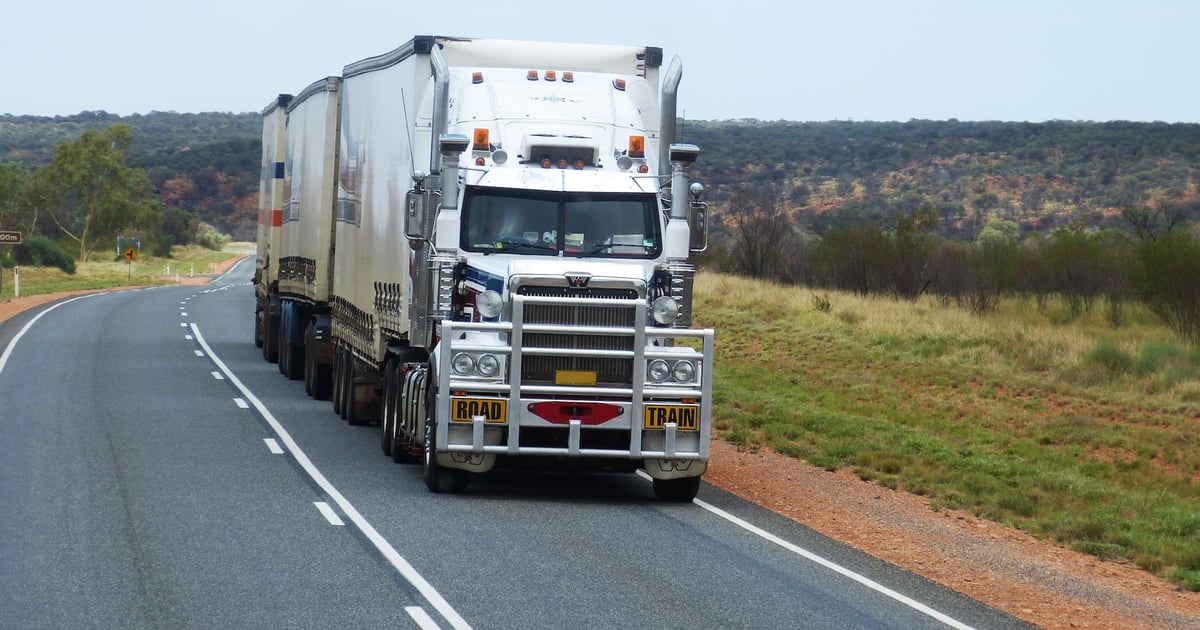
The Institute for Energy Economics and Financial Analysis (IEEFA) provided input for the report.Image: IEEFA.
Australia’s Productivity Commission has released its final report on heavy vehicle reform, identifying regulatory and planning barriers to electric truck charging infrastructure as one of five priority reform areas needed to restart a decade of stalled road freight productivity growth.
The report,Impacts of heavy vehicle reform, was commissioned by Treasurer Jim Chalmers in September 2025 and delivered to the government on 30 June 2026, before its public release.
It sets out the Commission’s findings across five reform areas: access for high-productivity and heavy zero-emission vehicles (HZEVs), acceleration of a National Automated Access System (NAAS), administrative and regulatory barriers to charging infrastructure, heavy-vehicle curfews, and the National Heavy Vehicle Driver Competency Framework.
The Commission found that road freight physical productivity has stalled for more than a decade as trucks reached their technical and regulatory limits, and that advances in vehicle technology and design, including HZEVs, provide an opportunity to restart that growth while improving emissions outcomes.
It noted that “the recent fuel supply disruption has only strengthened the case for reform to unlock higher productivity and lower emissions vehicles,” pointing to high productivity vehicles, HZEVs and automated permits as the key levers available to policymakers, but only if all tiers of government collaborate to remove the regulatory barriers currently holding investment back.
Charging infrastructure gets a dedicated chapter in the Commission’s report
Unlike earlier state and territory-level reform discussions, the federal report devotes an entire chapter, Chapter 4, specifically to administrative and regulatory barriers facing HZEV charging infrastructure.
The Commission’s recommendations in this area centre on updating land-use planning regulations to recognise EV charging as an emerging and legitimate form of land use, rather than treating it as an ad hoc addition to existing frameworks designed around fuel stations and diesel refuelling infrastructure.
The report also examined grid connection challenges facing charging infrastructure developers, concluding that while connections remain genuinely difficult in many locations, this is largely not attributable to administrative or regulatory failures on the government’s part, a distinction that shifts some of the practical burden back toward network capacity and technical planning rather than red tape alone.
The Commission separately called for improved information to guide investment decisions, recommending clearer data and guidance to help charging infrastructure developers select viable sites, and highlighted heavy vehicle rest areas as warranting particular attention, given their existing role in the freight network and their potential to host shared charging infrastructure serving multiple operators.
The Commission’s key points summary states plainly that “governments are working together on new national approaches, while individual jurisdictions are pursuing reforms that demonstrate how new technologies can improve vehicle access and how regulations can be updated to recognise electric vehicle charging as an emerging form of land use,” but cautions that “more can be done to accelerate this work.”
Some of that jurisdictional activity is already underway.New South Wales opened an expression of interest process for heavy EV charging hubs under an AU$100 million (US$71 million) fuel security programme, targeting commercial-scale projects worth at least AU$100 million as the state works to build out the public charging network that commercial operators say they need before committing to full electrification.
In Melbourne,NewVolt broke ground on Australia’s first open-access heavy-duty truck charging hub at Laverton North, backed by an ARENA commitment of up to AU$25.3 million, illustrating the kind of shared-infrastructure model the Commission’s recommendations on rest areas and land use planning are designed to support at scale.
TheAustralian government has also backed a large-scale zero-emission heavy road freight depot at New Energy Transport’s Wilton facility in New South Walesthrough its Investor Front Door programme, and theClean Energy Finance Corporation (CEFC) committed AU$22 million to Zenobē Australia to fund the rollout of 148 battery-electric trucks for Woolworths, the largest single electric truck fleet deployment in the country to date.
Curfews, mass limits and driver competency round out the reform package
Beyond charging infrastructure, the Commission recommended adjusting noise-based curfews to exempt HZEVs, noting that heavy zero-emission vehicles operate considerably more quietly than their diesel equivalents, meaning blanket time-based restrictions designed around combustion engine noise are no longer well targeted at their original purpose.
The report argues that curfews should instead be tied more directly to actual noise output rather than vehicle category or time of day alone.
Regarding road access, the Commission’s economic modelling found that the largest potential productivity benefits would come from reforms that widen access to Australia’s road network for high-productivity vehicles.
Increasing General Mass Limits, a proxy for broader road access reform, could boost long-run GDP by between 0.03% and 0.10%, equivalent to between AU$900 million and AU$2.7 billion based on 2024-25 GDP, depending on the level of ambition pursued. Implementing the National Automated Access System, which the Commission said would substantially reduce trucking permit applications, was modelled to boost long-run GDP by a further 0.02% to 0.05%, or AU$600 million to AU$1.3 billion.
The Commission recommended prioritising reforms that move toward “as of right” access, reducing the time and cost associated with applying for permits for pre-approved vehicles operating on pre-approved networks, alongside additional funding for the road infrastructure assessments needed to support informed access decisions and a focus on building local government capacity so the NAAS rollout does not fall further behind schedule.
The report also addressed the National Heavy Vehicle Driver Competency Framework, finding that national driver competency reforms aimed at improving safety have already been agreed, though implementation across jurisdictions will largely occur between 2026 and 2028.
The Commission modelled that implementing the framework would boost long-run GDP by a comparatively modest 0.004% to 0.015%, or AU$100 million to AU$400 million.
The report’s release followed treasurers from federal, state and territory governments agreeing to a package of heavy vehicle productivity reforms carrying AU$400 million in Commonwealth funding for states and territories, delivered through the National Productivity Fund and contingent on jurisdictions delivering agreed reforms.
The package is intended to streamline truck permitting, reduce regulatory burden for zero-emission trucks, and work toward exempting near-silent electric vehicles from noise-based curfews, aligning directly with the Commission’s own recommendations on access reform and curfew targeting.
For heavy-duty charging infrastructure specifically, the Commission’s findings suggest the primary constraint on deployment in Australia is shifting away from a simple lack of funding, given the scale of programmes already committed through ARENA, the CEFC and state schemes, and toward the planning, land use and information gaps that determine how quickly that funding can be translated into operational charging sites.
Whether the reforms agreed by treasurers translate into the land use and planning changes the Commission has recommended will likely determine how quickly Australia’s heavy-duty charging network can scale to match its growing electric truck fleet.
heavy-duty vehiclesHeavy-duty EVAustraliaev chargingEV chargepointev charger
