

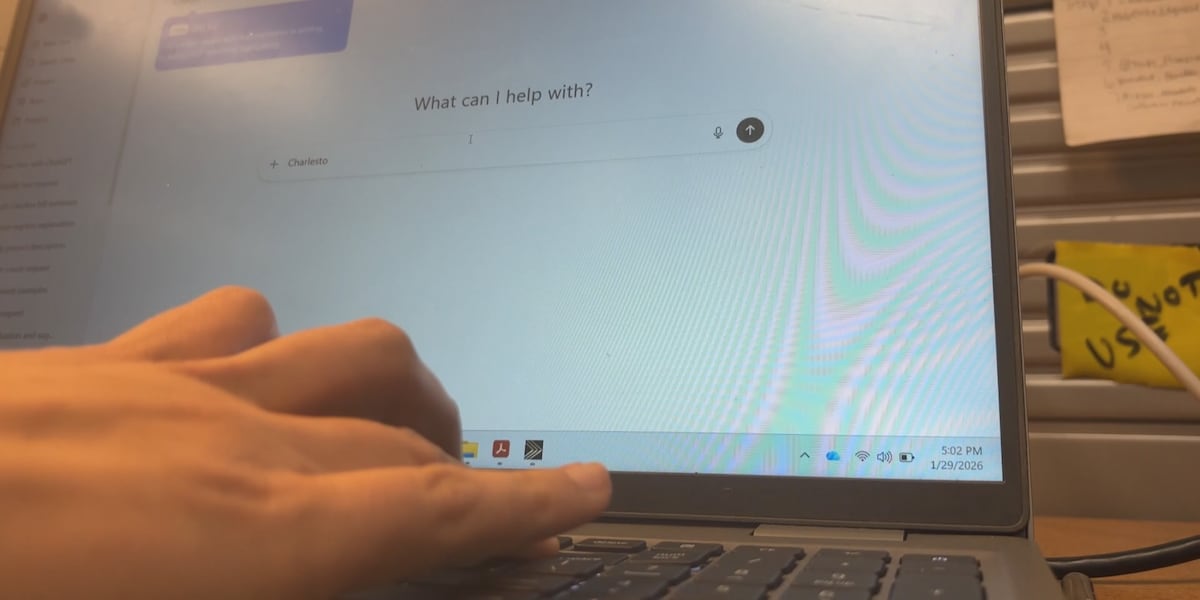
S.C. (WCSC) — As students return to classrooms across Charleston County, new technology is becoming part of the conversation
The Charleston County School District is launching a districtwide <a href="https://bitcomme.com/north-carolina-central-university-opens-ncs-first-artificial-intelligence-building/" title="North Carolina Central University opens NC's first artificial intelligence building”>artificial intelligence policy this school year aimed at teaching students and staff how to use AI responsibly rather than trying to keep the technology out of classrooms.
District leaders said the question is no longer whether students and educators will interact with artificial intelligence, but how they can use it in a way that supports learning while protecting academic integrity.
Superintendent Anita Huggins said CCSD is among the first districts to create a comprehensive approach to artificial intelligence in schools.
“We’re fortunate to be one of the first districts in the nation that has really implemented a robust policy, which we hope will respond to and answer some of the questions and concerns from parents and the community,” Huggins said.
Dr. Luke Clamp, the deputy superintendent for the Charleston County School District, said introducing new technology requires finding a balance between innovation and engagement.
“Integration of any new technology is really a delicate dance between the engagement with students and staff and how that technology can make it more efficient,” Clamp said.
Clamp said the district’s first step with artificial intelligence is building understanding among students, staff and families.
“For Charleston County School District, the integration of artificial intelligence first begins with literacy, building the background literacy of staff, of students and of families to both understand how the technology works and then more specifically how the technology will work for them,” Clamp said.
The district said that foundational literacy is built around what it calls the SEE framework: safe, ethical and effective.
Clamp said anyone using generative AI should first consider whether the technology is safe, including whether data is protected and how information entered into an AI system could impact the output.
“‘Is what I’m using or integrating safe?’” Clamp said. “‘Is there data integrity? Is there a safety amongst anything that I’m putting into the engine versus what’s going to be on the output?’”
The district also wants students and staff to consider the ethical use of artificial intelligence.
Clamp said AI should be used to enhance learning, not replace critical thinking or original ideas.
“‘Am I using it to improve or to enhance what I’m doing, not to create something brand new?’” Clamp said. “We want our students to still think critically, to solve problems collaboratively and to really be able to generate ideas on their own while using technology to make it more enhanced and improved.”
The final piece of the framework focuses on effectiveness. Clamp said users should evaluate whether AI-generated information is accurate and reliable before using it.
“Has the output from the engine really been analyzed for its integrity?” Clamp said.
During the summer, teachers from across Charleston County participated in professional development sessions with the AI for Education Foundation. The training focused on how generative AI works and how it can be used to support classroom instruction, lesson planning, presentations and student assignments while protecting academic integrity.
District leaders said the policy provides guidance, not requirements. Teachers will decide whether and how AI tools are used in their own classrooms based on what best supports their students.
Clamp said conversations about artificial intelligence should extend beyond the classroom and into students’ homes.
“I’m a parent myself, so I’ve got a high school student and one going into college,” Clamp said. “So these conversations about the use of any form of resource is something that’s happening in our own home.”
Clamp encouraged parents to stay involved in how their children are using technology.
“First of all, I tell parents, get involved,” Clamp said. “Don’t assume if they have no homework that that’s truly what’s happening.”
District leaders said the goal is to balance the benefits of new technology with the importance of human connection in education.
“We don’t believe there’s any replacement for a teacher in the classroom,” Clamp said. “We don’t believe there’s any replacement for a conversation and dialogue among students.”
Clamp said while technology will continue to evolve, the district has a responsibility to prepare students for a future workforce shaped by artificial intelligence.
“Technology is going to continue to enhance, and it’s our moral responsibility to give our students experience with it as the career field that they’ll enter regardless of their grade level now will be dramatically different than the ones we entered when we exited high school and college,” Clamp said.
Superintendent Anita Huggins said the district’s goal is to make sure artificial intelligence supports student learning without replacing the skills students need to develop.
“I want the public to know that we take this seriously and our job is to teach students how to collaborate, how to communicate and how to think critically and not to allow those processes to be replaced by technological systems, including AI,” Huggins said.
“We’re looking forward to a new year and learning and growing through it,” Huggins said.
Along with teacher training, district leaders said every student, from early grades through high school, will receive some level of AI literacy instruction this school year.
The district is also investing in AI tools and infrastructure, with funding already budgeted for artificial intelligence initiatives in fiscal year 2027.
CCSD’s first AI initiative will be a one-year pilot program with MagicSchool, an AI-powered instructional tool designed to support teachers with tasks like lesson planning and classroom preparation. District leaders said the pilot is expected to launch later this fall.
As artificial intelligence continues to become more common in education and the workplace, district leaders said the goal is not to replace traditional learning, but to help students understand how to use new technology responsibly.
Copyright 2026 WCSC. All rights reserved.
