

SHARE ON
READ NEXT
At Expo Industrias, competitiveness gets discussed on the plant floor
Argentina brought its tech sales pitch to San Francisco in October with a bigger promise than skilled engineers. The country, speakers argued, can give the AI economy both the people to build it and the energy to run it.
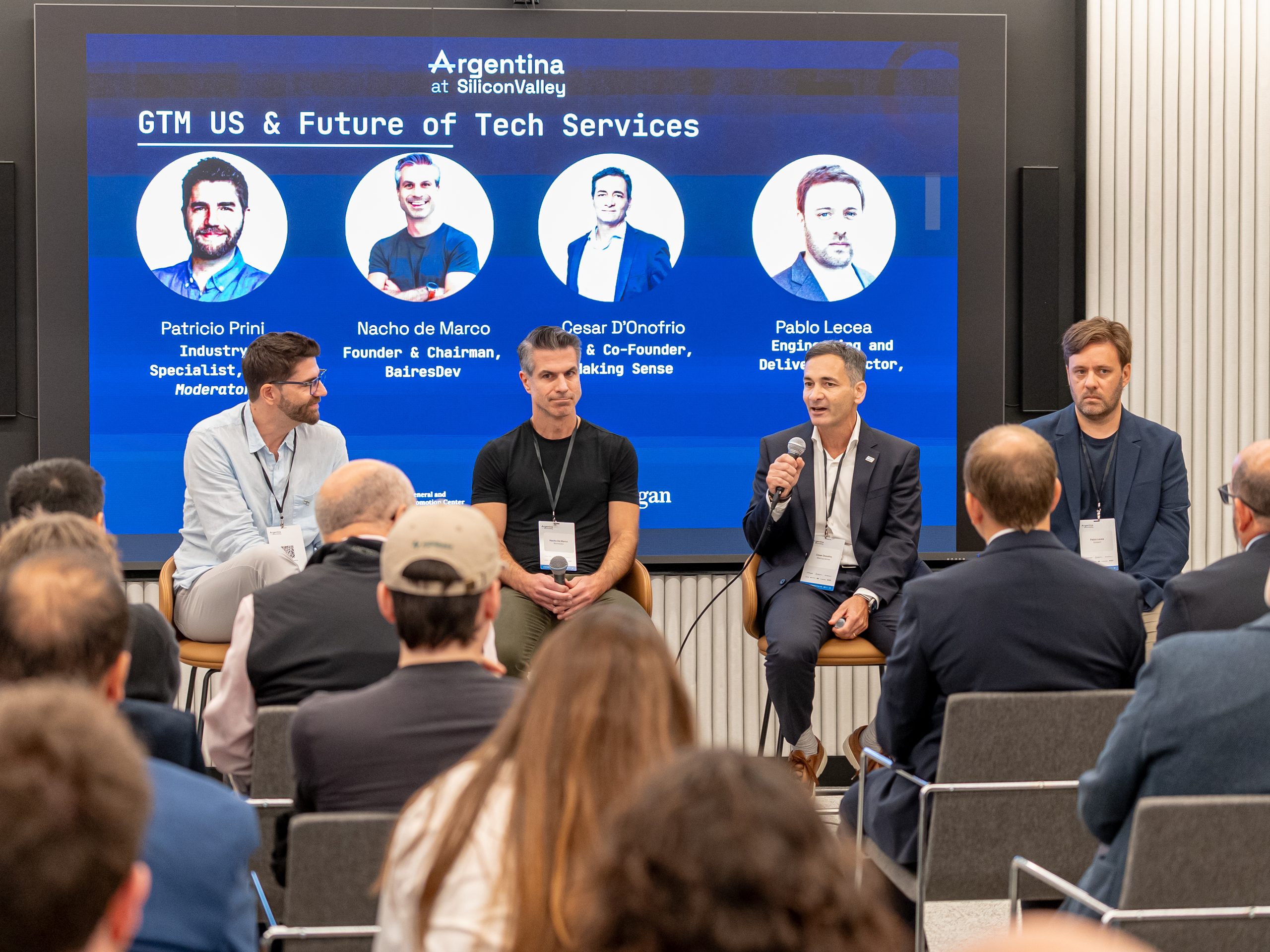
The case was made at “Argentina at Silicon Valley,” a full-day event hosted on October 7 by the Embassy of Argentina in the United States at JPMorgan’s San Francisco building. It ran as part of SF Tech Week, the festival organized by venture capital firm a16z (Andreessen Horowitz).
Ambassador Alec Oxenford, a tech entrepreneur whom President Javier Milei sent to Washington in late 2024, led the first edition. More than 500 founders, investors and executives attended.
About half were startup founders themselves. They shared the room with Argentine-born companies such as Mercado Libre, Globant, Despegar and Tiendanube, staff from Google, Microsoft, AWS, NVIDIA and OpenAI, and investors including SoftBank, Goldman Sachs and Endeavor.
The event is part of the Milei government’s drive to court U.S. tech capital. Argentina’s knowledge economy, which covers software, IT and professional services sold abroad, exported a record $9.6 billion USD in 2025, up 8.1%, according to Ministry of Economy figures based on INDEC data. The sector employs more than 285,000 people in formal jobs.
It now accounts for 53% of Argentina’s services exports and ranks as the country’s third-largest export complex, behind grains and oilseeds and oil and petrochemicals.
Growth has continued in 2026. Industry body Argencon says exports crossed $10 billion for the first time in the twelve months through March, up 11.7%.
Selling to a buyer’s market
The agenda spanned venture capital, with investors from a16z and MELI VC, biotechnology, and Argentina’s potential to power AI’s computing needs, with a panel featuring state oil company YPF.
One session tackled how Argentine tech services firms win U.S. clients. Around 120 people attended “Development and Engineering Services from Argentina.”
On stage were Diego Fernández, senior vice president at Globant, Nacho De Marco of BairesDev, and Cesar D’Onofrio, CEO and co-founder of Making Sense. His firm helps U.S. mid-market and private-equity-backed companies grow through AI-driven solutions and software modernization.
D’Onofrio said American buyers have changed what they want. “My message was simple: today it’s a buyer’s market,” he said. “Companies aren’t looking for capacity; they’re looking for someone who has already solved their problem. That’s why specialization and trust are what open doors, and trust is built in person.”
That is why Argentine firms keep turning up at events like this one. For D’Onofrio, who lives and works in Silicon Valley, the real value lies in the conversations between sessions and the chance to see where the industry is heading.
Beyond writing code
For decades, Argentina sold U.S. companies on skilled engineers in a convenient time zone at a competitive price. Generative AI is testing that model.
Argencon has acknowledged that AI brings challenges as well as opportunities for countries built on specialized talent. The panelists leaned toward opportunity.
“AI is shifting value away from writing code and toward solving business problems,” D’Onofrio said, “and it makes projects viable that used to be too expensive, like modernizing legacy systems.”
Fernández agreed that results depend on more than technology. Moving AI from research to real-world impact, he explained, requires understanding a company’s organizational context, not just deploying models, pilots or agents.
The opening for Argentine firms is to turn engineering expertise into measurable outcomes for U.S. clients, the panel argued. At Making Sense, that already shapes its work with mid-market and private-equity-backed companies, where AI and modernization projects are increasingly tied to wider business goals.
Power and talent
AI and energy came up again and again during the day. D’Onofrio sees them as one opportunity.
“Argentina has something very few countries have: top-tier talent and the energy to power AI infrastructure,” he said. “It’s an enormous opportunity, and we have to seize it.”
Oxenford pressed the same point from the stage. He cited Vaca Muerta’s shale reserves and Patagonia’s wind, sun and cold climate as reasons Argentina could host the energy and data centers AI will need.
He also said Buenos Aires “can be for artificial intelligence what Amsterdam was for trade.”
The day closed with Oxenford in conversation with two Argentines who represent each half of that pitch: Vercel founder Guillermo Rauch and Vista Energy founder Miguel Galuccio.
The ambition is large. Argencon projects knowledge-economy exports could hit $30 billion within a decade, but only with macroeconomic stability, clear rules and a long-term talent policy.
The talent part is already a worry. Argencon has warned that Argentina’s 72nd-place ranking out of 91 in PISA mathematics puts the sector’s future pipeline at risk.
Featured image: courtesy of Making Sense
Disclosure: This article mentions a client of an Espacio portfolio company.
SHARE ON
Salome Beyer Velez is the Deputy Editor of ESPACIO Media Incubator and Senior Reporter at Latin America Reports. Born in Medellín, Colombia, Salome has an MA in History and Politics from the University of Edinburgh. She’s also a columnist at Colombian outlet No Apto, and was a former Project Assistant for the Global Forum for Media Development, as well as the President of the University of Edinburgh Latin American Society. Her work has appeared in Al Jazeera, The Latin Times (from the International Business Times), El Nacional, Entrepreneur Magazine, Vogue México, and others.
You Might Also Enjoy

Business
Argentine startup aims to disrupt space sector with sustainable, low-cost, ultra-light rocket
Analysis
Head of the Central Bank Luis Caputo resigns amid IMF negotiations and general strike
