

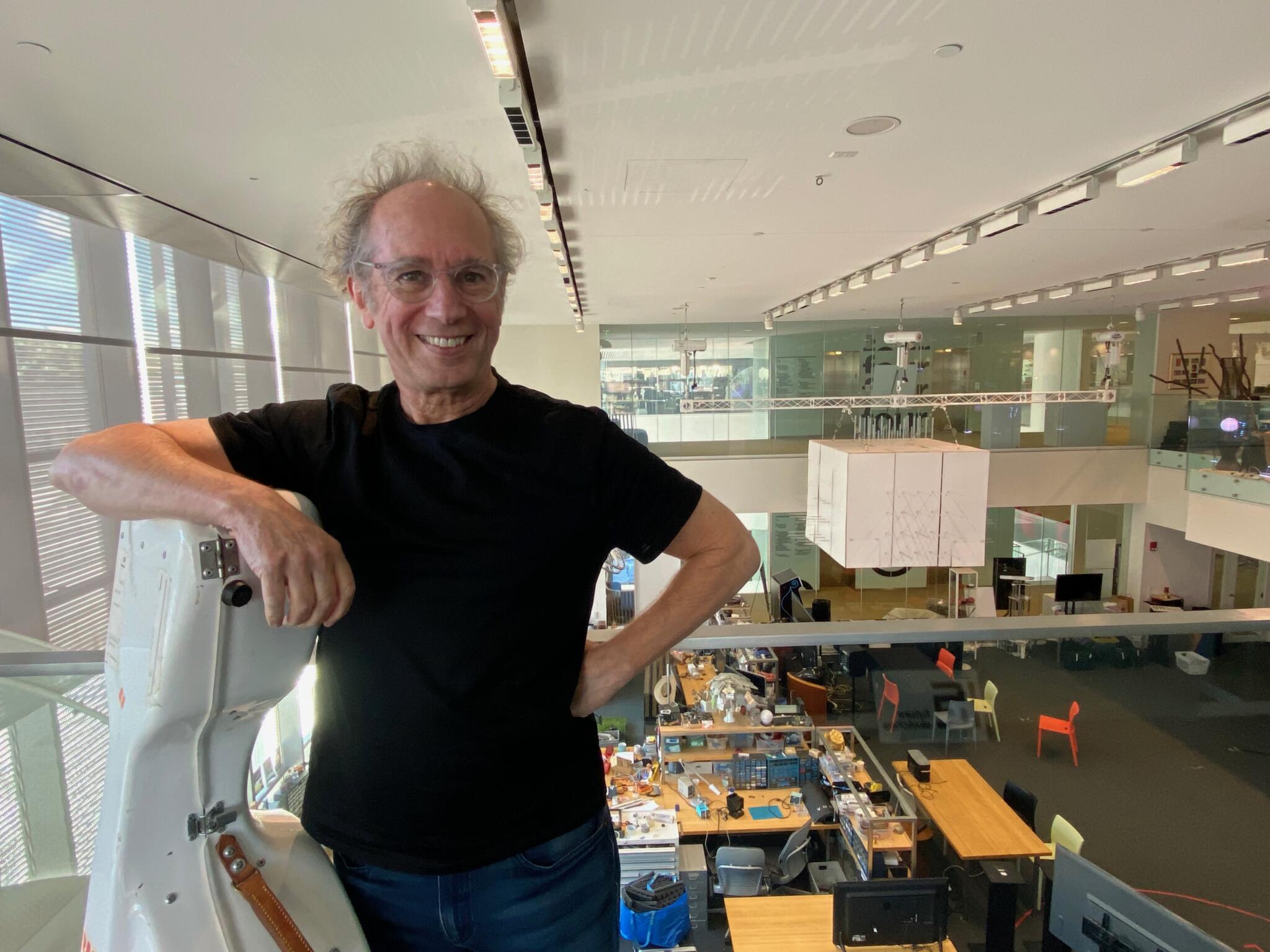
MIT Media Lab professor Tod Machover has been merging music with cutting-edge technology for nearly half a century. There’s the “hypercello” he invented for Yo-Yo Ma in 1991. And his robot opera that became a 2012 Pulitzer Prize finalist. Now Machover is premiering one of the most challenging experiments of his career: an interactive composition he wrote for the Boston Symphony Orchestra and artificial intelligence.
Yes, AI will be taking the stage at Symphony Hall.
“There are lots of kinds of AI, and I don’t think anybody has done anything quite like this with a major symphony orchestra,” Machover said at the Media Lab a few weeks ago. “For 30-plus years I’ve been interested in technology, and I want the technology to respond to what humans are trying to express.”
Machover, now 72, has been called “America’s most wired composer” by the Los Angeles Times. Two years ago he jumped at the chance to express something entirely new through a BSO commission to mark the Media Lab’s 40th anniversary. Machover was a founding faculty member in 1985.
The Juilliard alum – who worked with pioneering, avant-garde composers Elliott Carter and Pierre Boulez – holed up in his 18th-century barn behind his Waltham home and got to work. Over many months, Machover crafted a 25-minute piece titled “already and not yet” that pairs 80-plus musicians with a new kind of AI system.
To bring it to life, the composer joined forces with Manaswi Mishra, a doctoral student in Machover’s Opera of the Future group. “We’re interested in how we think <a href="https://bitcomme.com/real-or-not-teaching-children-about-generative-ai-2/” title=”Real or Not? Teaching Children About Generative AI”>about this as an instrument,” Mishra said, while sitting in front of an array of computer monitors in a Media Lab studio.
The 32-year-old has built AI instruments for expert musicians before, but never for an entire orchestra. The new software is not the type of AI that spits out a song after being prompted with a few words.
“It’s a collaborator, and we’ve designed it like that,” Machover said. “It’s in dialogue with the live musicians playing on stage — either something I’ve written, an extension of what I’ve written, or some things that are improvised. The AI isn’t trying to take what the musician does and make a new piece out of it – it’s trying to respond and have a back and forth.”
Mishra will also be on stage at Symphony Hall, guiding the sophisticated technology’s responses to musicians’ sounds. “We can make their harmonic information stand out, we can make the rhythmic information stand out, we can make the timbre move in different directions,” he said.
Mishra believes in smart technology’s potential in the hands of human musicians. “I do not think the future of AI music is in just requesting music, but actually participating in the happening of the music,” he said.
“already and not yet” is Machover’s meditation on the power of dialogue in a newly imagined democracy. The work’s three movements – titled “Smash Up,” “Wake Up” and “Stand Up” – are a journey through crisis to awakening. The orchestra’s musicians represent society, and Machover said the final movement is his vision “of what happens with these 100 players not only listening to each other, but having to negotiate a new way to communicate.”
The composer wants the players to be inspired by what the AI gives back to them on stage.
“When you have a solo, you not only get to play your solo, but you get to bend it, improvise a little bit on it, and the AI responds,” he said. “It’s a back and forth – and it’s different for each performer.”
Machover and Mishra didn’t have access to the orchestra to “tune” the AI, so they enlisted New England Conservatory students to help out by playing violin, double bass and French horn.
“We’ve designed it so that it’s always going to make a kind of variation, a coloration, an extension of what the musician’s playing – but exactly what it’s going to do I do not have complete control over,” Machover said. “And I’ve leaned into that – I want it to be a surprise.”
When we spoke, the two weren’t exactly sure how the new AI would ultimately sound with the full orchestra. They’d be learning that with the musicians once they were all together at Symphony Hall. “Wow, I’ve done some crazy things, and this sure is one of them,” the composer said, laughing. “But I think if people are game, something really special might happen.”
Machover and Mishra introduced some BSO musicians to the AI system a week before the premiere, not knowing how they might react. While developing this project, Machover watched AI evolve faster than at any other time in his career. He’s well aware of how scary it is for people, including musicians.
“So many aspects of AI have gone in a really dangerous and difficult direction over these last couple of years, and it’s changed everybody’s attitude about AI, including mine,” he said, then asked, “If there isn’t a human desire and meaning behind something – especially in music – what is it then?”
BSO cellist Owen Young was curious about how Machover’s system would work with the orchestra. He acknowledged, “In this day and age, AI is kind of a dirty word, you know?”
But Young felt more fascination than fear after learning more, he said, because humans will be making the music in Machover’s piece, not the AI.
“It is a tool – but the fear is it will replace us – and it’s not replacing us in this composition,” Young said. “So, in a way, there’s nothing artificial about it – it doesn’t exist on its own – it can only create expressive sound from what it’s receiving from the orchestra.”
Young said his mind is open for whatever transpires over the three performances at Symphony Hall. Machover hopes audiences will also go along for the ride. He encourages them to try to forget about the technology and just experience how the machine-enhanced music makes them feel.
“I’m not trying to evangelize AI, I’m trying to show that it can be integrated in a beautiful, provocative and interesting way in a serious piece of music,” Machover said.“But I’ve been in this business for a while, so I am expecting all kinds of reactions.”
“already and not yet: A world premiere by Tod Machover” will be performed at Symphony Hall as part of the BSO’s “Technology and Our Humanity” series Oct. 22 – 24.
