

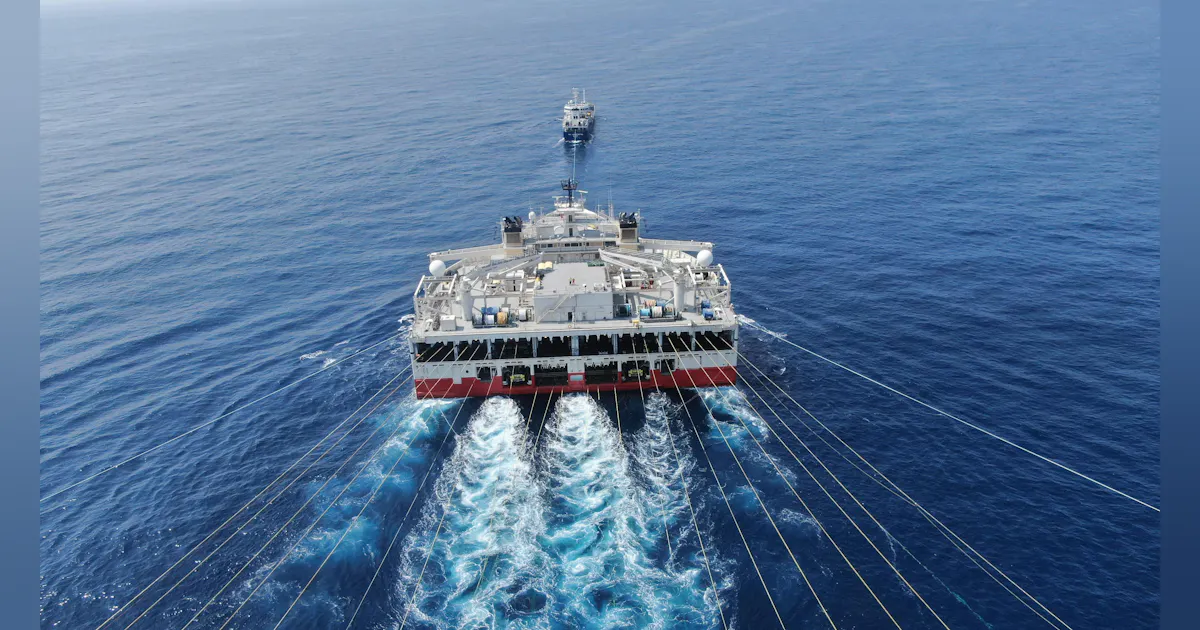
Advances in seismic imaging, drilling technology and data analytics are helping revive interest in frontier offshore exploration. TGS CEO Kristian Johansen sees opportunities emerging across Brazil, Africa, the Eastern Mediterranean and Asia-Pacific, while AI is enabling faster prospect screening and more integrated exploration workflows. He recently spoke with Offshore about the outlook for frontier exploration, the growing role of AI and the challenges facing explorers in the years ahead.
Offshore: What is driving renewed interest in frontier and emerging offshore basins?
Johansen: Energy security, peak oil estimates extended and the need to replace naturally declining production remain important drivers. Offshore discoveries can also provide material, long-life resources with competitive economics.
At the same time, better seismic imaging, drilling technology and data analytics are making frontier risk more manageable. Companies are therefore becoming more selective rather than stepping away from exploration—focusing on opportunities with scale, strong economics and competitive emissions performance.
Offshore: How are data integration, AI and analytics changing exploration decisions?
Johansen:Exploration is moving from sequential interpretation toward integrated, data-driven workflows. Seismic, well, geological and regional analog data can now be evaluated together, allowing teams to test more ideas and rank opportunities faster.
AI can accelerate activities such as fault and channel mapping, prospect screening and analog identification. It does not replace the geoscientist; it reduces repetitive work and allows experts to focus on geological reasoning, uncertainty and investment risk. Trusted data, governance and transparent outputs remain critical.

Offshore: Where will the most significant opportunities emerge?
Johansen: The Atlantic margins will remain a major focus, particularly Brazil’s emerging basins and their conjugate margins in West and Southern Africa. We also see potential in selected deepwater areas of East Africa, the Eastern Mediterranean and Asia-Pacific.
The most attractive plays combine material resource potential with a credibleetitive fiscal terms and manageable above-ground risk. Geological potential is essential, but commercial access and development viability are equally important
Offshore: What will be the biggest challenges over the next decade?
Johansen:The industry will need to manage geological uncertainty alongside cost inflation, long project timelines, regulatory complexity, emissions expectations and greater scrutiny of investment decisions.
Addressing those challenges will require stronger subsurface intelligence, phased capital commitments and closer collaboration among operators, governments, regulators and local stakeholders. The objective should be to identify the most advantaged resources early, avoid unnecessary wells and develop successful discoveries as safely and efficiently as possible.
