

The Intergovernmental Panel on Climate Change Sixth Assessment Report (IPCC-AR6) stresses the need for climate policies to prioritise carbon dioxide (CO₂) removal (CDR) processes. International agencies have, in parallel, increasingly recognised the role that regenerative agriculture plays in achieving net-zero targets through agricultural CDR. The agricultural sector has the potential to capture historically emitted CO₂ on a large scale by sequestering it in various forms—crop tissue, biochar, and soil organic carbon.
Yet a profound accounting injustice prevents the sector from being properly valued for the carbon services it already provides. At the heart of this discrimination lies an inconsistent greenhouse gas (GHG) accounting methodology to a fundamental aspect of human existence: our metabolic emissions.
Human metabolic emissions originate from respiration, excretion, and kitchen waste—all unavoidable consequences of the biological processes that sustain human life. Each person emits approximately 0.54 tonnes of CO₂ equivalents (tCO₂e) per year, primarily as CO₂ and methane. Collectively, the global population of 8 billion emits around 4.3 gigatonnes of CO₂ equivalents per year through metabolism alone.
These emissions are an unavoidable category that should be recognised as a separate sub-sector in GHG inventories, exempt from mitigation efforts. Unlike emissions from industrial processes or fossil fuel combustion, they cannot be reduced without compromising human nutrition and survival. While they constitute a small fraction of fossil fuel emissions, their omission from sectoral GHG accounting introduces a significant bias against agriculture—one that leads policymakers to apply the well-established GHG Protocol inconsistently across national GHG inventories.
This misattribution obscures a distinction between carbon cycles that is central to sound climate accounting. Fossil fuel emissions introduce “new” carbon into the active biosphere—carbon locked away in geological reservoirs for millions of years. In contrast, the carbon in our breath, food waste, and excreta is already part of the short-term biogenic cycle. It was recently captured from the atmosphere by plants through photosynthesis then entered our food systems and returned to the atmosphere within months or years, creating a balanced loop. Agriculture does not extract new carbon from deep underground; it continuously cycles existing carbon between the atmosphere, living plants, livestock, and the soil. Such biogenic emissions are a critical component of the fast carbon cycle, absorbed and re-emitted over timescales far shorter than long-lived fossil emissions.
By conflating these two fundamentally different carbon flows, the current GHG Protocol effectively penalises agriculture for facilitating the rapid recycling of atmospheric carbon that is essential to all life. This stands in contrast to the treatment of the fossil fuel sector, which is never held accountable for the eventual metabolic or combustion emissions of its products—those are correctly assigned to downstream users.
The GHG Protocol is the most widely used climate accounting standard globally. It defines three scopes of GHG emissions—Scopes 1, 2, and 3—representing increasing levels of an enterprise’s control and accountability for mitigation. Scope 1 refers to the GHGs that an enterprise can directly control while producing a product or service. Net positive Scope 1 represents emissions; net negative Scope 1 represents CDR by various government or private sectors. National GHG inventories build upon the GHG Protocol to allocate net Scope 1 to sub-sectors, providing sector-specific data for climate policy.
Here lies the inconsistency. Emissions from human metabolism—respiration, excretion, and unavoidable household food waste—are not distinguished but are attributed by default to Scope 1 of the food crop and horticulture sub-sectors. Emissions from fossil fuel use, by contrast, are separated and treated as Scope 1 of downstream users rather than of the petroleum sub-sector. Loading the full burden of human metabolism onto agriculture’s Scope 1 account is incorrect. As a result of this misattribution, the agriculture sector is denied due recognition for the majority of its climate services.
The numbers clarify the scale of the problem. India’s official GHG inventory says that agriculture and land use related to farming remove approximately 228 million tonnes of CO₂ from the atmosphere each year. India’s farms also emit approximately 660 million tonnes of CO₂. Under the current accounting method, the inventory records agriculture as adding 432 million tonnes of CO₂ to the atmosphere—14 per cent of India’s total emissions. What this method omits is the metabolic CO₂ from India’s 1.4 billion people, which amounts to approximately 756 million tonnes per year, at 0.54 tonnes per person. These metabolic emissions are currently misattributed to agriculture.
When they are correctly separated from the agricultural account, a completely different picture emerges. India’s agriculture sector’s gross CDR is actually 984 million tonnes—228 million tonnes in recognised sequestration plus 756 million tonnes of metabolic emissions currently misattributed as agricultural Scope 1. Against on-farm emissions of 660 million tonnes, this yields a net Scope 1 sequestration of 324 million tonnes. In reality, India’s agriculture sector is a net sink, not a net source.
Carbon pricing is widely accepted as a policy instrument to incentivise further CDR. The current damage cost of GHG emissions is approximately $100 per metric tonne of CO₂. The estimated annual financial value of Indian agriculture’s climate services is therefore $98.4 billion (Rs.8.1 lakh crore). With 155 million hectares of arable land, this translates to approximately Rs.52,000 per hectare per year—or Rs.67,000, according to some expert estimates.
These figures establish the financial scale of the distortion arising from the scope inconsistency. Providing just compensation to the food sub-sector of agriculture would also have broader welfare benefits. Food price inflation constrains the income potential of farmers and farm workers. Investing in agriculture through global carbon funds for CDR would benefit the most vulnerable sections of society while simultaneously advancing climate goals.
This accounting inconsistency is not unique to India. Applying the same corrective methodology globally reveals the true scale of agriculture’s hidden climate contribution. Global human metabolic emissions total approximately 4.3 billion tonnes annually. When properly excluded from agricultural Scope 1 and recognised as a distinct, unavoidable category, the net emissions profile of global agriculture shifts markedly. Preliminary calculations suggest that many nations with large agricultural sectors and significant rural populations may find that their farmland already functions as a net sink—a reality the current reporting framework completely obscures.
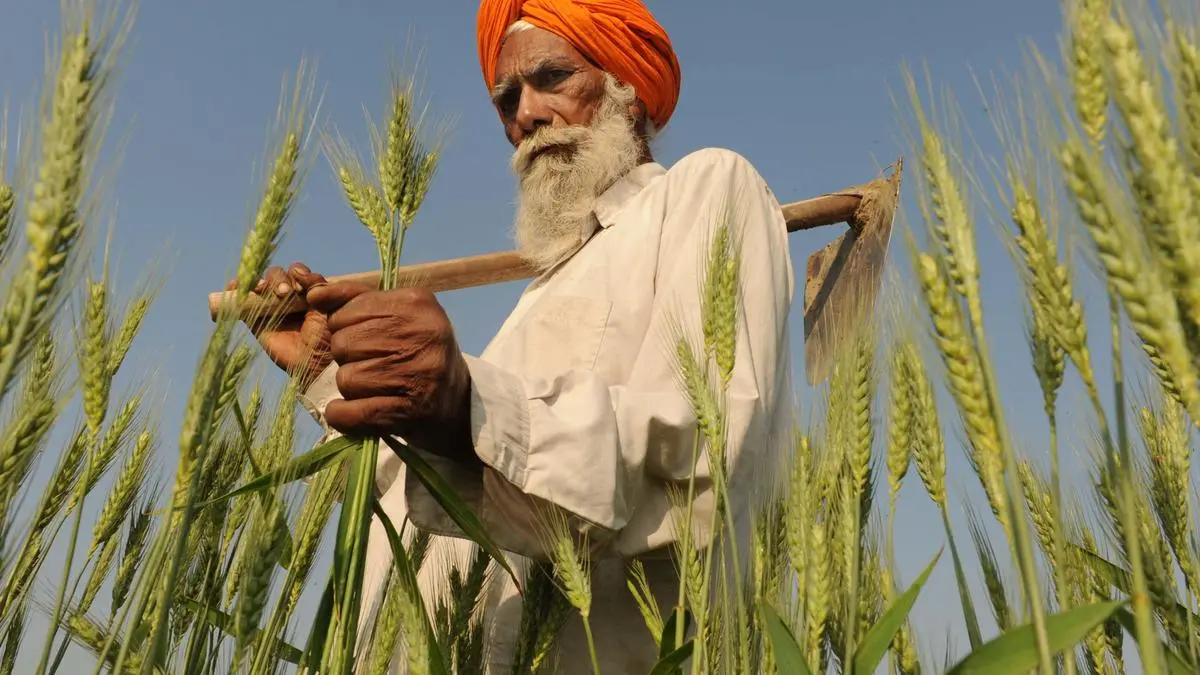
Food price inflation constrains the income potential of farmers and farm workers. Investing in agriculture through global carbon funds for CDR would benefit the most vulnerable sections of society while simultaneously advancing climate goals.
| Photo Credit:
Umesh Negi/Getty Images
New Zealand offers an instructive model. The country’s prolonged debate over agricultural emissions pricing, particularly concerning biogenic methane from livestock, has forced a reckoning with the limitations of GHG inventory conventions designed primarily for industrial and energy systems. New Zealand’s split-gas approach—which acknowledges the distinct atmospheric behaviour of short-lived biogenic methane versus long-lived CO₂—represents a partial recognition that not all emissions should be treated identically. The logical extension of this principle demands a similar reconsideration of biogenic CO₂ from human metabolism. The European Union Emissions Trading System also recognises such aspects of biogenic emissions and generally exempts them from major carbon pricing schemes.
Correcting this scope inconsistency would fundamentally reshape access to climate finance for agricultural communities. Under Article 6 of the Paris Agreement, nations can trade Internationally Transferred Mitigation Outcomes (ITMOs). If agriculture in countries like India is formally recognised as a net sink rather than a net source, the implications for carbon credit generation are substantial. Farmers could potentially receive payments not merely for additional sequestration practices, but for their existing role in maintaining the biogenic carbon balance that sustains the global food system.
This is not merely a technical accounting exercise—it represents the difference between agriculture being perceived as a climate liability requiring costly mitigation and a climate asset deserving compensation for ecosystem services. The $98.4 billion annual value calculated for Indian agriculture’s climate services dwarfs the entire global voluntary carbon market, which was valued at nearly $2 billion at its peak and had contracted sharply to approximately $723 million by 2023. This disparity reveals how much value remains unrecognised and uncompensated owing to flawed accounting conventions.
The solution requires a formal revision to national GHG inventory guidelines. Emissions from human metabolism should be classified as a separate category outside the Scope 1 boundary of the agriculture sector. This “Human Metabolic Emissions” category would be reported for informational purposes in national inventories but would not be attributed to any productive sector for mitigation purposes, since these emissions are non-reducible without compromising human nutrition and survival.
The IPCC Task Force on National Greenhouse Gas Inventories is the appropriate body to develop methodological guidance for this reclassification. It should prepare a technical paper or supplementary methodology report providing countries with a standardised approach for separating metabolic emissions from agricultural production emissions, enabling consistent application across all national inventories. Until such guidance exists, individual nations committed to equitable climate accounting may choose to report adjusted figures as supplementary information alongside their official inventory submissions (Biennial Transparency Reports) to the UNFCCC.
Critics may argue that this reclassification is a form of creative accounting that shifts emissions elsewhere without reducing atmospheric concentrations. However, this objection misses the point. The current system does not shift emissions—it buries them within agriculture’s Scope 1, creating a distorted picture that leads to misdirected policy and unjust financial outcomes. Accurate accounting is a prerequisite for effective policy, not a substitute for genuine emission reductions. Recognising agriculture as a net sink would strengthen, not weaken, the case for maintaining and enhancing soil carbon sequestration, agroforestry, and other proven CDR practices. If farmers are compensated for the climate services they already provide, they gain both the resources and the incentive to do more.
A second concern relates to double counting. If human metabolism is separated from agriculture, could these emissions be counted elsewhere? They should not be counted against any sector, since they represent the unavoidable respiration of the global human population—a non-discretionary, survival-linked emission category analogous to the respiration of all heterotrophic organisms, which cannot synthesise their own food and instead obtain energy and nutrients by consuming other organisms and organic matter. The purpose of excluding them from sectoral accounting is precisely to acknowledge that some emissions cannot be attributed to productive economic activity and should not enter into the calculus of sectoral mitigation obligations.
The treatment of human metabolic emissions within national GHG inventories is a structural flaw that systematically undervalues agriculture’s climate services. By conflating the short-term biogenic carbon cycle with fossil fuel emissions, and by forcing unavoidable human respiration into the Scope 1 boundary of food production, the existing framework penalises the very sector most capable of delivering carbon removal at scale. The case of India—where a correction transforms agriculture from a purported 14 per cent contributor to national emissions into a net sink valued at nearly $100 billion annually—demonstrates both the scale of the injustice and the opportunity that lies in getting the accounting right. Correcting this error is not merely a matter of technical rigour; it is a prerequisite for climate justice, sound agricultural policy, and unlocking the full potential of the land sector in the global effort to stabilise the climate.
C.P. Rajendran is an adjunct professor at the National Institute of Advanced Studies, Bengaluru.
Also Read |
Also Read |
