

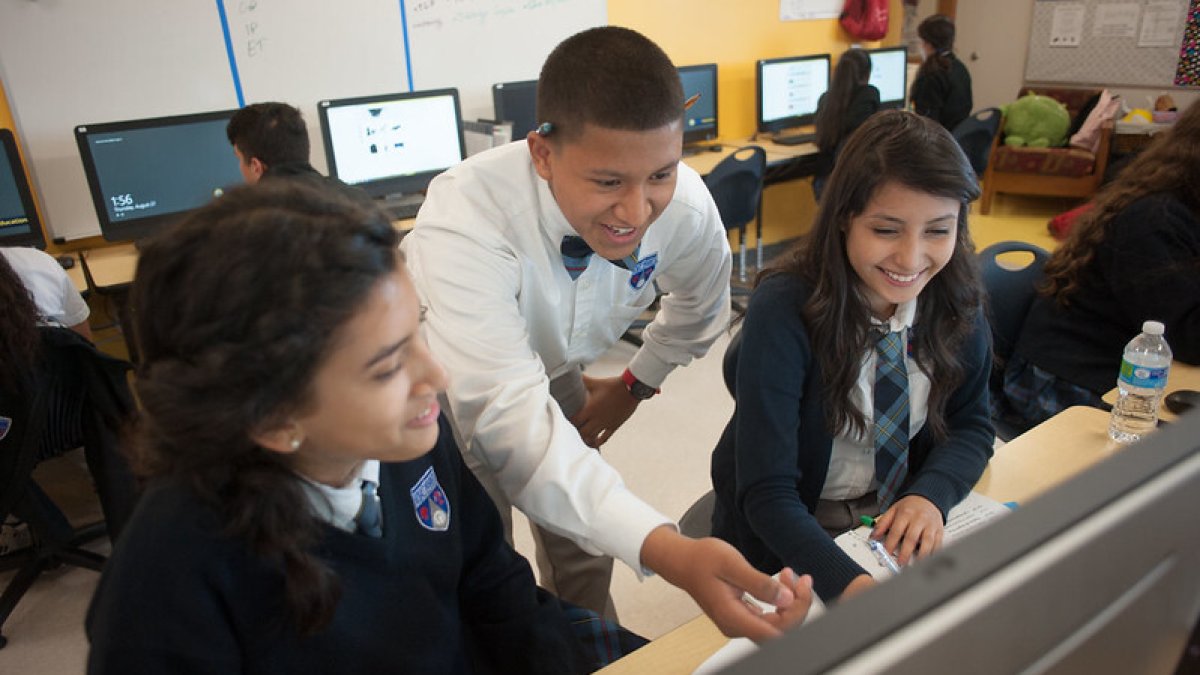

There is a new artificial intelligence curriculum headed to some North Texas high school classrooms thanks to a new grant given to the University of Texas at Dallas.
The world is changing, and students must change with it. That’s the message at Uplift Schools across North Texas as they start the new school year. Uplift Education is the largest, free-tuition public charter school network in North Texas with 20 locations.
Watch NBC 5 free wherever you are
They will also start the 2026-2027 academic year introducing a new crop of students to their new curriculum on artificial intelligence.
“Artificial intelligence is shaping every industry, and our responsibility as educators is to ensure students are prepared. Not just to use these tools, but to understand and shape them,” CEO of Uplift Dr. Remy L. Washington said. “Partnering with UT Dallas allows Uplift to build a powerful K-12 to higher education pipeline that connects learning, ethics and real-world application.”
Washington said this is the first year for the program.
UTD received $4 million over four years from the U.S. Department of Education to boost high school and college students’ proficiency in AI and prepare them for the future workforce. It’s called the UTD/Uplift: Future Ready AI Collaborative. The AI literacy classes will focus on students in 10th through 12th grades to help strengthen college and career readiness.
Dr. Gaurav Shekhar, associate dean in the Naveen Jindal School of Management, said this is the perfect way to help students see AI as an assistant and not a replacement.
Wake Up to Something Good
Every morning, NBC 5 Today is dedicated to delivering you positive local stories of people doing good, giving back and making a real change in our community.
Youth Ninja Warrior participant celebrates successful summer
Dallas kids step into class with new tennis shoes
“I think what people have to realize, AI is already here,” Shekhar said. “We have been using it; we use it every day and platforms and apps and things of that sort, and so it would actually probably be malpractice if we did not prepare students to be able to understand what AI is and how to use it.”
Shekhar said their institution is one of 18 nationally to receive a grant, a portion of the $51 million through the Office of Postsecondary Education. It’s an effort to advance understanding and use of A.I.
Both educators emphasized that they understand the concerns when it comes to A.I. Just recently, NPR highlighted a study that showed the risks of using generative A.I. to educate children and teens outweigh the benefits.
That study comes from the Brookings Institution’s Center for Universal Education, a policy center focused on quality education. Its research is funded by private and public partnerships.
Both Washington and Shekhar said that’s even more of a reason to advocate for education… to ensure more responsible use.
