

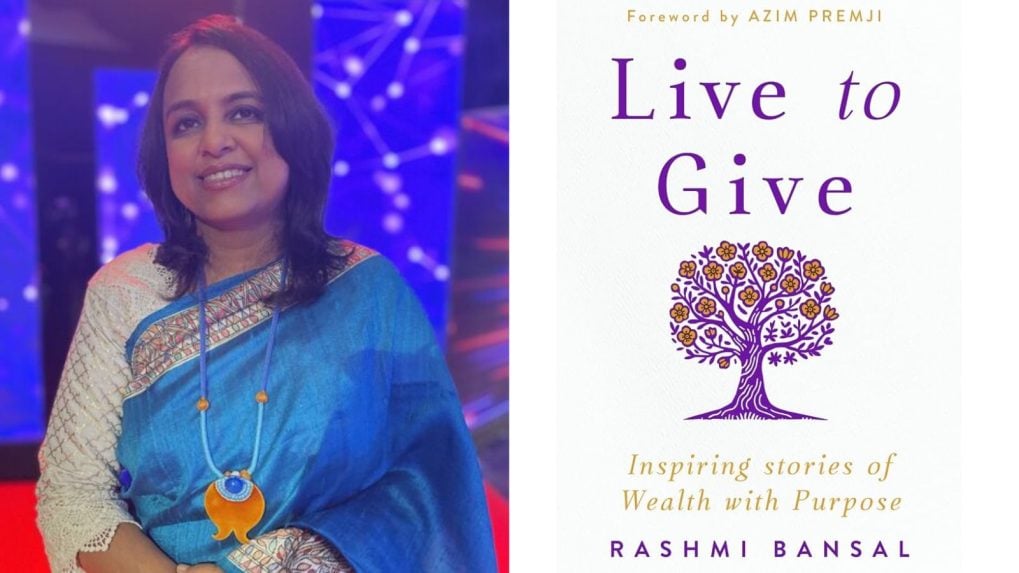
If you’ve read Rashmi Bansal’s books, then your idea of ‘possibility’, involves not only those born with a silver spoon, but also the chai seller’s son, the village dropout and the first-generation dreamer. When she puts pen to paper, entrepreneurship stops being a privilege and becomes a possibility, one that whispers to every ordinary Indian: “Why not you?”
In her latest book, ‘Live to Give’, she shifts gears and documents the work of India’s philanthropists. Storyboard18’s Reeta Ramamurthy Gupta caught up with the author to speak to her about her body of work.
You left a conventional corporate path after IIM-A to become a writer and publisher. What was the moment you realized you wanted to tell other people’s stories?
I wrote the book ‘Stay Hungry Stay Foolish’ in 2008, and the first email I received from a reader had the subject line: ‘I read your book and I quit my job’. That was the day I realized that stories have power. This reader had a desire to ‘do something’ but was also afraid. He was an ordinary middle class person who had studied well and secured a good job. Could he leave all that to pursue a dream?
Trending Topics
Carlsberg India IPOMicrosoft Outage<a href="https://bitcomme.com/jensen-huang-just-resigned-from-nvidia-a-study-of-187-forced-ceo-exits-shows-what-could-happen-next/” title=”Jensen Huang Just Resigned From Nvidia. A Study of 187 Forced CEO Exits Shows What Could Happen Next”>Jensen Huang ResignsSunil DsouzaSwiggy Revenue
My book was able to convince him, because it featured the 25 stories of IIM(A) graduates who took that leap of faith. It imbued him with a sense of ‘Main bhi kar sakta hoon.’ I saw clearly that if I could dedicate myself to the task of writing stories of real people, I could impact more lives.
Your books profile entrepreneurs who “made it.” That may leave out those who tried and failed. Have you considered survivorship bias when you choose your subjects?
I view failure as an event in life, which teaches you many lessons. I’m not just saying this, I have experienced it myself. I started JAM magazine, which became India’s leading youth magazine and ran successfully for 15 years. Then, due to a combination of circumstances, the venture failed. It was devastating at one level, but I picked myself up and reinvented myself. This is a pattern you will see in many of the stories I have published. There is no such thing as permanent success or permanent failure. I am drawn to the journey, and its highs and lows. I leave the analysis to business school professors.
Has your method of finding the ‘story behind the founders’ changed over time, and what’s the one question you now ask in an interview that you didn’t at the start?
When a person who’s doing something interesting comes in my radar. I follow them for 2-3-4-5 years, sometimes more. I want to see consistency, commitment and also how they deal with difficult events. I will not write about a company unless I am convinced there is real substance, not just hot air. Unicorns don’t impress me, it’s the journey from point A to point B matters, as does its ability to inspire and guide my readers.
As for interviewing; I believe that it’s more important to listen, than to constantly butt in with questions. I make my subject comfortable and allow them to speak, take pauses and find their flow. Now and then, I may ask for some clarifications and gently nudge them to say more.
Founders can be of all scales and sizes…
In 2014 I wrote ‘Take Me Home,’ which featured stories of entrepreneurs outside the 6 main metro cities. It was a bit ahead of its time. In the past decade, the idea of ‘apna kuch karna hai’ has spread to Tier 2 and 3 cities and even villages, thanks to broadband internet, social media provides access and market connections. When I visited Jadgalpur (the district HQ of Bastar district), I met six local entrepreneurs, i.e. young people who were selling a product or service to people across India, such as Bastar tourism, mahua laddoos, local organic produce and so on. This was indeed very heartening.
Looking back across your whole body of work, which entrepreneur’s story changed you the most, and what did it make you rethink about success, risk, or what a good life looks like?
I wrote the story of Akshaya Patra foundation in my book ‘God’s Own Kitchen’. I spent almost 2 years on the project, interviewing over a hundred people, and making several trips to ISKCON Bangalore. I felt the presence of a ‘Higher Power’, while writing this book. It made me more spiritual, and more grateful for all that God has given me. And convinced me that ‘entrepreneurship’ does not apply only to business and making money. The entrepreneur mindset applies to all facets of human life.
Reeta Ramamurthy Gupta is a Reading Coach and biographer. You can connect with her on Instagram @OfficialReetaGupta.
Follow Storyboard18 on Google for the latest and breaking brand makers and industry updates, along with in-depth coverage of digital media and brand marketing. Stay informed with the latest perspectives only on Storyboard18.
Tags
First Published onNovember 14, 2026, 12:01:02 IST
SPOTLIGHT

Special CoverageGen Z is rewriting the media-to-commerce funnel, forcing brands beyond traditional cohorts
The conversation highlighted a fundamental shift underway in the relationship between audiences, platforms and brands. Rather than treating Gen Z as a uniform consumer segment, marketers are increasingly having to account for individual behaviours, fragmented content consumption and a stronger expectation
SAC 2026: Swiggy, Nestlé, HDFC, Flipkart, Puma, Lahori Zeera shine | Why Piyush Pandey remains India’s creative North Star
Storyboard18 brings you top five news updates from the world of advertising, marketing, and business of brands.
