

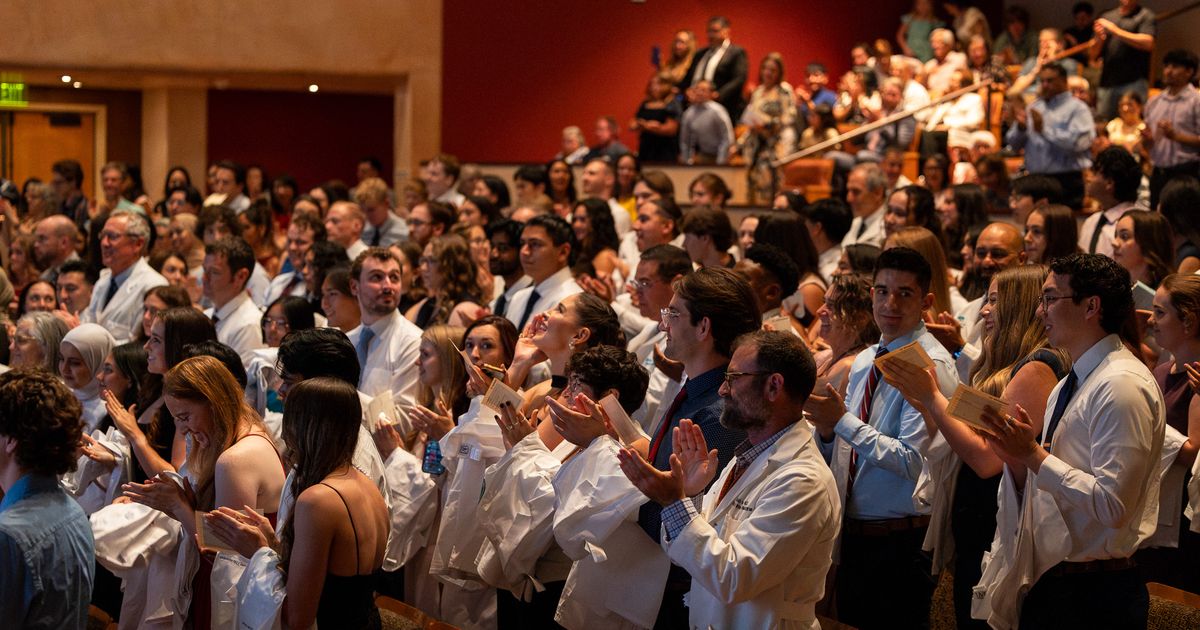
The announcement was barely finished before the room erupted in cheers.
During orientation for incoming University of New Mexico medical students, School of Medicine leaders shared news that would affect not only the students in the room, but every student earning a Doctor in Medicine degree at UNM this academic year.
During the 2026 New Mexico Legislative Session, state leaders approved a one-time $5 million appropriation that will be applied directly to medical school tuition in the 2026-2027 academic year. More than 400 students are eligible to receive these funds.
For students facing years of demanding training and the financial pressures that can come with it, the meaning of the announcement was immediate.
“I can breathe a little bit more,” incoming medical student Gabriela Sandoval said.
That relief is one part of a much larger goal. By reducing the financial burden of becoming a physician, New Mexico is investing in the people it hopes will one day care for patients in communities across the state.
Chandler Todd, MD, associate dean of Medical Student Affairs, knew what that could mean for students as soon as she learned about the funding.
“This appropriation means more than I can say,” Todd said. “We’re going to apply it directly to as many students’ tuitions as possible. This is going to reduce the financial pressure on our students, reduce their stress and enable them to study and learn to be great doctors more easily.”
Patricia Finn, MD, dean of the UNM School of Medicine, said reducing that burden is an important way the state can help strengthen its physician workforce.
“Reducing the debt our graduates carry is one of the most direct ways we can strengthen New Mexico’s healthcare workforce because it frees our students to serve where they are needed most,” Finn said. “This gift reflects the deep trust that our state’s leaders continue to place in our people and our mission, and we are grateful.”
The financial toll of medical school can extend well beyond tuition. Students may enter medical school with debt from their undergraduate education while also paying for housing, food and other living expenses during four demanding years of learning.
For some UNM medical students, those pressures can affect basic needs.
“Many of our students experience things like housing insecurity and food insecurity while studying to become physicians,” Todd said. “This appropriation is going to allow them more breathing space, more time to focus on what’s important.”
The immediate benefit is financial, but the investment comes at a time when New Mexico is working to address a much larger challenge: ensuring communities across the state have access to the physicians they need.
I hope to give it back to you, New Mexico, as service, and I hope to be the best that I can be for this state.
– JoséAntonio Mendoza,First-Year Student, UNM School of Medicine
New Mexico continues to face physician shortages, particularly in rural and underserved areas. For State Sen. Shannon Pinto, D-McKinley County, supporting medical students is part of addressing that need.
“We have a shortage of MD providers within the state of New Mexico,” Pinto said. “We’re doing all we can to see how we can help—all throughout New Mexico, not just in certain areas.”
That connection between investment in students and investment in the state’s future physician workforce was also at the center of the message when the incoming MD class gathered again for the School of Medicine’s White Coat Ceremony.
Michael Richards, MD, MPA, executive vice president of UNM Health Sciences and CEO of the UNM Health System, described the appropriation as an “extraordinary statement of support.”
“It says to our students: New Mexico believes in you,” Richards said. “It says: You belong here. It says: Your future matters—not only to you and your families, but to the health and future of this state.”
For students, that message was personal.
“It made me feel like I belong here,” said José Antonio Mendoza, a first-year medical student.
Makylah Kostal, another incoming student, said the investment reinforced the idea that students from different socioeconomic backgrounds have a place in medicine.
“It reiterates that no matter what your background is, we all deserve to be here,” she said.
Incoming UNM School of Medicine students applaud during the MD White Coat Ceremony as Dr. Michael Richards thanks New Mexico state leaders for a $5 million appropriation supporting medical student tuition. Photo Credit: McKaela Arviso
Incoming UNM School of Medicine students pose together after receiving their white coats during the 2026 MD White Coat Ceremony. Photo Credit: McKaela Arviso
Incoming UNM School of Medicine student Anthony Languit puts on his white coat during the 2026 MD White Coat Ceremony. Photo Credit: McKaela Arviso
Incoming UNM School of Medicine students line up before the 2026 MD White Coat Ceremony. Photo Credit: McKaela Arviso
The UNM School of Medicine emblem is displayed on a white coat before the 2026 MD White Coat Ceremony. Photo Credit: McKaela Arviso

Those students are now beginning the work behind the white coat. In classrooms, laboratories and clinical settings, they will spend the coming years developing the knowledge and skills they need to care for patients. After medical school, they will continue their training through residency and, for some, fellowship before becoming independent practitioners.
Some students already have a clear idea of where they hope that path will eventually lead: back home.
Mendoza is from Clovis, which he described as “a little rural town in eastern New Mexico.” He is also participating in UNM’s Rural and Urban Underserved Program (RUUP), which gives medical students additional experience working with New Mexican communities where access to healthcare can be limited.
“I definitely hope to go back home and serve my community. Absolutely,” Mendoza said.
For Mendoza, the state’s investment in his medical education adds another dimension to that commitment.
Those ambitions matter in a state where rural communities can struggle to recruit and retain physicians. For students who grew up in those communities, medical school can provide a path not only to becoming a physician, but to returning home with skills their communities need.
That is also what Pinto hopes state investments like the tuition appropriation will encourage. Representing a geographically large district which includes much of the Navajo Nation, she sees supporting New Mexicans who already have roots in the state as an important part of addressing its physician shortage.
“I think the main resource within New Mexico that we haven’t really invested in is the human resource,” Pinto said. “It’s making sure we invest in those that are here, willing to stay here, want to live here, work here, grew up here.”
Reducing medical school debt can give students greater flexibility to follow through on those plans. Financial obligations can factor into decisions about specialty, residency and where physicians ultimately establish their careers. Less debt can give graduates more freedom to consider critically-needed fields such as primary care or locations which may be less lucrative, such as rural communities and other areas where New Mexico has significant workforce needs.
I think the main resource within New Mexico that we haven’t really invested in is the human resource.
– State Sen. Shannon Pinto,D-McKinley County
The state’s investment in the healthcare workforce also extends beyond medical students. This year, New Mexico expanded its Health Professional Loan Repayment Program, providing continued loan repayment support for physicians and more than 25 other health professions, including nursing, pharmacy, behavioral health, social work and physical therapy, in exchange for service in communities with healthcare workforce shortages.
Gratitude has been a central part of the School of Medicine’s response to the appropriation. At the White Coat Ceremony, UNM publicly recognized state leaders for their support and for viewing medical education as an investment that can benefit communities throughout New Mexico.
Richards emphasized that the return on the state’s $5 million investment will extend far beyond the students receiving tuition support this year.
“Medical education is not simply an investment made by a student and their family,” Richards said. “It is also a public investment. It is an investment in access to care. It is an investment in rural and underserved communities. It is an investment in the future health of New Mexico.”
For the students who cheered when they first heard the news, that investment is already making a difference. For New Mexico, its full impact may be measured years from now—in the physicians who choose to build their careers here and the communities they return to serve.
