

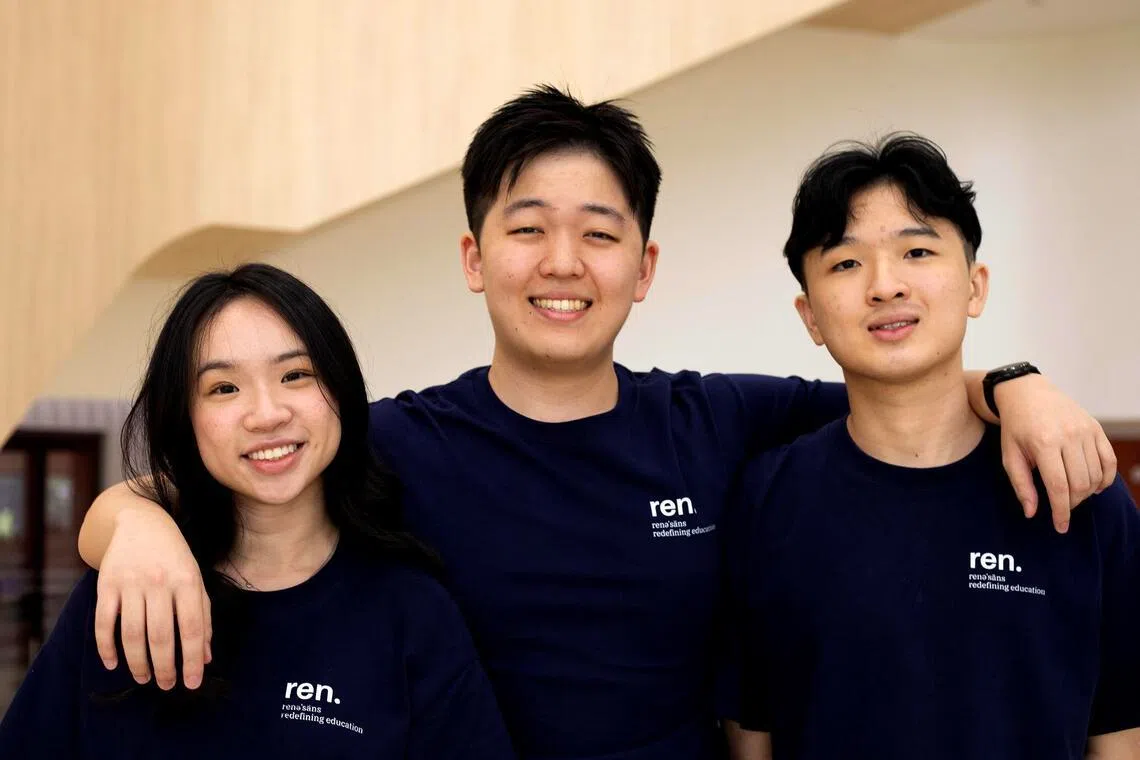
The AI-assisted marking tool Ren was developed by NUS students (from left) Natasha Koh, Wong Eu En and Justin Cheah.
PHOTO: REN EDUCATION

Gabrielle Chan
SINGAPORE – When senior lecturer Lee Boon Kee first assigned written work to 490 National University of Singapore (NUS) computing students, marking the papers took six weeks.
Last semester, the same task took a fraction of the time – five minutes for a first pass.
The difference was Ren, an AI-assisted marking tool that generated draft grades and feedback for review by teachers.
But for Lee, who teaches a compulsory Digital and AI Ethics module for all NUS freshmen, the biggest benefit was not speed but the quality of marking.
The tool can systematically check whether students applied several ethical frameworks and give detailed feedback, said Lee, adding that grading has become consistent.
Ren was developed by three 23-year-olds from NUS – Wong Eu En, Justin Cheah and Natasha Koh – who founded education technology start-up Ren Education.
Wong is a second-year computer science student and Cheah is a fourth-year computer science and business student, while Koh just graduated with a degree in information systems.
Ren allows students to submit handwritten or typed assignments. Drawing on markingrubrics, syllabus materials and learning outcomes uploaded by teachers, the artificial intelligence generates a first-pass grade and detailed feedback.
Teachersthen review, edit and approve every grade and comment before they are released to students.
Ren is now being piloted in 11 institutions in Singapore – including the School of Science and Technology and NUS. It is being prepared for its first full schoolwide roll-out at St Andrew’s Junior College in July.
The tool is among a growing number of AI applications finding their way into classrooms.
The Ministry of Education also has AI-powered tools on its Student Learning Space platform, including Markly, which helps teachers provide feedback, along with another tool called Authoring Copilot that generates lesson ideas and activities, and feedback assistants that give students immediate feedback.
Ren is currently working with 40 to 50 educators at the 11 partner institutions. By July, the team expects to serve about 5,600 students, Wong said.
Schoolssubscribe to the service through customised annual plans.
Most recently, the company partnered with Malay/Muslim self-help group Mendaki to offer free academic support for A-level students.
Since May 30, Mendaki, together with Ren, has been running tutoring sessions for these students in subjects like literature, history, chemistry and economics. About 600 students are expected to benefit.
For lecturer Lee, consistency had long been one of the biggest challenges in grading.
With one teaching assistant for every 20 to 30 students, different markers often gave different grades for similar answers.
Ren helped create a common starting point, after which teaching assistants would review the recommendations, adjust their assessments and make final decisions.
This includes changing the tone of the feedback, expanding on explanations or correcting areas where the AI had missed nuances in a student’s response.
This also frees teachers to focus on students who need the most help, Lee said.
That balance between automation and human judgment is central to Ren’s design, said Wong.
“A lot of tools today adopt what we call a centurion approach – the human is at the top, but the AI does all the labour,” said Wong, but Ren is different.
The system learns from each teacher’s changes and preferences over time, from their marking style and preferred phrasing to the types of questions they ask and even whether they capitalise certain words.
By the second or third assignment, teachers typically accept 80 per cent to 90 per cent of the AI-generated comments without modification, Wong said.
After marking, Ren generates reports for each student, assignment and the entire class. It highlights strengths and weaknesses by topic and question type, allowing teachers to track progress.
For Chen Ziling, a second-year junior college student, the tool has changed how she practises writing for General Paper (GP). She encountered the tool during GP tuition with Wong.
Instead of writing full essays, the 18-year-old drafts individual paragraphs on the platform, receives feedback and revises them accordingly. “Quick feedback helps me (learn more) effectively as I can still recall my logic when I’m writing,” she said.
The tool provides line-by-line suggestions and examples of how she can better express her ideas – feedbackthat sometimes her teachers, having to manage dozens of students, cannot always provide for every draft.
In one instance, Ren flagged a conceptual confusion Chen had between human rights and civil liberties, a distinction she had not known she was struggling with.
“Personalised feedback is very important to me as a student,” she said.
AI/artificial intelligence
NUS
Students
Education and schools
Teachers
