

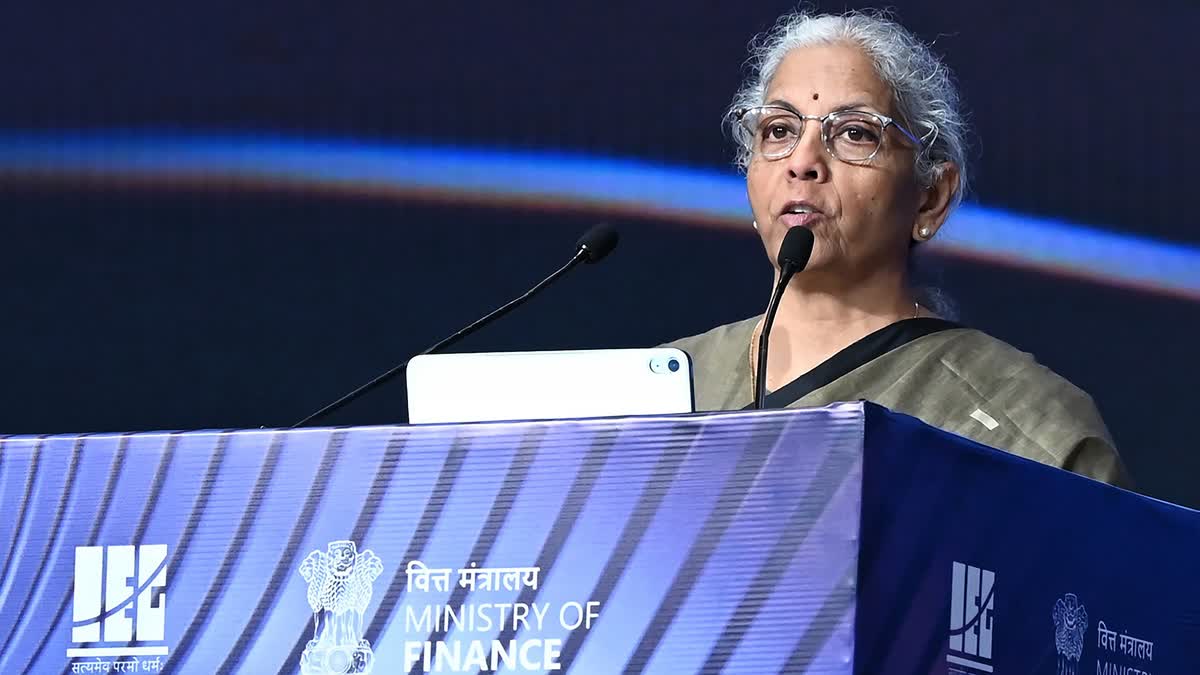
Addressing the 5th Kautilya Economic Conclave, Sitharaman said India emerged from the shocks of past four years with its economic fundamentals intact, reports Saurabh Shukla.
Union Minister for Finance and Corporate Affairs Nirmala Sitharaman speaks during the 5th Kautilya Economic Conclave, in New Delhi (IANS)
New Delhi: Finance Minister Nirmala Sitharaman on Saturday said that India has built strong economic resilience over the past decade and the next stage is to convert these capacities into higher productivity, better employment and wider opportunities as the global economy enters an era of prolonged uncertainty.
Addressing the 5th Kautilya Economic Conclave 2026 in New Delhi, the Finance Minister defined economic resilience as the ability to absorb shocks without losing the growth trajectory while retaining enough policy space to deal with future disruptions.
Union Minister for Finance and Corporate Affairs Nirmala Sitharaman (2nd from R) attends the 5th Kautilya Economic Conclave, in New Delhi (IANS)
She said the real evidence of resilience often lies in the crises that do not materialise, including runaway inflation, fuel shortages, banking stress or forced fiscal correction.
According to her, India has emerged from the shocks of the past four years with its economic fundamentals intact. She cited 7.8 percent real GDP growth in Q1 FY27, 4.82 percent CPI inflation in August 2026, a current account deficit of 0.5 percent of GDP and foreign exchange reserves of around $766 billion.
Sitharaman also said the “resilience visible today” has been built through a series of measures since 2014. These, as per her, include stronger last mile delivery of welfare schemes, greater access to finance, infrastructure creation, reforms, economic stability and fiscal prudence. She also highlighted the Jan Dhan, Aadhaar and Mobile framework and Direct Benefit Transfer, saying these systems have strengthened the ability of households to withstand economic shocks. She also pointed to schemes including PM Awas Yojana, Swachh Bharat, Ujjwala, Ayushman Bharat and PM Garib Kalyan Anna Yojana.
On financial resilience, the FM said PM MUDRA has sanctioned more than 52 crore collateral free loans, while banking sector reforms and schemes such as ECLGS (Emergency Credit Line Guarantee Scheme) helped maintain the flow of credit and protect businesses and employment during periods of disruption. Non-food credit grew 18.8 percent year on year in August 2026, she added.
Rs 12.22 lakh crore capex in FY27
The Finance Minister said infrastructure investment has significantly expanded India’s productive capacity. The Centre has budgeted Rs 12.22 lakh crore in capital expenditure for FY27, while effective capital expenditure including grants for capital assets is estimated at Rs 17.15 lakh crore, or 4.4 percent of GDP, she said.
She stressed that national highways have expanded by about 61 percent, operational airports have more than doubled and cargo handling capacity at major ports has risen by nearly 60 percent. Indian Railways commissioned 36,429 km of new tracks between 2014 and 2026, noted Sitharaman.
Fiscal prudence remains central
The Finance Minister stressed that fiscal discipline remains critical to maintaining the government’s ability to respond to shocks. She said India’s FY27 fiscal deficit is budgeted at 4.3 percent of GDP, while the IMF projects India’s general government debt to fall from 83.4 percent of GDP in 2026 to 77.7 percent by 2031. She said the next phase of India’s development must convert the capacities built over the last decade into higher productivity, better employment and wider opportunities.
AI to reshape jobs; skilling must keep pace
Looking ahead, Sitharaman said uncertainty has become a permanent feature of the global economy and India must continuously strengthen its resilience. She identified skill development as a key priority, particularly as artificial intelligence and frontier technologies reshape workplaces and the skills required for employment.
The FM also called for young people and existing workers to upgrade their capabilities and said industry must play a greater role in designing training programmes through partnerships with educational institutions, apprenticeships and workplace learning. Digital and AI skills, she said, must be combined with professional knowledge and judgement.
Strategic autonomy and critical minerals
The Finance Minister also stressed the need for strategic resource security, saying supply chains designed only around cost efficiency can create hidden vulnerabilities. She highlighted the National Critical Mineral Mission, Rare Earth Corridors and India Semiconductor Mission 2.0, along with the focus on small modular reactors as part of efforts to build greater domestic capacity in strategic sectors.
Focus on R&D
Sitharaman further called for stronger private investment, particularly in research and innovation. She noted that R&D spending in India is currently 0.83 percent of GDP, compared with 2.7 percent in OECD economies, while the private sector accounts for only 36 percent of India’s total R&D expenditure. The government’s Rs 1 lakh crore Research, Development and Innovation Scheme, she said is aimed at changing this equation and moving India from ‘Made in India’ to ‘Imagined and Made in India.’
Global openness remains important
At the same time, the Finance Minister said resilience should not mean isolation. She called for global economic relationships that are open, predictable and rules based, with countries diversifying partnerships while keeping trade, investment, energy and capital flows stable.
The Finance Minister said the coming years would test India’s ability to absorb shocks without major disruption to households and businesses and argued that this record of resilience should be considered as important a measure of economic management as headline growth figures.
