

Salesforce Review: The Enterprise CRM That Still Leads the Market?

Ask anyone who’s shopped for CRM software, and Salesforce is probably the first name that comes up, and also the one people have the most complicated feelings about. It’s the platform that basically invented the cloud CRM category; it’s used by well over 100,000 businesses, and lately its entire pitch has shifted toward agentic AI.
It can supposedly run parts of your sales and service work on its own. That’s a big claim, and a big price tag to go with it.
The problem is that most of what’s written about Salesforce falls into one of two camps: either it’s a marketing copy dressed up as a review, or it’s a dry feature list that tells you nothing about whether the thing is actually worth using.
This Salesforce review is different. We’ll go through what the platform is, what it’s genuinely good at, and where it becomes more trouble than it’s worth. If you’re trying to figure out whether it belongs on your shortlist, this should give you enough to make that call.
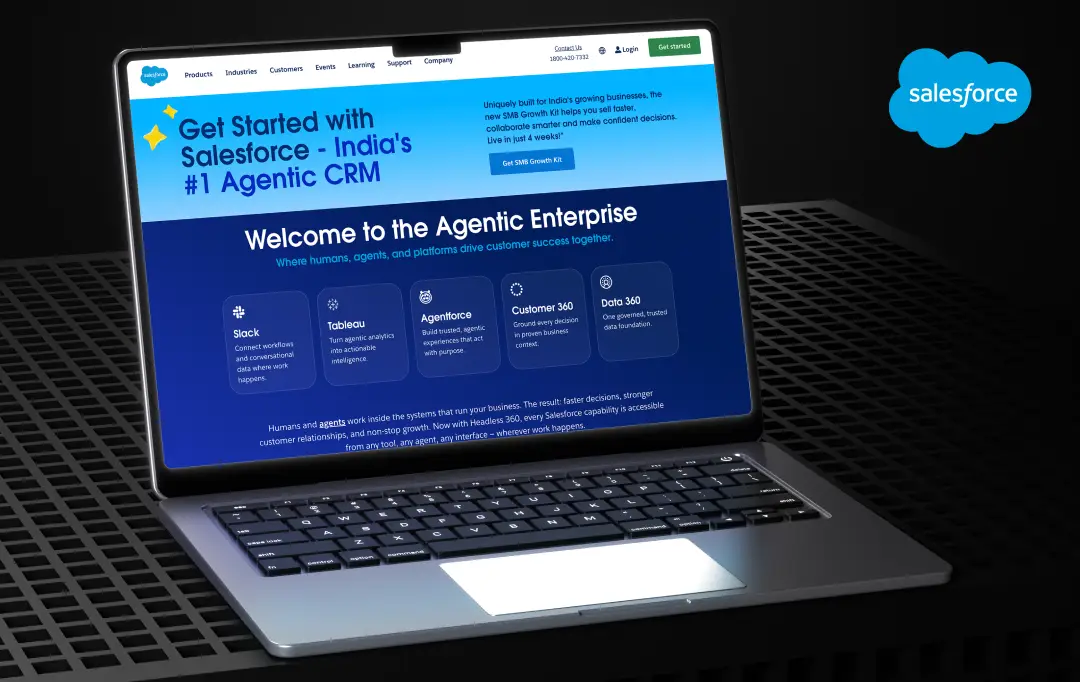
What Is Salesforce?Salesforce is one of the best CRM software that helps businesses manage everything related to their customers, from first contact to ongoing support, in one place. That includes tracking leads, managing sales pipelines, running marketing campaigns, handling customer service tickets, and increasingly, automating parts of that work with AI. It is less a single product and more a customizable platform that companies build their entire customer-facing operation around. |
Pros and Cons of Salesforce
- Extremely comprehensive feature set. Sales, service, marketing, commerce, and analytics are all available under one platform
- The AppExchange marketplace offers thousands of third-party apps and integrations
- You can start with a basic suite and add users, automation, and AI capabilities as your organization grows
- Agentforce stands out by delivering measurable improvements in areas like autonomous case resolution and lead conversion
- With over 100,000 businesses using Salesforce and a long-standing market presence
- Nearly every aspect of the platform can be tailored to fit unique business workflows
- Expensive, and pricing is genuinely confusing
- Extra data storage, sandbox environments, premium support, and implementation services are billed separately
- Businesses with simple contact management and sales pipelines may find Salesforce unnecessarily complex
- Valuable capabilities, such as lead scoring, are reserved for higher-priced plans, increasing costs as your requirements expand
Salesforce Features at a Glance
Salesforce is a comprehensive, cloud-based CRM platform designed to streamline sales, marketing, and customer service operations. By providing a 360-degree view of every customer, it empowers teams to collaborate efficiently and drive scalable growth.
Here are a few Salesforce features that make it one of the best AI agents for enterprises and a complete package-
1. Sales Cloud (4.2/5)
Sales Cloud tracks leads as they move through your pipeline, manages opportunities, and gives sales teams a single place to see every interaction with a prospect or customer. It also includes forecasting and reporting tools that give managers a real-time view of how the team is tracking against targets.
2. Salesforce Service Cloud (4.1/5)
Salesforce AI’s Service Cloud is built around managing customer support at scale, starting with case management that logs and routes every customer issue to the right person. It includes a self-service help center, so customers can find answers without opening a ticket in the first place. More recently, it’s been paired with AI-assisted case resolution, which can handle simpler queries automatically and hand off anything more complex to a human agent.
3. Marketing Cloud (4.1/5)
This handles outbound marketing across email, SMS, and other channels, letting teams build and run campaigns without leaving the Salesforce ecosystem. Because it’s connected to the same customer data as sales and service, campaigns can be personalized based on real purchase or interaction history instead of generic segments.
4. Commerce Cloud (4.0/5)
Commerce Cloud powers online storefronts, handling everything from product listings to checkout for businesses selling directly to customers. What sets it apart from a standalone e-commerce platform is that it’s tied into the same customer data as the rest of Salesforce. This is particularly useful for businesses that sell both directly to consumers and through a sales team.
5. Agentforce (Agentic AI) (4.4/5)
Salesforce’s Agentforce is Salesforce’s push into autonomous AI agents that don’t just suggest actions but actually take them. It can resolve straightforward customer service cases on its own, qualify incoming leads before a rep ever sees them, and flag deals that look at risk of falling through.
The key difference from older AI features is that Agentforce is designed to act with minimal human input. Though most businesses still find it works best with some oversight built in, at least early on.
Bonus Read:Best AI Agents for Sales
6. Data 360 (4.0/5)
Data 360 is the unified data layer sitting underneath everything else, pulling in customer information from multiple systems and sources into one consistent view. This matters because every other product, and every AI agent, is only as good as the data it’s working from.
It’s Salesforce’s answer to that problem, aiming to give every part of the platform the same trustworthy picture of each customer.
7. Tableau (Analytics) (4.1/5)
Tableau is Salesforce’s built-in data visualization and business intelligence tool, letting teams turn raw CRM data into dashboards and reports without needing a separate analytics platform. It’s increasingly being positioned around agentic analytics.
Here, AI helps surface insights or answer questions about the data directly, rather than requiring someone to manually build every report. For businesses already using Salesforce, this cuts out the need to export data into a third-party BI tool.
8. Slack Integration (4.3/5)
Since Salesforce acquired Slack, the two have been increasingly woven together, bringing CRM data and workflows directly into the messaging app teams already use daily.
Instead of switching tabs to check a deal’s status or a customer’s case history, that information can surface right inside a Slack conversation. This is aimed at cutting down the friction of jumping between tools, which is a common complaint with large, multi-product platforms.
9. AppExchange (4.2/5)
AppExchange is Salesforce’s marketplace, and it’s one of the platform’s biggest practical advantages: thousands of third-party apps, integrations, and even pre-built AI agents are available to extend what Salesforce can do out of the box.
If there’s a niche workflow or industry-specific tool you need, there’s a reasonable chance someone has already built it here. Salesforce integration is a big part of why the platform rarely hits a hard wall on functionality, even if it sometimes means paying for yet another add-on.
Salesforce Products
The Salesforce CRM software offers a diverse portfolio of interconnected, cloud-based products. Each of these products is tailored to specific business functions, including marketing, sales, customer support, etc. Here’s a quick overview of the products-
| Product | Explanation |
|---|---|
| Sales Cloud | Designed to optimize the entire sales process by helping teams manage leads, track opportunities, and accurately forecast revenue |
| Service Cloud | Empowers support agents with a 360-degree view of customer history to resolve issues faster across multiple channels |
| Marketing Cloud | Enables marketers to deliver personalized journeys at scale across email, SMS, social media, and paid advertising |
| Commerce Cloud | Provides the digital backbone for both B2B and B2C e-commerce, handling everything from product catalogs to secure checkouts |
| Data Cloud | Ingests and organizes massive amounts of real-time data to create highly unified, actionable customer profiles |
| Agentforce | A suite of autonomous AI agents that go beyond simple chatbots to handle complex, multi-step business tasks natively |
Who is Salesforce Suitable For?
Salesforce software is a highly adaptable platform built to serve organizations of all sizes, across nearly every industry. Its scalable architecture and extensive customization options make it a valuable tool for multiple use cases. Here’s a list of a few primary use cases of Salesforce-
| User Persona | How Salesforce Helps |
|---|---|
| Sales Managers & Directors | Provides real-time pipeline visibility and accurate revenue forecasting, enabling managers to track team quotas, identify bottlenecks, and deliver targeted coaching |
| Customer Support Agents | Unifies a customer’s complete purchase and interaction history in one place, helping agents resolve tickets faster and deliver more personalized support |
| Healthcare & Life Sciences | Securely centralizes patient data to personalize care plans, streamline appointment scheduling, and maintain regulatory compliance |
| Financial Services | Helps wealth managers and bankers track client financial goals, manage complex portfolios, and build long-term relationships through proactive, data-driven insights |
| Startups & Small Businesses | Offers scalable, out-of-the-box solutions that automate routine administrative tasks, allowing small teams to grow efficiently without immediately increasing headcount |
| Users in B2B E-commerce Industry | Connects complex product catalogs, custom pricing, and contract terms directly to CRM data, creating a seamless and personalized purchasing experience for business buyers |
What is Salesforce Agentblazer?
On the Salesforce platform, an Agentblazer is a professional who specializes in building, managing, and strategizing around autonomous AI using the Agentforce platform. Through the Trailhead platform, individuals can earn “Agentblazer Status,”.
This acts as a living, year-based learning roadmap to validate their expertise in this new digital workforce.
1. Agentblazer Champion (Level 1)
This foundational tier is designed for beginners to learn the core building blocks of artificial intelligence and Agentforce. It covers essential topics like AI governance and Data Cloud, guiding learners step-by-step through the process of configuring their very first AI agent.
2. Agentblazer Innovator (Level 2)
Aimed at active practitioners, this level focuses on practical business applications using Salesforce’s custom Agent Builder. Users learn to configure autonomous agents for specific Sales and Service use cases, ensuring they can deliver tangible business outcomes and solve real-world challenges.
3. Agentblazer Legend (Level 3)
As the highest mastery tier, this level is designed for AI architects tasked with designing and managing the entire Agentforce lifecycle across an organization. It covers advanced enterprise strategies and serves as the official preparation path for earning the Agentforce Specialist certification.
4. Continuous Skill Validation
Rather than being a static, one-time credential, Agentblazer Status acts as a living, year-based recognition of an individual’s AI capabilities. It requires ongoing learning as new modules are introduced, ensuring professionals stay perfectly aligned with Salesforce’s rapidly evolving AI landscape.
Rate the product based on your experience?
How was your experience with the product?
