

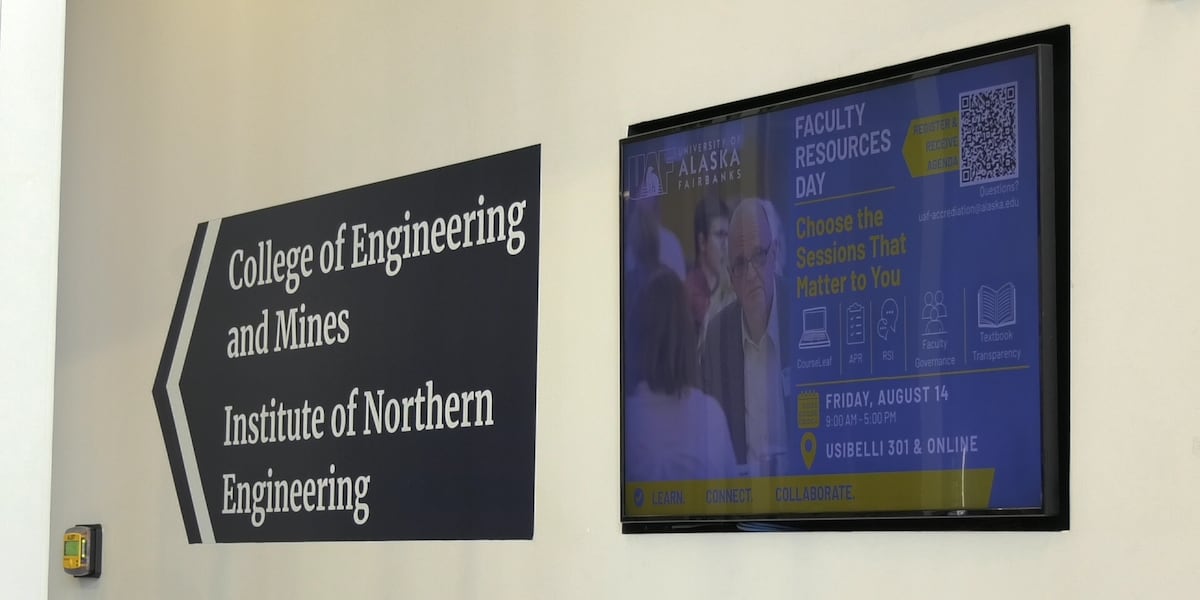
Alaska (KTUU/KTVF) – The federal government is signaling a major investment in America’s mining workforce, and the University of Alaska Fairbanks could be in line for a significant piece of it
On Aug. 7, President Donald Trump <a href="https://www.whitehouse.gov/fact-sheets/2026/08/fact-sheet-president-donald-j-trump-announces-billions-in-new-deals-and-investments-to-power-american-mining/” rel=”nofollow noopener” target=”_blank”>announced plans to invest up to $100 million through the Department of Energy, targeting all 14 accredited mining schools in the country. TheDepartment of Warseparately announced more than $80 million in intended investments across three other institutions. The combined total exceeds $180 million.
The goal of the DOE’s PROSPECT initiative — Providing Opportunities for Specialized Education in Critical Technologies — is to double the number of mining graduates within two years and produce roughly 6,000 new engineers over the next decade. Nationally, fewer than 200 mining engineers graduate each year.
No money has been confirmed for UAF. The Department of Energy’s announcement is a Notice of Intent, and UAF has not been assigned a specific dollar amount. But university leaders say the school is well-positioned.
“UAF is the only mining school in the entire Pacific Northwest,” said Tathagata Ghosh, chair of the Department of Mining and Mineral Engineering at UAF. “It’s not only in Alaska. If you go down everywhere else, there are no mining schools anymore. You can not only serve Alaska, but Idaho, Washington State, everywhere else along the Pacific Northwest.”
Ghosh attended the Aug. 7 meeting at the Eisenhower Executive Office Building at the White House, where representatives from all 14 accredited mining schools and mining industry CEOs gathered to discuss workforce development and supply chain strategy.
“We’re still awaiting confirmation of the exact details of the funding,” Ghosh said.
Alaska holds a unique position in the administration’s push to rebuild domestic critical mineral supply chains. Ghosh said Alaska contains 26 of the 30 minerals identified as critical by the federal government. The State of Alaska has that count listed as 49 of 50 critical minerals.
“Our future is tied to our mineral endowment. There’s no two ways about it,” Ghosh said.
The administration’s stated objective is to onshore the entire critical minerals supply chain — from extraction to refining, processing, and recycling — rather than sending raw ore overseas for processing.
Interim Chancellor Larry Hinzman said he was initially skeptical when UAF was invited to participate in the Washington discussions, but his outlook changed after the announcement.
“The University of Alaska has stepped up to do that for 100 years now. We’ve been a mining school since the very beginning. We have skills, we have abilities, we have good faculty, and we can do that,” Hinzman said.
Hinzman said any grant funding would be directed primarily toward increasing enrollment rather than new construction. He said the university would look to upgrade existing laboratories and work with industry partners to recruit students into mining engineering programs.
“The primary focus right now is just getting more students to accept mining engineering as a professional career that they want to follow,” Hinzman said.
He added that UAF’s mining program has maintained a 100% job placement rate and that the university already holds the highest amount of scholarships in the University of Alaska system for the field.
Ghosh said the PROSPECT program calls for modernizing curricula, which could include integrating automation and artificial intelligence into mining engineering coursework. UAF has already hired faculty with expertise in extractive metallurgy this year, he said, in anticipation of growing industry demand.
For now, UAF waits — but university leaders say the intent alone signals a potential turning point for Alaska’s mineral future.
See a spelling or grammar error? Report it toweb@ktuu.com
Copyright 2026 KTUU. All rights reserved.
