

The Beet.TV Leadership Sessions at Cannes Lions 2026, presented by The Trade Desk
Travel Marketing’s Funnel Is Becoming a 64-Day Loop: The Trade Desk’s Kelly Covato
CANNES, France – Planning a vacation used to involve choosing a destination, buying a ticket and wondering whether the hotel looked anything like the photographs.
Now it can take more than two months, span connected TV, audio, mobile devices and artificial intelligence, and generate enough behavioral data to make buying a plane ticket look like a minor component of the operation.
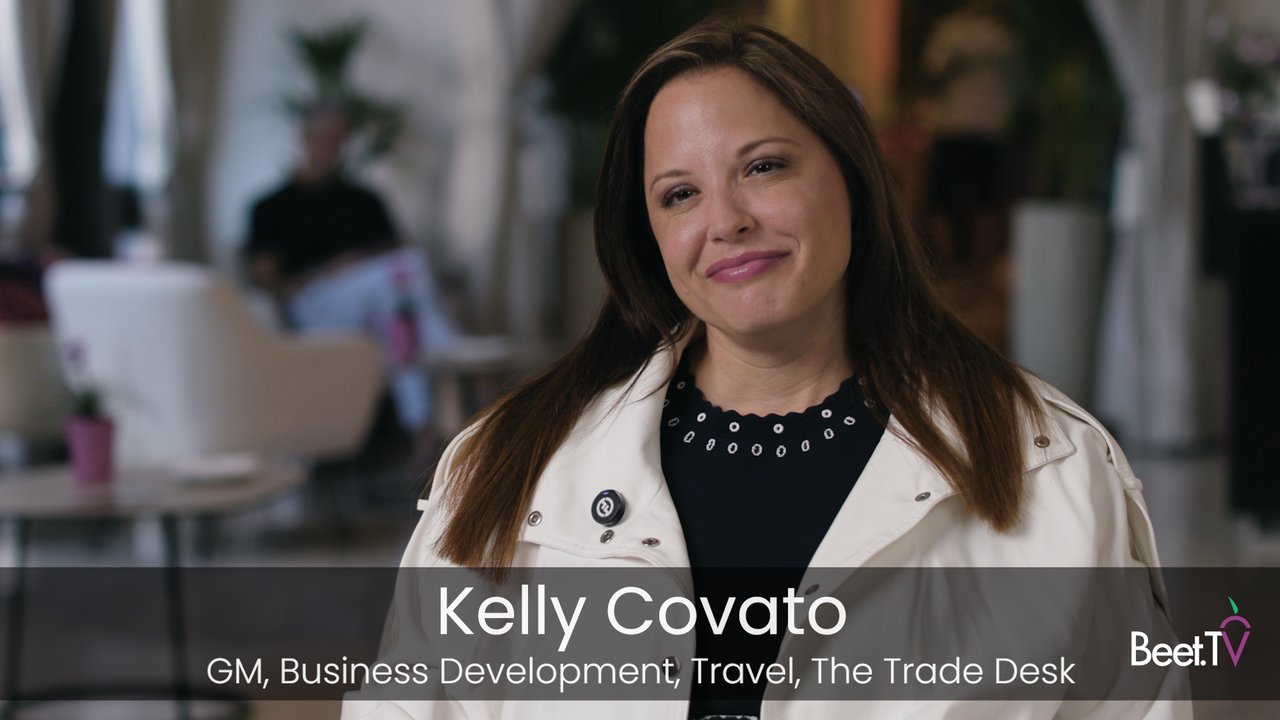
Kelly Covato, general manager of business development, travel, at The Trade Desk, says the increasingly complicated travel journey is forcing marketers to rethink how they find consumers, measure advertising and use their first-party data.
“So many of the most sophisticated travel brands today are really thinking about a continuous loop in that traveler journey,” Covato said in an interview with Beet.TV contributor David Kaplan at the Cannes Lions International Festival of Creativity.
Research published by The Trade Desk indicates the travel journey can stretch beyond 64 days as consumers move among inspiration, research, price comparisons and booking.
“This traditional funnel that we keep talking about in marketing is becoming more of a loop,” Covato said.
The funnel has missed its flight
The shift matters because consumers don’t politely proceed from awareness to consideration to purchase like obedient little dots in a marketing diagram.
They bounce around.
Someone might see a destination on connected TV, hear something during a podcast, check fares on a phone, forget about the whole thing for four days, panic over hotel prices and eventually book a vacation at midnight.
Covato said sophisticated travel marketers are responding by building strategies around identity rather than individual points in the traditional funnel.
That means recognizing the same traveler across different media and delivering relevant messages throughout the journey.
The Trade Desk’s UID2 identity solution, for example, is designed to help advertisers recognize consumers across the places where they spend their media time.
Covato illustrated the point with her own hypothetical day, moving from watching Netflix on the couch to listening to Mel Robbins during a commute before searching for European travel deals from bed.
Companies investing in identity “to ensure that their messages are relevant” are the ones that are winning, she said.
Your vacation plans are valuable data
Travel companies also have something advertisers increasingly covet: unusually rich first-party data.
A few years ago, Covato said, travel companies largely used that information defensively. They marketed to existing customers, tried to increase bookings or built lookalike audiences to find new travelers.
Now they’re discovering that knowing someone flies first class from Newark, books suites for a family of four and spends two weeks in Europe is potentially useful to companies that don’t own a single airplane or hotel.
“We are now moving to a place where not only is that happening in marketing,” Covato said, “but they’re monetizing it outside of travel.”
Travel and commerce media networks from companies such as United Airlines, Marriott, Expedia and Booking are opening that information to marketers in other categories.
The opportunity goes well beyond figuring out who wants a hotel room.
Travel companies may have insights into income, home location, preferred airport, travel frequency, party size and whether someone prefers first class, economy, luxury hotels or value accommodations.
“This is really rich customer data that can be used to predict the next purchase outside of travel,” Covato said.
Retail media taught advertisers that knowing somebody bought shampoo can be valuable. Travel data potentially tells them somebody is about to spend a week in Italy and may suddenly decide they need luggage, clothes, a credit card and approximately 14 things they didn’t know existed until yesterday.
A booking can unleash another $500
That spending halo makes travel data especially attractive to advertisers.
Covato cited Expedia Ads research showing that consumers spend more than $500 between booking a trip and actually taking it.
They may buy vacation clothes, sign up for a credit card to earn loyalty points or even purchase a vehicle for a family road trip.
Travel data therefore offers marketers signals about purchases that may happen well outside airlines, hotels and booking platforms.
“This data is really valuable to categories even outside of the travel window today,” Covato said.
That helps explain why travel media networks are following the retail media playbook. The difference is that a grocery transaction might reveal someone’s preferred toothpaste. A vacation can reveal considerably more about household finances, lifestyle and purchasing intentions.
CTV gets closer to the booking button
Covato also sees premium media playing a bigger role as travel discovery changes.
Travel marketers are investing in connected television and other storytelling environments while gaining better tools to connect those exposures with business outcomes such as bookings.
That becomes more important if conventional search loses some of its dominance.
Consumers increasingly can ask AI services for travel recommendations rather than typing the name of a hotel, destination or airline into a search engine.
Covato said winning brands will surround consumers with premium storytelling before they begin that discovery process, using connected TV, audio, display and digital out-of-home advertising.
The implication for marketers is significant. If AI increasingly influences which destinations, hotels and travel services consumers consider, building brand awareness before the question gets asked becomes more valuable.
Data becomes the competitive advantage
Measurement completes the picture.
Covato pointed to marketing mix modeling and incrementality testing as ways marketers can understand the business value of advertising throughout the lengthy booking journey.
Rather than asking which ad received the final click, marketers can assess whether exposures across connected TV and other channels actually contributed to bookings.
The travel companies best positioned for the next five years, Covato said, will treat their customer information as something more fundamental than another targeting input.
“The brands that again continue to invest in data as the biggest competitive advantage in their business strategies are ones that are gonna be set up for success,” she said.
For an industry built around getting people from Point A to Point B, travel marketing increasingly looks nothing like a straight line.
You’re watching The Beet.TV Leadership Sessions at Cannes Lions 2026, presented by The Trade Desk. For more videos from this series, please visit this page.
You can find all of our coverage from Cannes Lions 2026 here.
Recent videos
Viant’s Tim Vanderhook: When Nobody’s In The Room ‘Is Not An Impression, It’s An Invoice’
New in Ad-Land: AI Transformation Teams are Reshaping How Brands Organize for the Future
As Nielsen Buys DoubleVerify, Mark Zagorski Looks At Advertising’s Next 20 Years

Outcomes, AI and Data Dominate the Beet Retreat Berkshires: NYSE Interviews Tameka Kee
View more
They bounce around.
Topics Videos
Explore All
Viant’s Tim Vanderhook: When Nobody’s In The Room ‘Is Not An Impression, It’s An Invoice’
10 Aug 2026
As Nielsen Buys DoubleVerify, Mark Zagorski Looks At Advertising’s Next 20 Years
7 Aug 2026
Outcomes, AI and Data Dominate the Beet Retreat Berkshires: NYSE Interviews Tameka Kee
7 Aug 2026
Why High Ratings Don’t Mean High Attention: TVision’s Bid to Rewire Ad Buying
4 Aug 2026
