

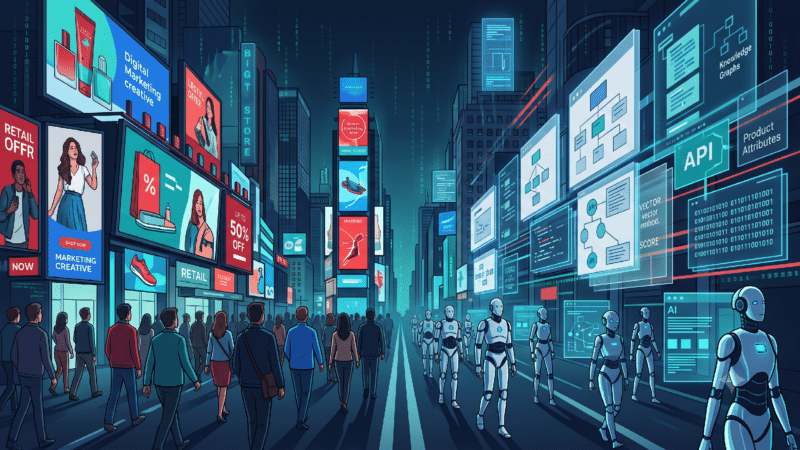
Time is serving ads directly to AI crawlers, a strategy that could reshape how brands influence AI-generated answers.
Table of Contents
Table of Contents
Spy on Any Website
Get traffic data and keyword intel on competitors instantly.
Time magazine is serving ads directly to AI crawlers rather than human readers. If it catches on, it could change how brands influence AI-generated answers
The magazine has a separate version of its website that delivers sponsored content to AI crawlers from companies including Anthropic, OpenAI, and Perplexity.
“There is now a layer of TIME.com written entirely for machines, and the humans who read the site have no idea it exists or what is being said to the models on their behalf,” Vincent Schmalbach, who discovered the new site, wrote on his blog. “This is probably the first clear look at what the web starts to become when the main audience is AI models.”
The German <a href="https://bitcomme.com/neworg-releases-educational-article-on-crm-software-for-nonprofits/” title=”NewOrg Releases Educational Article on CRM Software for Nonprofits”>software developer’s testing uncovered the practice while examining versions of Time articles delivered to AI crawlers. Those pages contained sponsored content for Ally Bank, including marketing claims and FAQ-style responses to common banking questions.
AI assistant crawlers — including ClaudeBot, OAI-SearchBot, and PerplexityBot — received the sponsored content, while Google’s standard search crawler received the same HTML shown to ordinary visitors. The Registerindependently replicated the findings using crawler simulation tools.
10X your SEO with Semrush for Enterprise.
The world’s most powerful SEO platform, purpose-built for Enterprise.
Request demo
Beyond GEO
This approach goes beyond GEO, which tries to increase the likelihood that AI systems retrieve and cite a brand’s content. By contrast, Time’s model tries to influence the information AI retrieves by serving different content directly to AI crawlers.
Time began converting webpages into AI-friendly formats in June as part of a partnership with adtech company Mobian The companies describe the offering as “agent ads.”
The objective is to shape what AI assistants say about brands.
“When you influence ChatGPT, you’re influencing potentially all of ChatGPT,” Mobian CEO and co-founder Jonah Goodhart told Digiday. “If ChatGPT changes what it says about [a brand], it’s massive, and it’s more than any one campaign could ever do. With a human, you influence one person.”
Ally Bank and the Project Management Institute are the first advertisers using the format, with additional brands expected to follow.
Why marketers should care
If Time’s effort is successful, other publishers are certain to sell AI-only advertising inventory as well. Marketers would then have to optimize for two audiences: people and AI systems.
The approach also raises transparency questions. Search ads are labeled. Sponsored social posts are labeled. But if sponsored crawler-only content influences an AI-generated response, users may have no indication that commercial messaging contributed to the answer they receive.
The big question: Are AI assistants going to be an advertising medium in their own right? We won’t know for a little while, but marketers might want to start thinking about dual optimization now.
MarTech is owned by Semrush. We remain committed to providing high-quality coverage of marketing topics. Unless otherwise noted, this page’s content was written by either an employee or a paid contractor of Semrush Inc.
Google’s “preferred sources” feature allows users to customize their search results by selecting news outlets they want to see more often in the “Top Stories” section.
