

Add to Google Preferred Sources
More than eight out of ten large South Korean manufacturing companies have adopted or plan to adopt physical AI, including robots and autonomous vehicles, according to a new survey. Companies that have already implemented the technology primarily use automated guided vehicles (AGVs) and autonomous mobile robots (AMRs), while those planning future adoption showed the strongest interest in humanoid robots. Manufacturers expect productivity to improve by an average of 31.9%, though they also expressed concerns about job losses. Nearly 80% of respondents said physical AI would have a positive impact on addressing national economic challenges.
Key Elements

More than eight out of ten large South Korean manufacturing companies have adopted or plan to adopt physical artificial intelligence (AI), including robots and autonomous vehicles, a new survey shows. Companies expect physical AI adoption to boost productivity by an average of 31.9%, while also expressing concerns about potential job losses.
According to a “Physical AI Adoption Status and Perception Survey” conducted by the Korea Employers Federation (KEF) targeting 100 manufacturing companies with 500 or more employees, 84.0% of respondents said they have already adopted physical AI or plan to do so in the future. Companies that have introduced the technology in commercial or pilot program form in their manufacturing processes accounted for 47%, while 37% said they have not yet adopted it but are planning to. Only 16% said they have no adoption plans.
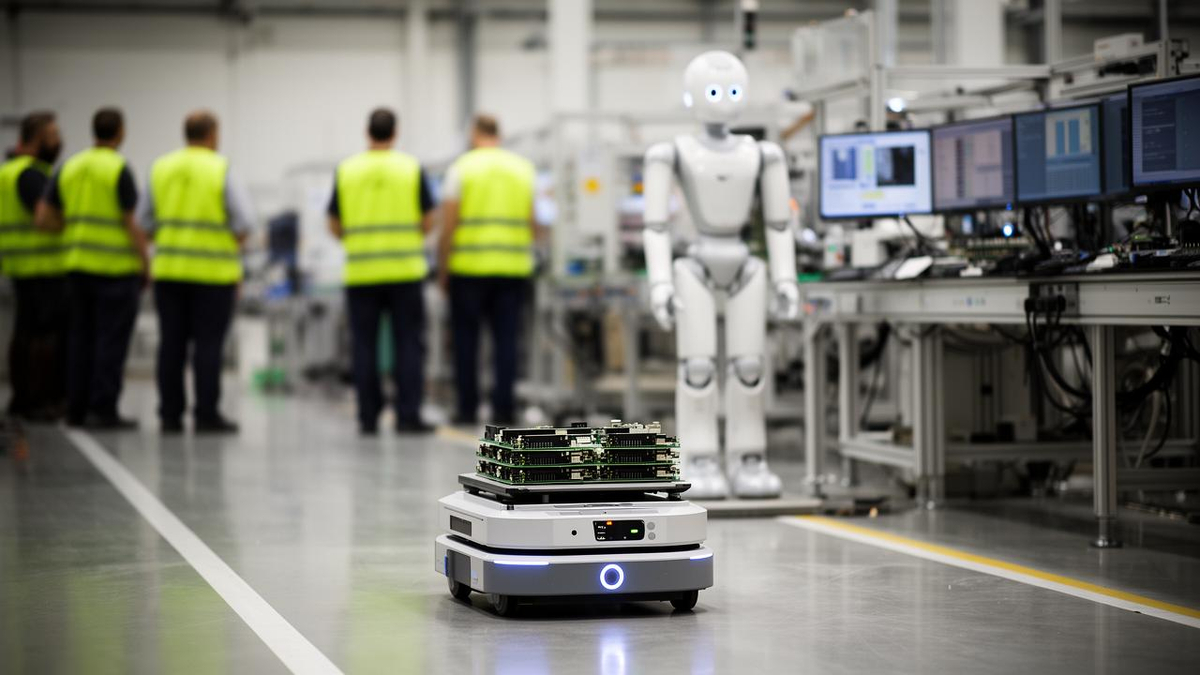
There were clear differences in the types of robots used depending on the adoption stage. Companies that have already implemented physical AI most frequently use automated guided vehicles (AGVs) and autonomous mobile robots (AMRs). Based on multiple responses, AGV/AMR types accounted for the largest share at 63.8%, followed by autonomous vehicle types at 31.9%, humanoid types at 29.8%, and drone types at 4.3%.
In contrast, among companies planning future adoption, 64.9% said they intend to use humanoid robots—the highest response rate. This was followed by autonomous vehicle types at 37.8%, AGV/AMR types at 35.1%, and drone types at 8.1%. This suggests that the center of gravity for physical AI as perceived by manufacturers is shifting from logistics automation to general-purpose task automation.
In actual workplace settings, robots were found to be primarily used in assembly and production processes (66.0%) and logistics, transportation, and warehouse management (57.4%).
Expected benefits from physical AI varied by company size. Among the 84 companies that have adopted or plan to adopt physical AI, 45.2% cited productivity and performance improvement as the most anticipated benefit. Resolving workforce management difficulties such as labor shortages followed at 26.2%, with industrial accident prevention and reduced accident risk at 22.6%.
Among companies with 1,000 or more employees, 49.3% cited productivity and performance improvement as the top expected benefit, while among companies with fewer than 1,000 employees, resolving workforce management difficulties such as labor shortages ranked highest at 66.7%.
Concerns about job losses were also significant. 61.9% of responding companies predicted that the job displacement effect from physical AI adoption and expansion would outweigh new job creation, leading to an overall reduction in employment. 34.5% said there would be no significant change in overall employment, while only 3.6% expected jobs to expand.
The most frequently cited challenge in adopting and utilizing physical AI was risk from technological instability and system failures at 34.5%. Uncertainty about profitability relative to investment costs followed at 31.0%, with opposition from labor unions or workers to adoption at 27.4%.
However, positive assessments prevailed regarding physical AI’s impact on the national economy. 79.8% of respondents said physical AI would have a significant positive impact on addressing national economic challenges such as labor force decline and productivity deterioration. 15.5% said the impact would be moderate, while 4.8% said it would be minimal.
Lee Seung-yong, head of the KEF’s economic analysis team, said, “As physical AI spreads further, its impact on companies and the national economy is expected to grow. To maximize the positive effects physical AI can bring, we need to carefully review relevant regulations and actively support various corporate assistance measures.”
Once added, BigGo Finance appears first in Google Search Top Stories, so you get the broadest, most up-to-the-minute, and most comprehensive global financial news first.
