

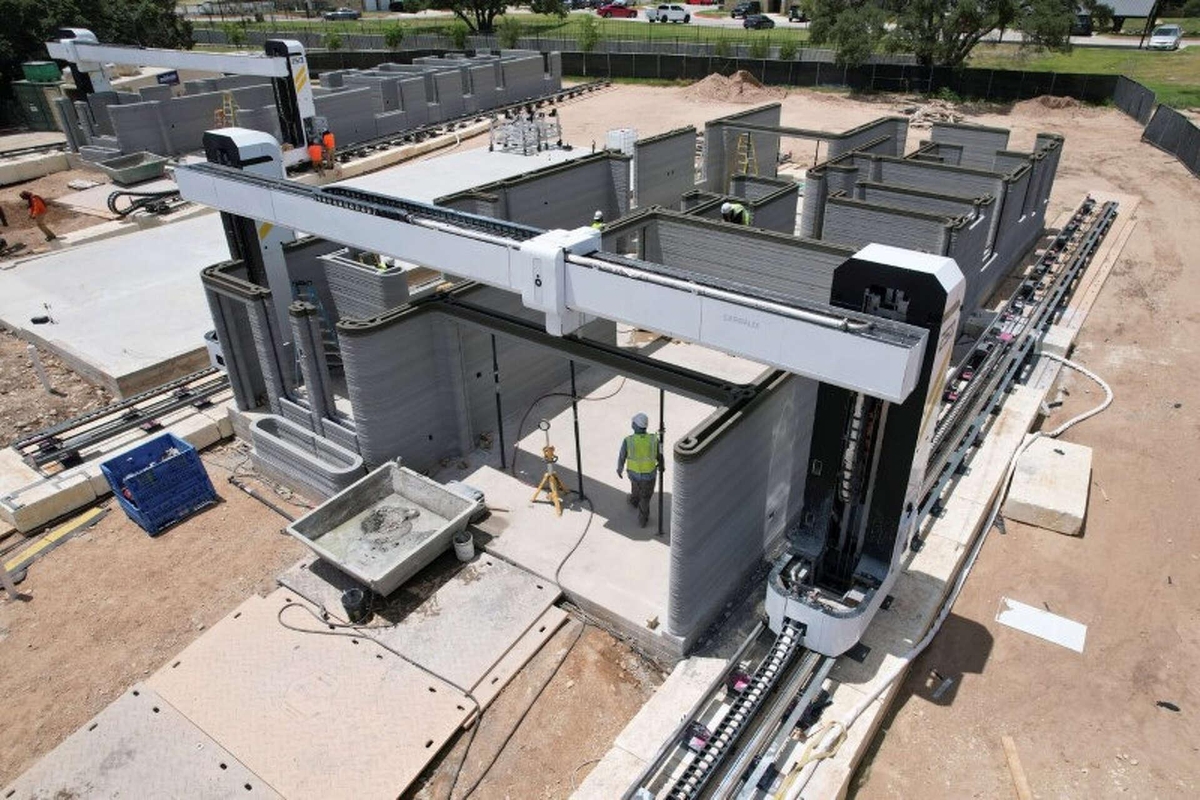
– Round led by Baillie Gifford and BlackRock-managed funds; expansion beyond Texas to Florida and Washington, D.C.
– “Prints a 2,500-square-foot home in seven days”… wall costs 40% below the national average
– ICON Prime, its space and defense division, secures more than $370 million in government contracts
ICON, a U.S. construction technology startup known for its 3D-printed homes, has raised $200 million in a Series D funding round. Global investors are once again backing the company’s strategy of using robotics to address structural challenges facing the construction industry: a housing shortage and an aging skilled workforce.
According to U.S. real estate publication The Real Deal, ICON, headquartered in Austin, Texas, announced the close of its Series D round on the 13th. The round was led by U.K.-based investment management firm Baillie Gifford and funds managed by BlackRock. Participants included Capital Factory, CAZ Investments, LAUNCH, Modern Ventures, Moonshot Capital, Norwest Venture Partners, Overmatch and Tiger Global.
Funding to focus on mass production of multistory construction robot Titan
ICON plans to use the funding to produce and deploy its proprietary multistory robotic construction system, Titan; expand in Texas, Florida, Washington, D.C., and new markets; and grow its workforce.
The company said the U.S. construction industry, valued at about $1.6 trillion, has changed little over the past half-century, and emphasized that a new era of construction led by “intelligent machines” is beginning. Its goal is to transform the industry with technology that can build homes faster, more affordably and with better performance.
Logan Grant, president of ICON’s design-build division, said Texas developers are struggling to make projects viable amid surging costs and a shrinking pool of skilled workers, adding, “Titan changes that math.” He said the funding will put more Titan systems in the field, with Texas as the first destination. Grant also said multiple projects are underway in major Texas metro areas and predicted that developers who move first will shape the course of construction in Texas over the next decade.
Florida strategy targets hurricanes; D.C. focuses on defense
Co-founder and CEO Jason Ballard named Florida as a priority for expansion beyond Texas. ICON sees a strong fit for its technology because Florida’s construction industry already designs with hurricanes and rising insurance premiums in mind. Washington, D.C., will serve as a hub reflecting the company’s growing work with federal government and defense partners. Ballard said ICON is also considering entering other U.S. markets depending on demand for Titan.
263 structures built to date, from housing for people who have experienced homelessness to large-scale communities
ICON has built a total of 263 structures in the United States and Mexico to date, including 117 homes that have been sold. Of those projects, 257 were commercial or residential projects in Texas.
Notable examples include the Mueller district in Austin, completed this year, and Wolf Ranch, a master-planned community in Georgetown owned by Ross Perot Jr.’s Hillwood Communities. Wolf Ranch is the first 3D-printed residential community of its kind. Residents have reportedly said its thick walls make them feel as though they live in a fortress. ICON also developed Community First!, a permanent affordable housing community for people who have experienced homelessness in Austin, spanning about 51 acres.
A home in seven days; walls built to withstand winds of 280 km/h
ICON’s core technologies are its first-generation printer, Vulcan, and Titan, unveiled in May. According to the company, Titan can print a home of about 2,500 square feet (about 232 square meters, or 70 pyeong) in under seven days. Wall costs are about $20 per square foot, 40% below the national average.
Titan runs on the company’s proprietary BuildOS software and uses its dedicated construction material, FormCrete. ICON says walls made with the material can withstand winds of up to 175 miles per hour (about 282 km/h), far above the 40 mph (about 64 km/h) standard for conventional walls.
Each Titan system costs $899,000. Builders can apply to purchase one by placing a $5,000 deposit on ICON’s website.
From lunar base construction to expansion in space and defense
In April, ICON launched ICON Prime, its space and defense division. The unit has secured more than $370 million in government contracts, including work with the U.S. Army and the Department of Defense. In particular, ICON signed a $57 million contract with the National Aeronautics and Space Administration (NASA) to develop a lunar construction system using lunar soil, or regolith.
Hiring plans in focus after rebound a year after restructuring
Last year, ICON cut about a quarter of its workforce as part of an effort to improve business efficiency. At the time, the company said it would focus on key projects in residential, hospitality, social and affordable housing, and defense. CEO Ballard did not provide specifics about the organizational changes tied to the new funding or their connection to last year’s layoffs, but said new hires would support projects in the pipeline and expansion into new markets.
Industry observers are watching to see whether the investment signals that 3D-printing construction is moving beyond “experimental technology” and into commercial-scale production. Housing shortages and construction labor shortages are also challenges in South Korea, so the spread of robotics-based construction technology offers lessons for the country’s proptech and construction startup ecosystem.
※ Won conversions are based on an exchange rate of 1,325.4 won per U.S. dollar as of 10 a.m. on October 21, 2026.
Original article:3D printing construction firm ICON raises $200M in Series D financing round, scaling Texas presence – The Real Deal ( October 13, 2026)
#startups#ICON#ICON#3D printing#3D-printing construction#construction robots#Titan#Titan#Series D#fundraising#BlackRock#Baillie Gifford#Tiger Global#proptech#contech#housing supply#affordable housing#ICON Prime#space construction#NASA#Texas#U.S. startups#global startups
