

Add preferred source
Three South Korean AI startups—Farmkit, Silicofarm, and Superb AI—attended Oracle AI World 2026 in Las Vegas to pursue the North American market. The companies built services on Oracle Cloud Infrastructure (OCI) spanning e-commerce recommendations, biomedical data analysis, and industrial video analytics, and received cloud credits and technical support from Oracle through South Korea’s Ministry of SMEs and Startups’ LLM Challenge. Farmkit aims to secure roughly 10 potential enterprise sales opportunities in North America, Silicofarm is pursuing partnerships with local consulting firms, and Superb AI plans to expand deployments at manufacturing and logistics sites.
Key Elements

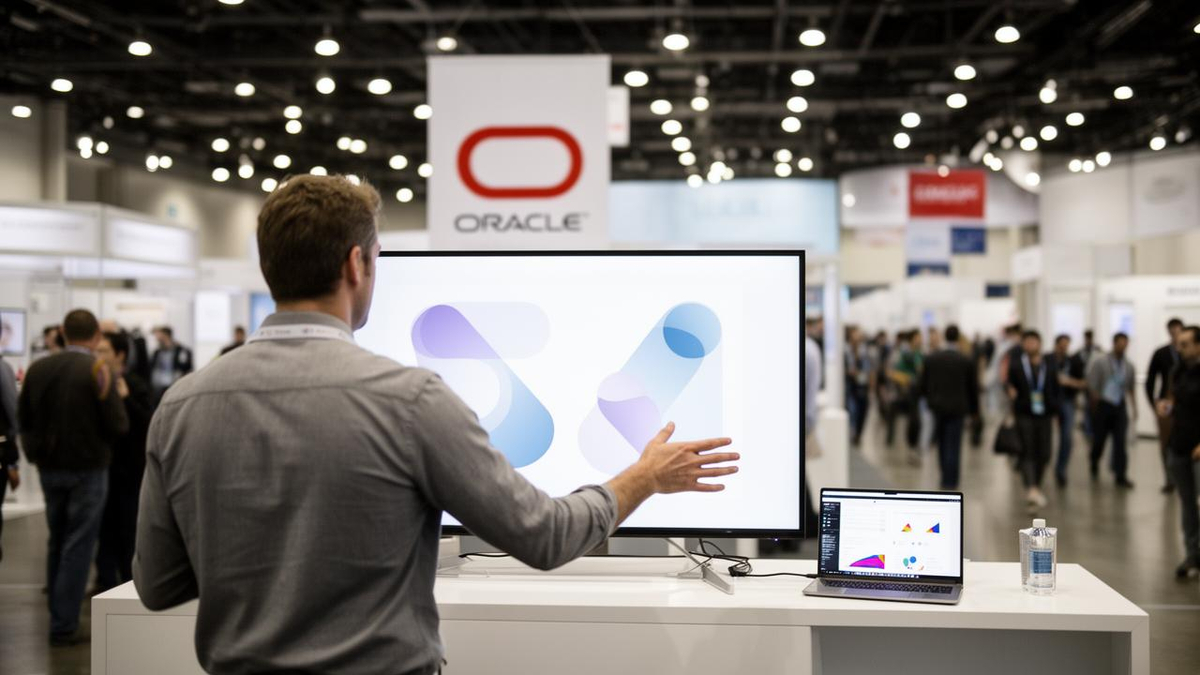
Three South Korean artificial intelligence (AI) startups are setting out to crack the North American market, using Oracle’s cloud infrastructure as their springboard. Farmkit, Silicofarm, and Superb AI—which operate in distinct fields including e-commerce recommendations, biomedical data generation, and industrial video analytics—said on the 27th that they participated in Oracle AI World 2026 in Las Vegas to showcase their solutions and pursue local customers and partners.
The three companies share a strategy of building their services on Oracle Cloud Infrastructure (OCI) and using the event as a bridgehead for overseas expansion. They are participants in the LLM Challenge, part of the “Ultra-Gap Startup Project” hosted by South Korea’s Ministry of SMEs and Startups and organized by the Korea Institute of Startup & Entrepreneurship Development, and have received cloud credits and technical support from Oracle. The actual buildout of the three projects was handled by EtiVerse and Turtlenology, members of the Oracle PartnerNetwork (OPN).
The first to knock on North America’s door is Farmkit, which operates “TasteQ,” an AI-based personalization and recommendation platform. It runs its application on OCI Compute and manages container-based services with OCI Kubernetes Engine (OKE), giving it an environment capable of handling large volumes of user requests. Yang Sun-heung, CEO of Farmkit, said, “We have secured about 200 customers in South Korea and are pursuing overseas expansion centered on the North American market,” adding, “Our goal at this event is to secure potential sales opportunities with around 10 North American enterprise customers.” He cited as reasons for partnering with Oracle the technical advice on vector database technology needed for its ontology-based recommendation engine and access to large enterprise customers through Oracle’s sales network.
Silicofarm, a biomedical AI company, uses OCI to process omics data—the comprehensive analysis of diverse molecular information from living organisms, including genomes and proteomes. Based on OCI Compute and Object Storage, it has established a system that runs more than 400 omics screening tasks simultaneously and automatically scales computing resources according to analysis demand. Kim Tae-hyung, CEO of Silicofarm, said, “Oracle has already provided database solutions to hospital customers and designed systems for them, which was a great help,” adding, “We are planning a business to supply our solution in cooperation with a U.S. consulting firm or to have it used internally at such firms.” The company said Oracle’s experience was also leveraged in regulatory compliance and system design required for hospital and clinical environments.
Superb AI, which develops industrial vision AI, built its “Superb Video Control” platform by combining Oracle AI Database with OCI Compute and Object Storage. The service uses AI to analyze video data from industrial sites to identify safety, security, and operational issues, and is expanding its scope of application mainly in manufacturing, robotics, and physical security. Lee Jae-min, head of Superb AI’s global business division, said, “To build AI specialized for industrial sites, you have to base it on data generated in the field,” adding, “We will expand real-world AI adoption cases by leveraging Oracle’s database technology and global partner network.” The company currently operates in the U.S. and Japan and plans to expand into Singapore and the ASEAN region.
The case dovetails with Oracle’s strategy of broadening its cloud customer base within South Korea’s AI ecosystem. The structure is one in which Oracle supplies not only the computing resources needed to develop AI models but also the infrastructure required to build actual services—from data storage and management to application operations—while expanding its touchpoints with early-stage companies. Once a startup begins using OCI in the service development and validation phase, cloud usage grows along with customer demand and service scale.
Kim Seong-ha, president of Oracle Korea, stressed, “South Korean AI startups are rapidly moving beyond the experimentation stage to the stage of generating real business results,” adding, “They need infrastructure that can scale to match their growth goals.” He added, “OCI provides the performance, scalability, and reliability needed for South Korean AI startups to develop, deploy, and scale AI solutions that can capture new opportunities in the global market.”
That said, all three companies are still at an early stage where overseas revenue has yet to materialize, and what they are seeking at this event is not immediate contracts but touchpoints with potential customers. For startups that find it difficult to attend large overseas technology exhibitions on their own budgets, Oracle’s support serves as a practical channel for market entry. Yang said, “The bar is high for AI startups to attend multiple exhibitions on their own budgets,” adding, “I hope to see more cases where companies gain business opportunities through open innovation cooperation with professional IT firms like Oracle and go on to expand overseas.”
Industry observers say the move carries considerable implications for how South Korean AI startups approach overseas expansion. They assess that a model is taking hold in which startups offset the burden of investing in their own infrastructure by partnering with global cloud providers and secure early customers by borrowing the provider’s sales network and references. Conversely, from the cloud provider’s perspective, it can lock in high-growth-potential AI companies as customers from the outset—meaning startup support programs function not as mere corporate social contribution but as a customer acquisition channel.
The key question is whether this translates into actual results. The goals each of the three companies has set—securing North American enterprise customers, supply contracts with local consulting firms, and expanded deployment at manufacturing and logistics sites—are specific, but all are early-stage business development activities. Whether South Korean AI startups can move beyond technology validation to generate repeatable revenue overseas will be the test of how scalable these partnership models prove to be.
