

Forget the hypothetical business plan. At schools across Northeast Ohio, students are making products, finding customers and learning what it costs to be wrong.
Hannah Rosenfeld had an idea.Then she had to figure out what to do with it.
“I always knew there were problems in the world and society that I wanted to solve, and I never really connected that to starting a business,” says Rosenfeld, 18, aLaurel Schoolsenior who is developing Reentry Inspiring Systemic Equality, an initiative focused on self-advocacy and legal literacy for girls involved in the juvenile justice system.
She researched the need, consulted local judges, pitched the concept, secured funding and assembled a team to move it forward.
AtNorth Royalton High School, students are learning the same build-it-and-see-what-happens lesson with a very different product: honey. Royal Rooftop Honey started with one hive at the school, and now the endeavor functions almost like a multi-department business.
Marketing students developed the brand. Accounting students keep the books. Entrepreneurship students sell the jars in the community.
This is entrepreneurship education now.
Across Northeast Ohio, schools are moving beyond the business plan assignment and giving students opportunities to make, test, pitch and sell.
Jaclyn Iarocci, program manager for the Veale Youth Entrepreneurship Forum, has watched interest in entrepreneurship grow among schools, students and families. The reason why is twofold.
“For us to get students truly prepared to be successful and impactful in the world, we have to start with innovation and human-
centered design and problem-solving,” Iarocci says. “Our educators and parents see how important it is for our students to have those skills.”
Then there’s the COVID-19 effect on cottage industry ventures, inspiring a “Why not?”
“With how many people started side hustles or turned hobbies into little businesses — and access to people through social media — entrepreneurship feels much more tangible,” Iarocci says.
There are still entrepreneurship courses, clubs and dedicated academic pathways. But increasingly, entrepreneurial thinking is spilling into other corners of school life.
Colleen Greller, the dean of faculty and academics atMagnificat High School, describes the evolution as a move away from entrepreneurship as a siloed class and toward something “woven into the fabric” of a student’s experience.
The examples are everywhere. Magnificat students harvest and sell honey from school beehives. The robotics team makes earrings on a 3D printer and sells them to help support the program.National Art Honor Society students sell jewelry created in metals class. A new greenhouse will expand opportunities for students to grow vegetables, herbs and flowers, with possibilities ranging from a farmers market to student-created floral arrangements.
The school also reworked its entrepreneurship course, now Female Entrepreneurship and Marketing, bringing in teacher Nicole Bozickovich, who has launched businesses herself. Instead of simply writing a business plan for a grade, students move through the entrepreneurial cycle: create an idea, pitch it, sell it and learn from what happens.
Last year, a senior interested in fashion collaborated with Magnificat’s bookstore on a sweatshirt. She pitched the design, created a prototype, calculated costs and marketed it to students. She sold 50.
“We had motivated students and a person in place who had walked that path,” Greller says.
Having an entrepreneur in the classroom who can tell students, “I wish someone would have told me this,” she adds, “amps up the program.”
Euclid High Schoolis taking a similar approach. Business, Marketing and Entrepreneurship teacher Adam Mott brings his own small business experience to the classroom. His vintage Cleveland sports apparel venture, Thrift the Land, began as an Instagram side hustle during the pandemic and grew into an e-commerce business.
Now he is helping students prepare to operate a roughly 500-square-foot spirit store, run by students, inside Euclid High School. They’ll learn customer service, inventory management, visual merchandising, bookkeeping and marketing while developing and testing products themselves.
“If they want to make magnets, pins — whatever they think will sell to the student body — will it sell, will it not?” Mott says.
That question changes the assignment. The teacher isn’t deciding whether an idea deserves an A. The customer is deciding whether it deserves $10. And closing those sales depends on something Mott says students are short on: talking to people face to face.
Mott points to a survey byIntelligent.comthat found 53% of employers report recent college grads struggle to maintain eye contact during job interviews.

Make It. Sell It. Adjust.
At North Royalton, business teacher Kriste Smith divided students into teams and gave each $100 to develop a product. They had to decide what to make, how to make it and how to sell it.
The process forces students to interact — with classmates, teachers, customers and business professionals. “My classes, where you’re hands-on creating something, you have to have some communication,” Smith says, pointing to a post-pandemic skills gap. “You have to have some reliability.”
Smith also taps into theYoung Entrepreneur Institute’sYIPPEE Exchange, where educators earn points through professional development and use them to bring entrepreneurship resources into the classroom. That’s how a soap-making kit landed in hers.
“I happened to buy a soap kit,” Smith says. “Let’s start small and just try this.”
The soap caught on. Teachers are asking when they can buy more, and students are asking, “What next?” Bath bombs followed, along with the inevitable rethink: “I don’t think that’s going to work. What if we did this?”
Smith supports the school’s Diverse Design intervention class, where students make and sell T-shirts and have expanded into caps, mugs and tote bags. Veale Youth Entrepreneurship Forum funding helped purchase a direct-to-fabric printer to increase production.
The class takes orders and fulfills them, and responds when its community needs something new.
The real world also delivers something classrooms sometimes struggle to manufacture: rejection.
A product flops. A pitch bombs. Somebody else wins.
Laurel encourages students to seek that external validation — and risk the opposite.
“They learn to deal with failure and that can be daunting, especially for high-
achieving students,” says Joe Corsaro, Laurel’s director of signature programming.
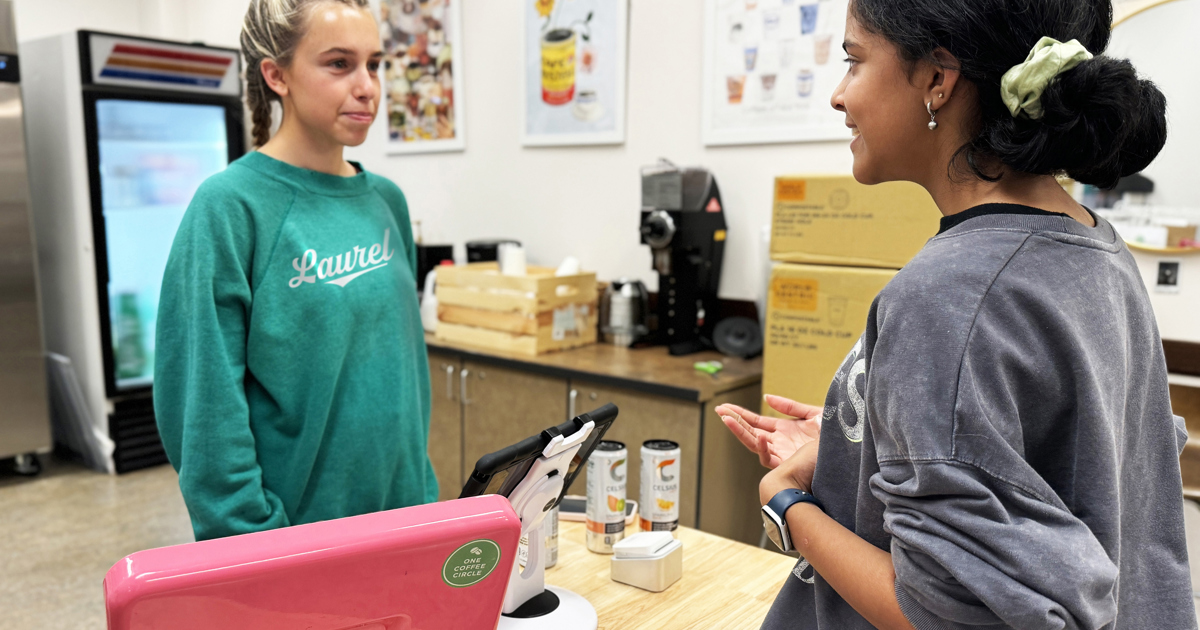
Students might start small at One Coffee Circle, where they make drinks, handle marketing and create merchandise.
“They learn how to deal when the ice maker is broken or a customer isn’t happy or someone doesn’t show up for a shift,” Corsaro says.
From there, students can move into entrepreneurship courses, an investment committee managing a $20,000 fund and, ultimately, Capstone, where they research and develop a tangible project.
Iarocci sees another kind of growth at pitch competitions, where a strong idea doesn’t guarantee a win.
“You don’t know who the judges are going to be when you’re pitching your idea,” she says. “You don’t know who the recipients are going to be when you get invited into an interview for a job.”
Students have to absorb the feedback, adjust and try again. “It’s a really great skill that they get to try on in real time,” Iarocci says.
Schools aren’t building these opportunities alone.
Since 2012, the Veale Youth Entrepreneurship Forum has connected Northeast Ohio educators and students through grants and programming. Students attend hackathons, visit places such asSears think[box]atCase Western Reserve Universityand participate in pitch competitions. The foundation also supports a network of schools, helping educators learn from one another and funding opportunities, including school stores, cafes and pop-up shops.
This entrepreneurial ecosystem is expanding in another direction, too. Like Rosenfeld, more students are asking how they can turn a cause they care about into something sustainable. For the 10th anniversary of its thinkBIG! Summit, the Veale Youth Entrepreneurship Forum added a social impact track exploring the difference between nonprofits and revenue-generating social enterprises.
And whether students launch a business now, later or never, the entrepreneurial mindset sticks.
At Magnificat, Greller says whatever ideas are “bubbling up” around the school, she wants students to leave believing one thing: “They can do it.”
Hannah Rosenfeld, Laurel School senior.
Rising to the Challenge
Laurel School senior Hannah Rosenfeld, 18, wanted to make a tangible difference. Research led her to girls in the juvenile justice system — and an opportunity to help. She created Reentry Inspiring Systemic Equality, an initiative focused on self-advocacy and legal literacy.
A problem worth solving.“The reason I chose juvenile detention is that they are kids my age,” she says, tracing a path to the cause from an Advanced Placement English course on incarceration to a podcast project about women in prison and deeper research into the juvenile justice system. “They have similar interests, but they are going through something entirely different.”
Pitching with purpose.Rosenfeld earned $250 as a Teen Accelerate finalist and $1,000 as runner-up at the Veale Youth Entrepreneurship Forum’s thinkBIG! Summit. She also secured a $2,000 Laurel public service stipend and assembled an advisory board to help move RISE forward.
Room to explore.“Being able to explore and not being given, ‘This is what you have to research, this is how you have to do it,’ made an impact on me.” That freedom, Rosenfeld says, helped her find work that gives her purpose.
Success, redefined.“If RISE gives even a few girls a voice and pathway to education, that’s a win.”
Finn Frato-Sweeney, Western Reserve Academy 2025 graduate.
Finding His Focus
Finn Frato-Sweeneyarrived atWestern Reserve Academyeyeing a future in engineering. He left with a growing sports photography business and a new direction. Now 18, he’s studying media management at the University of Miami and interning with its athletics program, creating social media content.
Dive in.As a “massive sports fan,” Frato-Sweeney joined Reserve Sports Network and got a camera. “I dove in headfirst,” he says. He taught himself the fundamentals, photographed campus events and used his work to bring more attention to WRA athletics.
Create the opportunity.As coaches noticed his work, Frato-Sweeney gained greater access. “I was looking to grow an opportunity, and coach Matt Garvey was looking to get his program out to a wider audience,” he says. “It was a win-win.”
Passion pays.Operating as Finn Frato Studios, Frato-Sweeney has expanded into events and commercial work. WRA programs and families became paying clients, and this summer he was hired to shoot for North Coast Yard, a pop-up venue along Lake Erie.
Keep the aperture open. His advice to other students is simple: “Follow what you love. And if you don’t know what you love, keep an open mind.” Had he remained fixed on one vision, he says, “I would have never found this new pathway in life.”
Emmett Wuliger, University School junior.
A Sweet Start
University School junior Emmett Wuliger,16, found his first business idea in a cooking class with his mom. After tasting fudge he couldn’t forget, he decided to make his own and sell it through the Young Entrepreneur Market on campus. Aww, Fudge was born.
Start with what sells. Wuliger began selling fudge in seventh grade and sold out at the school market the following year. Today, Aww, Fudge offers classic and mix-in varieties, with peanut butter emerging as a favorite. A good three-hour market can bring in about $300.
Know when to cut it loose.Not every flavor has been a hit. Marshmallow fudge consistently lagged. “When an idea isn’t working, cut it loose before it drags you down,” Wuliger says.
Story sells, too.Wuliger discovered customers wanted to know how a cooking class with his mom turned into a business. “People care more about the story of how you got there than you realize,” he says.
Mind the margins.Watching another young entrepreneur invest heavily in equipment drove home another lesson: “You have to consider how much it will cost and not just how good it will end up being.”
For more updates about Cleveland, sign up for our Cleveland Magazine Daily newsletter, delivered to your inbox six times a week.
Cleveland Magazine is also available in print, featuring immersive stories, helpful guides and beautiful photography and design.
Trending
- 1
50 Best Restaurants in Cleveland and Northeast Ohio - 2
Best Sports Bars in Greater Cleveland - 3
Things to Do This Weekend In Cleveland: Oct. 15-18 - 4
Cleveland Hopkins International Airport’s Full Masterplan Has Been Released - 5
The Primate Forest is a Centerpiece of the Cleveland Metroparks Zoo’s Longtime Transformation
Of Interest
EducationBusinessShaker HeightsRocky RiverHudsonCleveland NeighborhoodsPepper PikeHunting ValleyOctober 2026
